

June 10, 2026
By Wes Pauly | Dell Technologies is expanding factory capacity at its Franklin, Massachusetts campus to manufacture, integrate, test and ship thousands of high-end AI servers per week. Energy efficiency is critical to the campus as it can be scaled to meet market demand. To offset the electricity consumption associated with the expansion, Dell looked for an on-site solar solution.
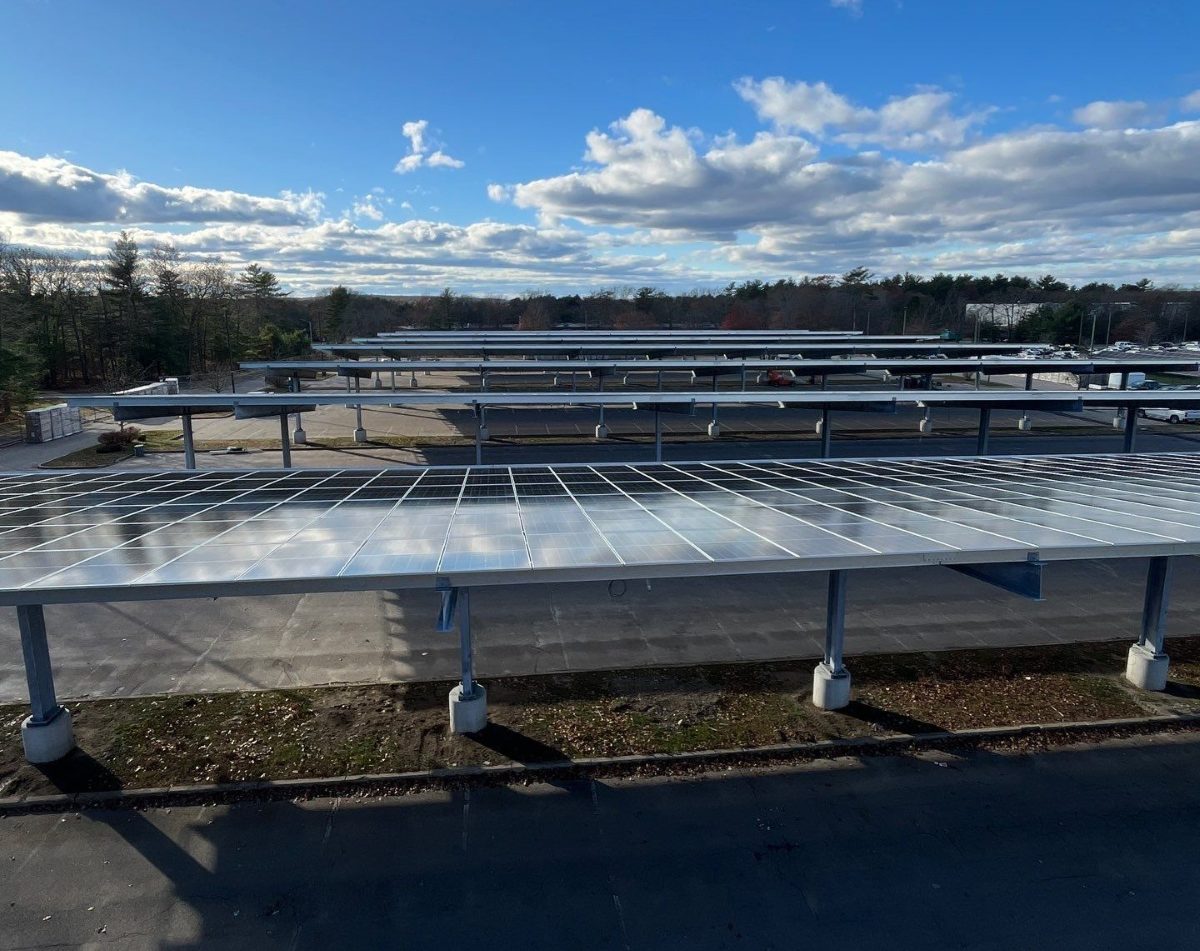
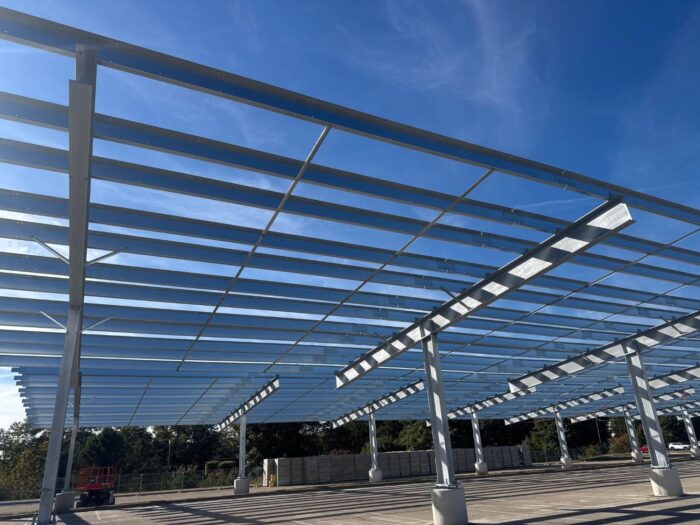
To provide sustainable energy for Dell’s accelerating energy needs, Dell has chosen to install both canopy and ground-mounted systems. Dell now benefits from a surface lot canopy with a capacity of 1.60 MWdc and a ground mounting system with a capacity of 0.87 MW.
Canopies on surface lots maximize land use and provide additional benefits beyond energy generation, such as shade for vehicles and protection from rainwater. The ground-mount project used a GLIDE Wave fixed tilt rack system, which is designed to follow the existing terrain of a project site, with continuous rows and pre-assembled components that make installation easier and faster. Installation speed proved even more valuable amid project challenges.
Challenges and solutions
Transitions and timeline shifts: Long development times are common on complex commercial projects. Once the awning supplier was on board, the team began the design and engineering (D&E) work. Throughout this process, the awning provider has welcomed and accommodated changes and new customer requests. Strong collaboration, flexibility and design refinement by the awning supplier’s engineering team and Dell kept the project on schedule and moving forward.
Once the design and engineering was complete, the stakeholder teams moved to kick-off, but were once again stalled by disruption to EPC business operations. Despite the setback, the solar racking team worked closely with Dell, Honeywell and a newly appointed EPC to regain momentum and accelerate manufacturing to meet Dell’s original completion goal, even with the short timeframe.
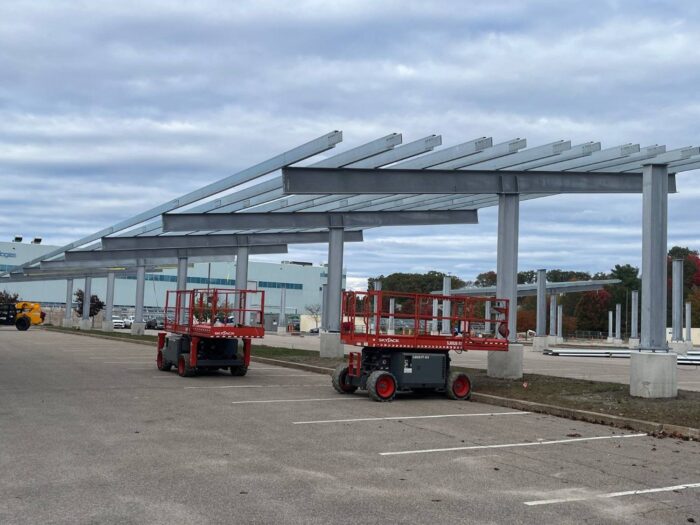
Construction site conditions: Installation began in late summer 2025, but crews encountered numerous underground obstacles while drilling the pier, which had not been identified in previous surveys. Even the most careful surveys are prone to subsurface hazards and surprises that linger beneath the surface, and once construction began it became clear that the retention basin was too close to the foundation.
The canopy engineering team solved this challenge by redesigning the foundation placements in just a few hours. Adjustments were made in real time so construction could stay on schedule. The team moved the entire canopy to avoid the catch basin without delaying the project schedule.
Specifically, once the problem was clear, the project manager called the designer for updated drawings. Within 15 minutes the designer checked the heights and ensured that moving the canopy would not cause any problems. Within an hour, the team shared the new drawings with the rest of the stakeholders for approval and started construction that same afternoon. A total of nine foundations, consisting of bored piers 36 inches in diameter and 15 feet deep, were moved without disrupting the time frame.
Why it worked
The Canopy Engineering team’s internal capabilities and open communication between D&E, project management, construction crews and customers ensured immediate same-day response and resolution. The project manager worked directly with the engineer so he could adapt quickly.
Partners without this flexibility would rely on an outside engineer or architect to review the drawings and produce updated drawings, a process that typically takes seven days. That extra step, plus the time needed to restart construction and move the foundations, could lead to weeks of delays. The canopy team’s rapid iteration kept the installation on schedule, avoiding escalating costs and staying within a tight construction window ahead of the often frigid Massachusetts winters.
Pivot halfway through the project
Underground surprises weren’t the only changes midway through the project. During manufacturing, Dell requested snow guards for the canopy structures. This was a wise decision, but not in the original purchase order. The canopy engineering team had a retrofit snow catcher design ready to go, anticipating potential design changes and allowing them to respond quickly.
From there, the canopy engineering team went to work creating updated drawings for fabrication. Their manufacturer pre-drilled the beams instead of having to drill on-site during installation, saving construction time and budget. The snow guards are prepared for a snow load of 35 lbs per square foot, and again the change was made without disrupting manufacturing or construction timelines.
Simultaneous delivery of integrated solutions
Dell’s solution was unique because its solar installation team delivered two types of solar systems simultaneously. The solar canopy system for parking coverage and the fixed tilt ground mounting system were managed by two different divisions of the solar racking company. This required close collaboration and project coordination, with the in-house project manager overseeing two different subcontractors in parallel to ensure a seamless installation. Together, the teams delivered a cohesive energy solution that fits the custom space and energy needs of Dell’s data center campus.
Results
Despite multiple disruptions, including EPC changes, unexpected underground obstacles and design changes, the project was:
- Completed on schedule.
- Complies with applicable wage and domestic withholding requirements.
- Time saving thanks to the agile internal processes of the solar design team (no project interruption due to construction or design changes).
- Delivered within the required 2025 construction window.
- Successfully deployed for Dell’s next-generation data center infrastructure.
The installation will help support the energy needs of Dell’s rapidly growing AI server manufacturing business while furthering the company’s clean energy goals.
Wes Paulytechnical sales manager for awning at Terrace mart.
Tags: carport/cover, data centers, sun canopy, solar powered parking canopies, Terrasmart
