

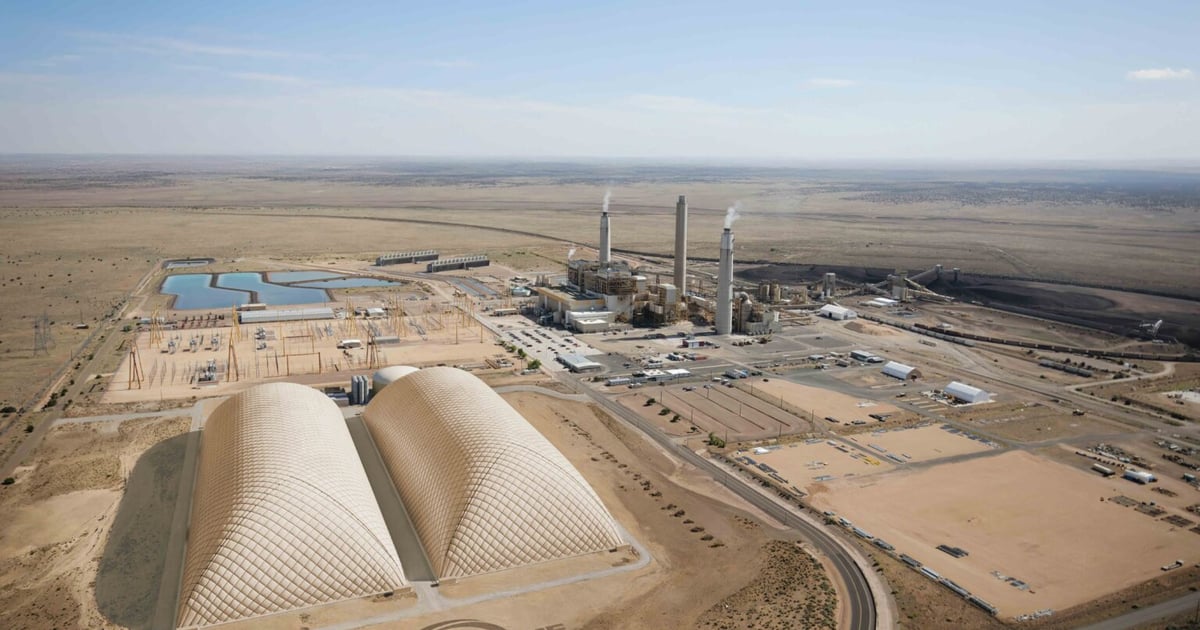
Google has signed an agreement with long-duration energy storage startup Energy Dome (LDES) for its 23MW/200MWh CO2 battery energy storage system in County Offaly, Ireland.
The search engine giant is 100% the off-taker of the project, which is expected to enter commercial operations in 2028, and the agreement marks the second investment in Energy Dome.
The sustainable CO2 battery system will not only give Google access to carbon-free energy for its nearby operations, but will also help reduce congestion in a strategic location of Ireland’s electricity grid, Energy Dome’s Ben Potter told our sister site Energy storage.news in an interview.
“We are very close to the Derryiron 110KV substation, so that is a very important junction of the electricity grid, feeding high-voltage networks into the Greater Dublin area,” says Potter, COO of Energy Dome’s Energy As-a-Service division.
“It is a large loading area and we can develop our project outside of Dublin but stabilize and feed the Dublin grid.”
The area is also rich in energy resources, including a large-scale wind farm, solar installations, battery energy storage systems (BESS) and other technologies such as flywheels, synchronous condensers and open-cycle gas turbines (OCGT).
“It’s a very strong renewable area, but there’s a large amount of congestion between this area in Offaly and the Irish Midlands and Dublin. So the use of long-term energy storage here is to alleviate congestion, which brings network benefits to this area, so that all that concentration of energy can reach Greater Dublin by moving it around the peaks and moving it around the congestion of the area, unlocking a lot of the renewables.”
The second unit could bid for the Irish government’s LDES scheme
Energy Dome technologyinvented by founder and CEO Claudio Spadacini, stores energy through the adiabatic compression of carbon dioxide gas. The gas liquefies during charging and evaporates during discharging in the thermodynamic Brayton cycle. In a closed process, heat is stored during the compression process and then used to expand the CO2 gas. The gas is driven through turbines to generate electricity.
Potter calls the latest project a “really beautiful energy transition story for an area that has a legacy of fossil fuels and is introducing new technology to enable both carbon-free energy but also greater affordability.”
Energy Dome will build, own and operate the system, which Potter clarifies is, in practical terms, an 8-hour system. The company also bid for and received a 10-year T-4 capacity market contract from transmission system operator (TSO) Eirgrid, competing with sources such as thermal generation, hydropower and battery storage.
There is also scope to add a second 23MW/200MWh unit at the site, for which Energy Dome has already secured planning permission, capacity contracts, grid connection and land. The second unit could be used to bid for the upcoming LDES tender mechanism, which is being developed in line with the Irish government’s electricity storage policy framework, Potter said.
The full version of this article is available for further reading Energy storage.news.
