

July 7, 2026
By Will White | Anyone in the solar industry knows that sites are built to withstand challenging weather conditions. Wind, heat, hail, standing water, freeze-thaw cycles – none of this is unusual, and none of it automatically becomes an outage that costs you production.
The problem is what these harsh conditions leave behind. The obvious damage gets attention first. The quieter damage often doesn’t occur: insulation worn out at a contact point, a ground fault that only occurs in wet conditions, a wire that remains offline because the team can’t justify hours of disruptive fault-finding while the rest of the installation needs proper maintenance.
That’s where resilience becomes more interesting than simply surviving. For operators, the real question is often less: “Did the site survive?” and more “What started that event that we still haven’t found?”
How most ground faults start
Ground faults are not a cornerstone of solar operation and maintenance (O&M). They are part of the background workload of running real sites and rarely arise from exotic failure modes. More often, they start with a common detail that has gone wrong or isn’t holding up: wire poorly routed, insulation damaged during installation, cable tied too tightly to the rack, movement over time, moisture, wear and tear, or animal damage.
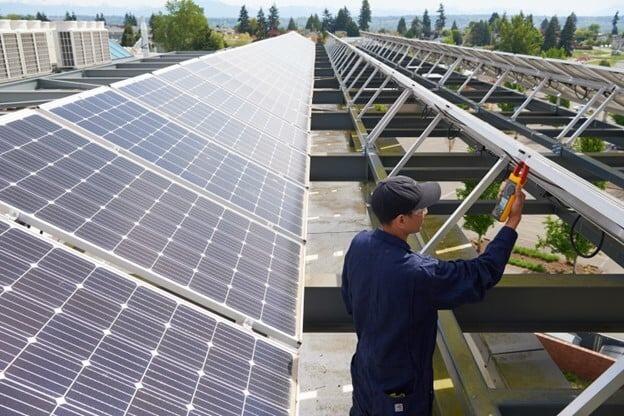
Thread management is worth mentioning because it tells you more than just where an error is coming from. An inspector walking to an installation can look under the array before getting near the electrical system and often get a clear picture of construction quality. Dangling wires are a reliable predictor of broader quality problems. The converse is also true: conductors that are neatly routed and properly secured often indicate a system that has been carefully constructed throughout. All types of systems involve routing discipline: wires running over the edges of the rack or stuck so tightly that they cannot move without chafing are errors already in progress.
Resilience starts before the first error warning. It is determined by how neatly the array is built, how well the conductors are secured and protected, and whether routine inspections detect wear before it results in lost generation and invasive troubleshooting.
Why problem solving stops
In practice, the hardest part isn’t confirming that something is wrong. It narrows the fault enough to fix it without turning the day into a lengthy search.
When an inverter trips, crews can usually identify the affected combiner quickly enough to get most of the plant back into service. Turn off the combiner, bring the inverter back online – you’ve gone from taking the entire system offline to a much smaller part of it. That is the immediate priority being addressed. But the fault itself is not resolved. It’s parked.
Finding which string in that combiner contains the error is slower. Identifying the precise fault point in that circuit is even slower. At that stage the work becomes intrusive: you disconnect the strings one by one, checking each one individually and working around live conductors, because it is impossible to de-energize the modules in daylight. Murphy’s law applies reliably here – it’s rarely the first strings you test. On a large combiner with twenty or more strings, that search can take hours, if not days, and all the time you’re dealing with live DC power with no way to make it safe.
Therefore, troubleshooting usually stops before the failure point is reached. Teams take the affected string offline, bring back the rest, and move on. Under operational pressure this is the right choice.
The track stops expanding
Once you can accurately locate the fault, the work stops expanding. You don’t have to disconnect healthy strings to reach the bad ones, you aren’t repeatedly isolating and retesting, and you don’t leave a string offline because chasing the exact point of failure would take the rest of the day. That last point is more important than it seems on paper. A combiner box that is offline for a month – as happens more often than it should – is not just a postponed job. It’s a bit of capacity that the site isn’t using, and it’s built up quietly until someone decides it’s finally worth solving the problem.
It also changes what is possible with the harder error classes. High resistance and periodic faults are difficult enough if you know where to look. They become much more difficult when the search itself takes up the maintenance window. A precise location gives the crew something to act on rather than something to keep working with – and means that intermittent faults can be properly detected when conditions make them visible, rather than remaining on the list indefinitely.
The cost consequences if this goes wrong are real and cumulative. Earth faults are a major cause of corrective maintenance costs in the sector. Every failure that is postponed rather than resolved increases costs and becomes more widespread across the fleet. But while the financial calculations are compelling, the business case for accurate error resolution lurks a more serious problem.
The fire department should not be your early warning system
A ground fault can energize racks and module frames that no one expects to be energized. If the connection to earth is not solid and a crew member touches that metalwork, he or she becomes the path to earth – which is where shocks and electrocutions occur. Separately, where the connection between conductor and metal is resistive rather than clean, the current arcs. Sparks generate heat. On an area on the ground with dry vegetation underneath, that heat finds fuel. There are documented cases where repeated arc faults caused grass fires under the arrays so frequently that the local fire department forced the operator to institute a strict vegetation management plan – and other locations where operators tilled the earth around the perimeter of the array as a permanent firebreak.
Research into solar ABCs Research into ground fault protection failures following real fires at large-scale locations in the US has shown that faults in grounded conductors can remain undetected for extended periods of time, creating a new “normal” condition that prevents system protection from interrupting a second fault.
Aside from the immediate safety concerns, not every amplifier that goes to ground goes to the inverter. The financial loss is simple: unresolved ground faults reduce generation, and the more faults accumulate at a site, the wider that gap becomes. ESFI data on electrical fatalities in the workplace From 2011 to 2023, ground faults were responsible for 4% of all workplace electrical fatalities in the US – a reminder that these are not abstract electrical events.
In other words, resilience is as much a matter of maintenance as it is of weather. The main event may be over. The more difficult question is whether the electrical damage it left behind is still in the system – waiting to trip again or endanger the next crew working that section.
Find it. Fix it. Go on.
Ask the technician who spent three hours disconnecting wiring in a combiner box and working in direct sunlight in direct sunlight, only to find the fault in the last one they tested. Was that a good use of a maintenance window? Was the site better protected?
That is the operational reality that precise fault localization tools respond to. Your crew finds the error, fixes it, and moves on – without staying offline more than necessary, without the hours of exposure that comes with searching by elimination. On an American solar fleet 43 GW added in 2025 alone and will continue to grow, that difference widens at every location, in every maintenance window, with every bug that is either resolved properly or sits in the system waiting for a better day that rarely comes.
Will White is a senior product manager at Fluke Corporation.
Tags: Fluke, earth fault detection, utility scale solar
