

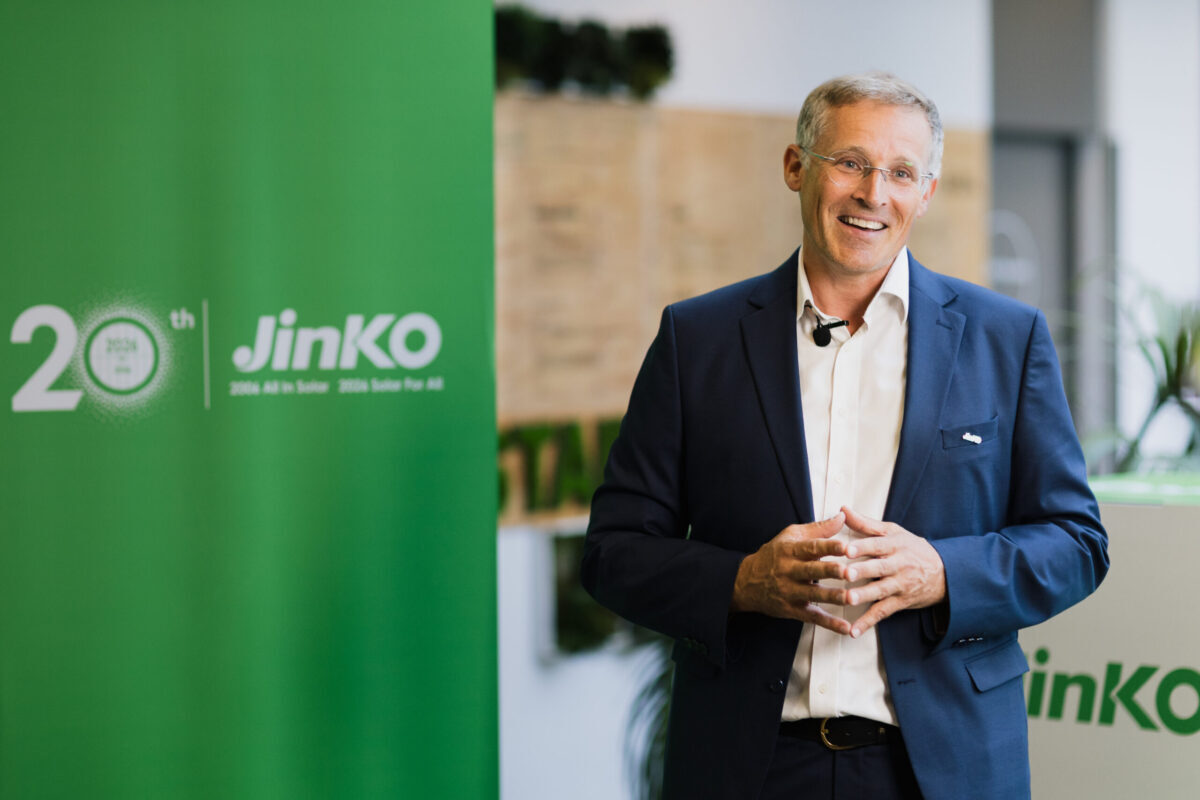
The global solar industry is entering another challenging period, with photovoltaic installations expected to decline this year and possibly remain flat through 2027, according to Frank Niendorf, vice president at JinkoSolar. In response, the company is placing greater emphasis on integrated energy solutions and accelerating the expansion of its energy storage business.
“We are in the third consecutive year of consolidation in the solar industry,” Niendorf said pv magazine in an interview at The smarter E Europe in Munich, noting that while all photovoltaic manufacturers continue to report losses, the main players remain active in the market.
Last year, Niendorf predicted that the significant losses suffered by many module manufacturers in the recent past would force some companies out of the market. “There is a market shock happening,” Niendorf says, especially regarding the Chinese central government’s efforts to take production capacity off the market. “However, provincial governments are providing tremendous support to manufacturers in their regions.”
Module prices have stabilized in recent months around €0.12/W (€0.13) to €0.13/W. Nevertheless, some second- and third-tier manufacturers are still offering modules below production costs, Niendorf says. Producers also face pressure from fluctuating raw material prices. For example, the silver price reached record highs earlier this year and accounted for about 25% of module costs at the time. The situation has since eased, he added.
Weak demand in key markets including China and Europe is also contributing to the current price pressure. “In Germany we are experiencing a market slowdown,” says Niendorf. “Given the current political discussions, we see significant uncertainty among investors.”
He expects stagnation rather than growth next year in Germany and throughout Europe. “From 2028, however, I expect new momentum,” says Niendorf. “Continued electrification and investments in data centers will increase demand in Germany again.”
The Chinese solar market is also showing signs of weakness. Niendorf expects annual photovoltaic installations in the country to drop from around 300 GW last year to around 150 GW this year.
The weak demand in China and Europe certainly also plays a role in price developments. “In Germany we are experiencing a slowdown in the market,” Niendorf continues. “Given the current political discussions, we see significant uncertainty among investors in this country.” Niendorf also expects stagnation rather than growth in Germany and the broader European market for next year. “From 2028, however, I expect new impetus,” says Niendorf. “Continued electrification and investments in data centers will increase demand in Germany again.”
Despite current market challenges, Niendorf believes JinkoSolar is well positioned for the next phase of industrial growth. This year also marks a significant milestone as JinkoSolar celebrates its 20th anniversary, a testament to the company’s resilience, continued innovation and long-term commitment to the global energy transition. Over the past two decades, JinkoSolar has grown from a photovoltaic manufacturer to one of the world’s leading clean energy technology companies, serving customers in more than 200 countries and regions.
Throughout changing market cycles, the company has consistently invested in technology, manufacturing excellence and customer partnerships, allowing it to maintain its position among the global leaders in the industry, Niendorf says.
Building on this foundation, JinkoSolar has grown into a comprehensive one-stop energy solutions provider, offering photovoltaic modules, battery energy storage systems and intelligent energy management solutions from a single source. The company’s strategic expansion into energy storage in 2022 has further strengthened its ability to support customers in the residential, commercial, industrial and utility markets, according to Niendorf.
JinkoSolar has also invested heavily in its own production capacity and now operates its own battery cell production facilities with a capacity of 12 GWh. The company has also launched its own energy management system. “Approximately 90% of our utility-scale projects combine photovoltaic generation with battery energy storage, reflecting the increasing market demand for hybrid energy solutions,” Niendorf added.
However, JinkoSolar is not only investing heavily in its storage activities. It is also focusing on the continued development of its solar panels. “About 5% of our turnover is invested in research and development,” says Niendorf. A significant part of this investment goes into the Tiger Neo series. At the Munich fair, the company presented modules from the 3.0 series, including a 760 W module for utility-scale applications. In China, JinkoSolar is already two steps ahead. At the SNEC fair in Shanghai in early June, the company introduced modules from the Tiger Neo 5.0 series. The residential modules deliver power up to 500W and are designed to compete with back-contact counterparts in the rooftop segment. They are expected to be offered in Europe soon, Niendorf explains.
Niendorf also said he expects silicon-perovskite tandem modules to achieve widespread market adoption within the next two to three years. JinkoSolar is already working on this technology. However, currently weak demand and low prices do not provide a suitable market environment for large-scale application. “Our twenty-year history has taught us that this industry is cyclical,” concludes Niendorf. “The companies that continue to invest during difficult periods are the ones that emerge stronger. We remain committed to innovation, our customers and the long-term energy transition. We are confident that the next phase of growth for the solar industry is already taking shape.”
