

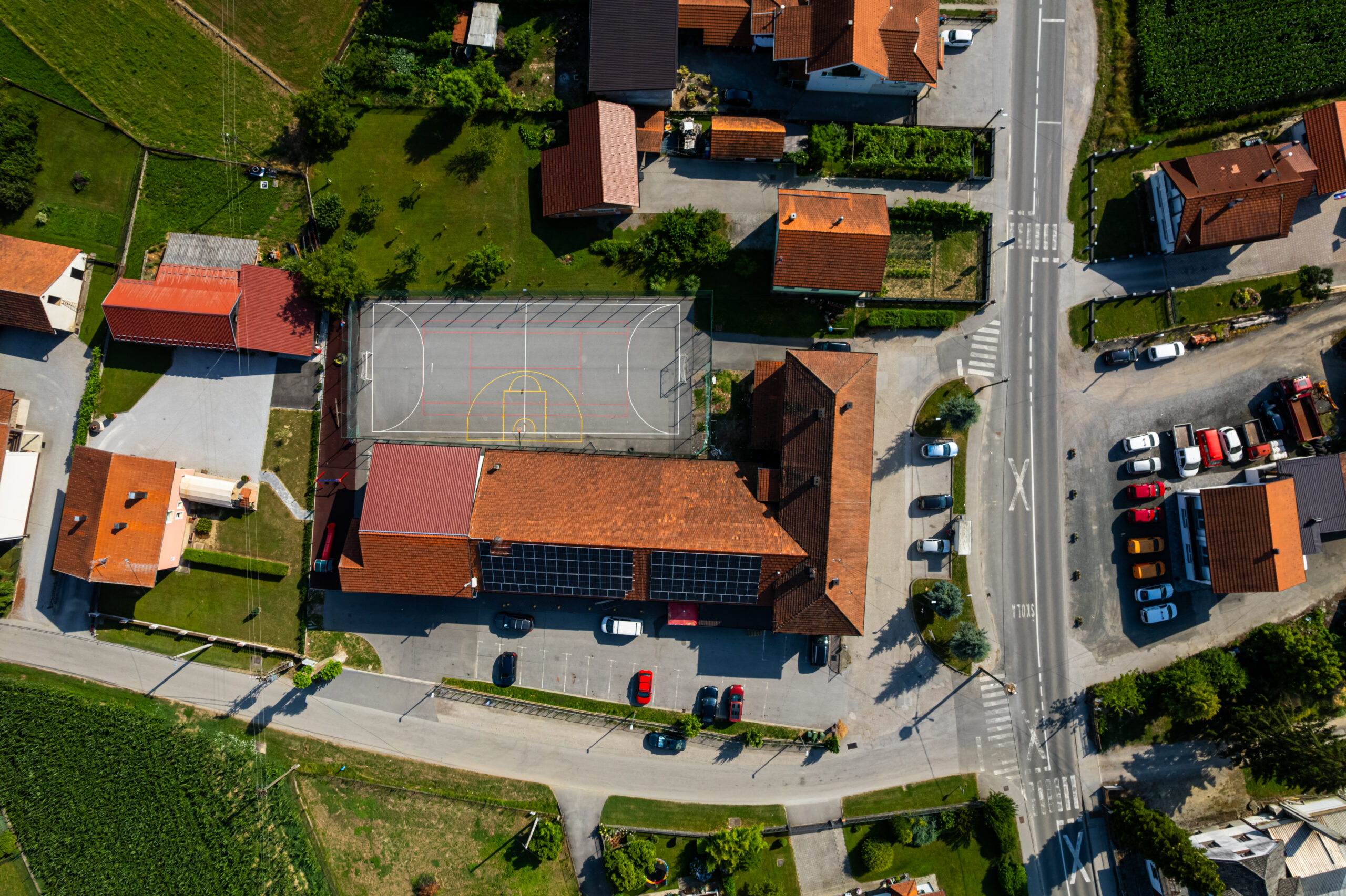
Croatia’s first energy community is now operational. The community uses a solar power plant on the roof of the volunteer fire brigade building in Špičkovina, a settlement near Zabok in Krapina-Zagorje County, northern Croatia.
The project, implemented by the Regional Energy and Climate Agency of Northwestern Croatia (REGEA), includes a rooftop solar panel currently measuring 32 kW, with plans to double the capacity to 64 kW.
The community has a total of 17 members, consisting of volunteer firefighters, local residents, a micro-enterprise and the volunteer fire brigade itself, called DVD Špičkovina.
Ivana Belić, head of strategic communications at REGEA, explained pv magazine the community operates on an energy sharing model, without on-site storage, which differs from conventional self-consumption.
“The electricity is not consumed behind a single meter. Instead, the output of the plant is distributed via the public electricity grid to the community members’ metering points, according to a fixed distribution key,” Belić explains. “Each member’s share is offset against the consumption recorded at that member’s own metering point. Members expect their electricity bill to drop substantially, by approximately half.”
The city of Zabok co-financed about half of the investment, while the members financed the other half, which according to Belić cut each member’s own expenses in half. She added that the purpose of the energy community is to benefit the community and not to generate commercial profit.
“Membership is open and voluntary, and members retain control of the organization,” Belić said. “A volunteer fire brigade is a natural host for this model. In Croatia, volunteer fire brigades are long-standing local institutions with a public role and a building that serves the entire settlement. The value created by the solar power plant remains in the local community.”
Energy sharing is the newest part of Croatian energy legislation. Croatian distribution system operator HEP ODS introduced the mechanism in early April this year.
The Renewable Energy Sources of Croatia (RES Croatia) told pv magazine this step marked the most important condition for energy communities to become operational. “However, there are still several administrative barriers that need to be simplified, and we expect further regulatory improvements in the near future,” the association said.
There are currently three energy communities officially registered in Croatia, RES Croatia added, with the Špičkovina community being the first to start its activities.
“We certainly expect this segment to grow. According to the latest public opinion survey, 71% of Croatian citizens would like to produce electricity together with their neighbors, for example through a shared solar installation on the roof,” the association said. pv magazine. “In addition, the Croatian Energy Regulatory Agency recently launched a public consultation on a new regulatory framework aimed at supporting citizens’ energy initiatives.”
Belić added that the experience gained with the Špičkovina energy community, from the community’s registration to the network procedures and the allocation of shared electricity, is directly useful for other Croatian communities.
“The importance of Špičkovina does not lie in its size,” Belić said. “It proves that energy sharing works under Croatian rules, and it gives other communities a proven path to follow.”
Croatia’s cumulative solar capacity exceeded the 1 GW threshold last year before reaching over 1.2 GW by the end of the year.
Earlier this year, Slovakia announced plans to develop energy communities. Elsewhere in the EU, Spain is accelerating the rollout of such communities, while Italian energy communities now generate more than 300 MW of power.
