
Close Menu
  • News
  • Industry
  • Solar Panels
  • Commercial
  • Residential
  • Finance
  • Technology
  • Carbon Credit
  • More
    • Policy
    • Energy Storage
    • Utility
    • Cummunity
What's Hot

Dutch solar owners asked to switch off during peak periods to ease the distribution crisis

June 7, 2026

The hydrogen flow: Toyota demonstrates its racing prototype on liquid hydrogen

June 7, 2026

Era of electrification exposing Australia’s weakest link

June 6, 2026
Facebook X (Twitter) Instagram
Solar Energy News
Sunday, June 7
  • News
  • Industry
  • Solar Panels
  • Commercial
  • Residential
  • Finance
  • Technology
  • Carbon Credit
  • More
    • Policy
    • Energy Storage
    • Utility
    • Cummunity
Solar Energy News
Home - Technology - New model shows how homes can be supplied exclusively with hydrogen, solar energy and batteries – SPE
Technology

New model shows how homes can be supplied exclusively with hydrogen, solar energy and batteries – SPE

solarenergyBy solarenergyMay 1, 2024No Comments3 Mins Read
Facebook Twitter Pinterest LinkedIn Tumblr Email
Share
Facebook Twitter LinkedIn Pinterest Email

Researchers in Spain have found that combining PV power generation with fuel cells and battery storage can help homes significantly reduce their levelized energy costs. Their simulation shows that houses can also become completely self-sufficient.

May 1, 2024 Lior Kahana

A group of researchers from the University of Cantabria in Spain have piloted a self-sufficient home powered solely by solar photovoltaics, batteries and hydrogen storage.

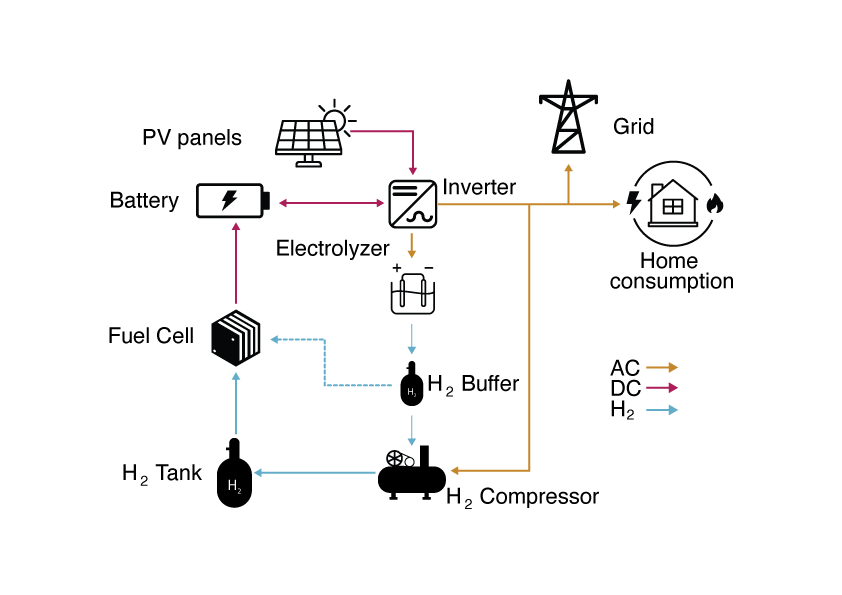
“This factory combines PV panels and hydrogen (PVHyP) as a method of seasonal energy storage, achieving the ambitious goal of achieving an electrically self-sufficient social housing unit all year round,” the group said. “To achieve this goal, a tailor-made energy management strategy (EMS) has been developed, based on the state of charge of the battery pack and the energy flow within the PVHyP, ensuring that the home’s electricity consumption is always covered by PV panels, fuel cell or battery pack.”

For their simulation, the scientists collected data from January 2022 to December 2023 for an 80 m2 social housing in Novales, a small village in northern Spain. Electricity bills from the years before the home’s renewable electrification showed that the home consumed 2,513 kWh/year with an average daily consumption of 6.88 kWh. The average consumption in winter and autumn was more than 7.3 kWh and in summer 5.88 kWh/day.

With this data, the scientists started to dimension the energy system using software optimization and market analysis. Ultimately, they ended up with twenty solar panels, each with a capacity of 40 W, on the roof, and four 2.4 kWh batteries. The remainder of the installation was installed in a shed on the adjacent property. This included a 35 L water tank that used tap water after purification for electrolysis and a 600 L hydrogen storage tank at 300 bar.

See also  New discovery paves the way for more efficient perovskite solar cells – SPE

In the proposed system configuration, the PV panels must first supply the residential load. The excess generation then charges the battery, and once full it is stored in a high-pressure storage tank in the form of hydrogen generated by an electrolyzer.

“When solar radiation is insufficient to meet the home’s demand, the batteries supply the necessary energy to the home,” the academics explained. “When the batteries are empty, the fuel cell generates electricity from the stored hydrogen to charge the batteries. The hydrogen stored in the buffer is used first as much as possible to avoid the compression phase, which increases energy efficiency. The system and the house are connected to the electricity grid on a self-consumption basis to sell any excess energy back to the electricity grid.”

According to the research group, the house was self-sufficient and the LCOE decreased from €0.86 ($0.92)/kWh to €0.34/kWh, and the tenants saved €1,170 annually. “Almost 15,200 kWh have been saved from fossil fuels, which corresponds to approximately 2,260 kg of CO2,” the researchers emphasize.

They presented their findings in the study “Sustainable and self-sufficient social housing through a combined PV-hydrogen pilot,” published in Applied energy.

This content is copyrighted and may not be reused. If you would like to collaborate with us and reuse some of our content, please contact: editors@pv-magazine.com.

Source link

batteries Energy exclusively homes hydrogen model shows solar SPE supplied
Share. Facebook Twitter Pinterest LinkedIn Tumblr Email
solarenergy
  • Website

Related Posts

Dutch solar owners asked to switch off during peak periods to ease the distribution crisis

June 7, 2026

The hydrogen flow: Toyota demonstrates its racing prototype on liquid hydrogen

June 7, 2026

Britain’s next energy dependency is already taking shape

June 5, 2026
Leave A Reply Cancel Reply

Don't Miss
News

EagleView now has new data on solar suitability

By solarenergyJanuary 22, 20250

Credit: Titan Solar EagleView announced the launch of its new ecosystem for real estate data.…

Otovo works together with the British VPP Levelise

August 29, 2024

Longi, Pertamina Plan 1.4 GW Solar cell, Module factory in Indonesia

June 27, 2025

The all-perovskite tandem solar cell, built with laser polishing, achieves an efficiency of 29.80%

May 12, 2026
Stay In Touch
  • Facebook
  • Twitter
  • Pinterest
  • Instagram
  • YouTube
  • Vimeo
Our Picks

Dutch solar owners asked to switch off during peak periods to ease the distribution crisis

June 7, 2026

The hydrogen flow: Toyota demonstrates its racing prototype on liquid hydrogen

June 7, 2026

Era of electrification exposing Australia’s weakest link

June 6, 2026

‘Come out from behind your screen, our industry is ultimately about people’

June 6, 2026
Our Picks

Dutch solar owners asked to switch off during peak periods to ease the distribution crisis

June 7, 2026

The hydrogen flow: Toyota demonstrates its racing prototype on liquid hydrogen

June 7, 2026

Era of electrification exposing Australia’s weakest link

June 6, 2026
About
About

Stay updated with the latest in solar energy. Discover innovations, trends, policies, and market insights driving the future of sustainable power worldwide.

Subscribe to Updates

Get the latest creative news and updates about Solar industry directly in your inbox!

Facebook X (Twitter) Instagram Pinterest
  • Contact
  • Privacy Policy
  • Terms & Conditions
© 2026 Tsolarenergynews.co - All rights reserved.

Type above and press Enter to search. Press Esc to cancel.