

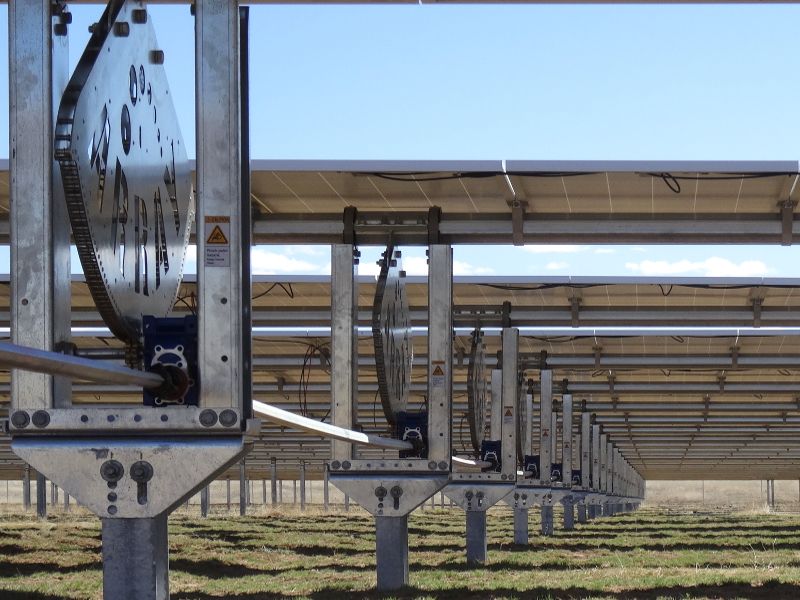
Researchers from Spain have developed a method to estimate the critical speed that a tracker can withstand. They found “good agreement” when comparing the model with experimental results.
Researchers from the Technical University of Madrid in Spain have introduced a new way to calculate the effective damping coefficient of single-axis solar trackers. In aerodynamics, damping is the force opposing the motion of a vibrating or oscillating system, and its effective coefficient is a parameter related to its stability.
The proposed approach allows developers to estimate the critical speed that a tracker can withstand.
“We do not rule out expanding our research to dual-axis tracking systems,” said corresponding author Juan A. Cárdenas-Rondón pv magazine. “Key challenges to be addressed include dealing with two degrees of freedom in torsion and three-dimensional aerodynamic phenomena.”
The researchers plan to increase the number of cases tested to develop a mathematical model.
In the study “Stability analysis of two-dimensional flat solar trackers using aerodynamic derivatives at different heights above the ground”, published in the Journal for wind technology and industrial aerodynamics, the research group tried to create the most general possible methodology to determine the stability curve of a PV tracker.
The mathematical model they developed depends on several parameters, such as the chord length of the solar tracker’s support structure, the height of the solar tracker’s axis, and the angle of the air strike on the rotating PV.
Furthermore, the model requires the use of two derivatives: one related to aerodynamic damping and the other to stiffness. While damping refers to the force opposing motion, stiffness refers to an object’s resistance to deformation by the system. These derivatives were obtained using a series of laboratory tests using different angles of incidence and standard chord height (H) to chord (B) ratios.
“The values tested are H/B = 0.3, 0.4, 0.5, 0.6, 1 and 2,” the academics said. “For each of the height-width values, the nominal angle of attack is varied. The tested angles are 0◦, ±5◦, ±10◦, ±20◦, ±30◦, ±40◦. Testing was limited to angles in the range of ±40◦ because at lower H/B ratios the model could not be tested at higher absolute nominal angles as it would collide with the ground.”
After finding both derivatives for all these different conditions, the scientists were able to calculate the effective damping coefficient of solar trackers as a function of incident wind speed. They then performed a series of tests on an additional experimental setup to validate their mathematical model.
“The results obtained with the model are in good agreement with the results obtained in the validation tests performed in the additional experimental setup for the case of large angles of attack,” they stated. “Conversely, for small angles of attack it can be noted that the value of the maximum critical reduced speed has been accurately determined, but both results do not agree with respect to the angle of attack at which it is achieved.”
The team also found that, in terms of oscillation frequency, the model predicts the experimental results for low reduced speeds. “But as the system approaches unstable conditions, the forecasts become overestimated,” the report concluded.
This content is copyrighted and may not be reused. If you would like to collaborate with us and reuse some of our content, please contact: editors@pv-magazine.com.
