
Close Menu
  • News
  • Industry
  • Solar Panels
  • Commercial
  • Residential
  • Finance
  • Technology
  • Carbon Credit
  • More
    • Policy
    • Energy Storage
    • Utility
    • Cummunity
What's Hot

A deep learning model tracks the status of the EV battery with high precision

March 6, 2026

Mitsubishi Electric Trane announces new heat pump line for hydronic heating – SPE

March 6, 2026

Origis is developing a 413 MW solar portfolio in West Texas

March 6, 2026
Facebook X (Twitter) Instagram
Solar Energy News
Friday, March 6
  • News
  • Industry
  • Solar Panels
  • Commercial
  • Residential
  • Finance
  • Technology
  • Carbon Credit
  • More
    • Policy
    • Energy Storage
    • Utility
    • Cummunity
Solar Energy News
Home - Technology - Improving the performance of photovoltaic and thermal modules with Tesla valves – SPE
Technology

Improving the performance of photovoltaic and thermal modules with Tesla valves – SPE

solarenergyBy solarenergyMay 15, 2024No Comments3 Mins Read
Facebook Twitter Pinterest LinkedIn Tumblr Email
Share
Facebook Twitter LinkedIn Pinterest Email

Scientists in China have demonstrated a photovoltaic-thermal system that uses Tesla valves to increase cooling and efficiency. The system was found to have better performance compared to PVT systems made with different cross-sectional structures.

May 15, 2024 Emiliano Bellini

Researchers from Donghua University in China have designed a photovoltaic-thermal (PVT) system that uses a Tesla valve to improve cooling performance.

A Tesla valve is a passive, one-way valve line with a fixed geometry. It was designed and patented by Nicola Tesla about 100 years ago and is intended to move fluid in one direction without moving parts. “Tesla valves can improve heat transfer by creating swirls and turbulence in the fluid flow, increasing the heat transfer coefficient and reducing the temperature difference between the fluid and the solid surface,” the scientists said.

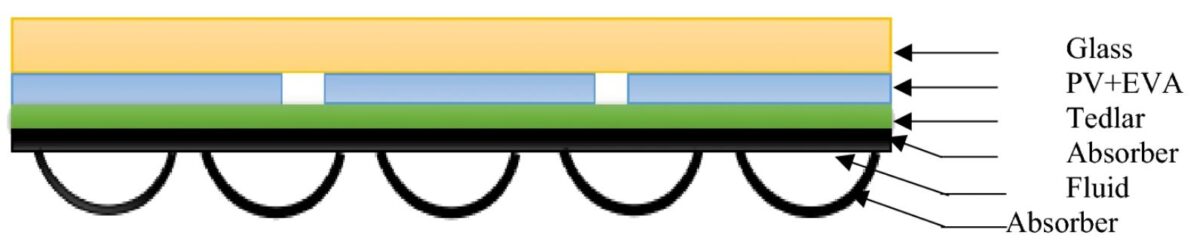
Through a numerical simulation, the research group developed a PVT module consisting of a glass cover, a PV panel, a heat-absorbing plate, a flow channel, liquid, ethyl vinyl acetate (EVA) encapsulant and Tesla valves.

The academics then assessed the cooling performance of the panel with the Tesla valves, assuming the use of four different fluids, namely water, magnesium oxide (MgO), titanium oxide (TiO2) and aluminum oxide (Al2O3). They emphasized that the cooling effect is significantly affected by the speed increase.

“In particular, when the velocity is within the range of the turbulent critical value up to 1 m/s, the increase in flow velocity has a significant effect on reducing the PV temperature,” they pointed out. “However, when the flow velocity was greater than 1 m/s, there was no significant cooling effect with the increase in flow velocity.”

See also  Philippines opens country's largest solar-powered irrigation system – SPE

The simulation showed that the PVT system with the Tesla valves achieved an electrical efficiency of 16.32% and a thermal efficiency of 59.65%. These results were then compared with those of identical PVT systems based on three different cross-sectional structures and the analysis showed that the flow channel of the Tesla valve structure provides superior thermal and electrical efficiency.

The scientists also identified optimal parameters for the Tesla valves, such as an angle of 30 degrees and a tube diameter ratio of 1.

Their findings can be found in the article “Numerical study of photovoltaic/solar thermal systems with Tesla valve,” published in scientific reports. Looking ahead, they said they want to test nanofluids in the proposed system configurations. “Nanofluids have the potential to achieve rapid cooling and heat storage,” they concluded.

Temperature cloud map with different runner structures: (a) rectangle; (b) triangle; (c) semicircle; (d) Tesla valve.

Image: Donghua University, Scientific Reports, Creative Commons License CC BY 4.0

This content is copyrighted and may not be reused. If you would like to collaborate with us and reuse some of our content, please contact: editors@pv-magazine.com.

Source link

Improving modules performance photovoltaic SPE Tesla thermal valves
Share. Facebook Twitter Pinterest LinkedIn Tumblr Email
solarenergy
  • Website

Related Posts

Mitsubishi Electric Trane announces new heat pump line for hydronic heating – SPE

March 6, 2026

Oleic acid anti-pollution coating for solar panels – SPE

March 5, 2026

Ground-mounted test field for Perovksite solar panels goes online in China – SPE

March 5, 2026
Leave A Reply Cancel Reply

Don't Miss
Solar Industry

Replacing silver in PV production by new graphene electrode technology

By solarenergyMarch 11, 20250

The Swiss spin-off of the university, GraphenergyTech, develops graphene electrode technology to replace silver and…

Sungrow builds first European factory in Poland – SPE

February 6, 2026

Res Solar and Storage Project will be in the pre-examination phase

June 13, 2025

Self-cleaning perovskite solar cell based on leek leaf-like film achieves 14.2% efficiency – SPE

July 30, 2024
Stay In Touch
  • Facebook
  • Twitter
  • Pinterest
  • Instagram
  • YouTube
  • Vimeo
Our Picks

A deep learning model tracks the status of the EV battery with high precision

March 6, 2026

Mitsubishi Electric Trane announces new heat pump line for hydronic heating – SPE

March 6, 2026

Origis is developing a 413 MW solar portfolio in West Texas

March 6, 2026

New Jersey expands state community solar program by 3 GW

March 6, 2026
Our Picks

A deep learning model tracks the status of the EV battery with high precision

March 6, 2026

Mitsubishi Electric Trane announces new heat pump line for hydronic heating – SPE

March 6, 2026

Origis is developing a 413 MW solar portfolio in West Texas

March 6, 2026
About
About

Stay updated with the latest in solar energy. Discover innovations, trends, policies, and market insights driving the future of sustainable power worldwide.

Subscribe to Updates

Get the latest creative news and updates about Solar industry directly in your inbox!

Facebook X (Twitter) Instagram Pinterest
  • Contact
  • Privacy Policy
  • Terms & Conditions
© 2026 Tsolarenergynews.co - All rights reserved.

Type above and press Enter to search. Press Esc to cancel.