

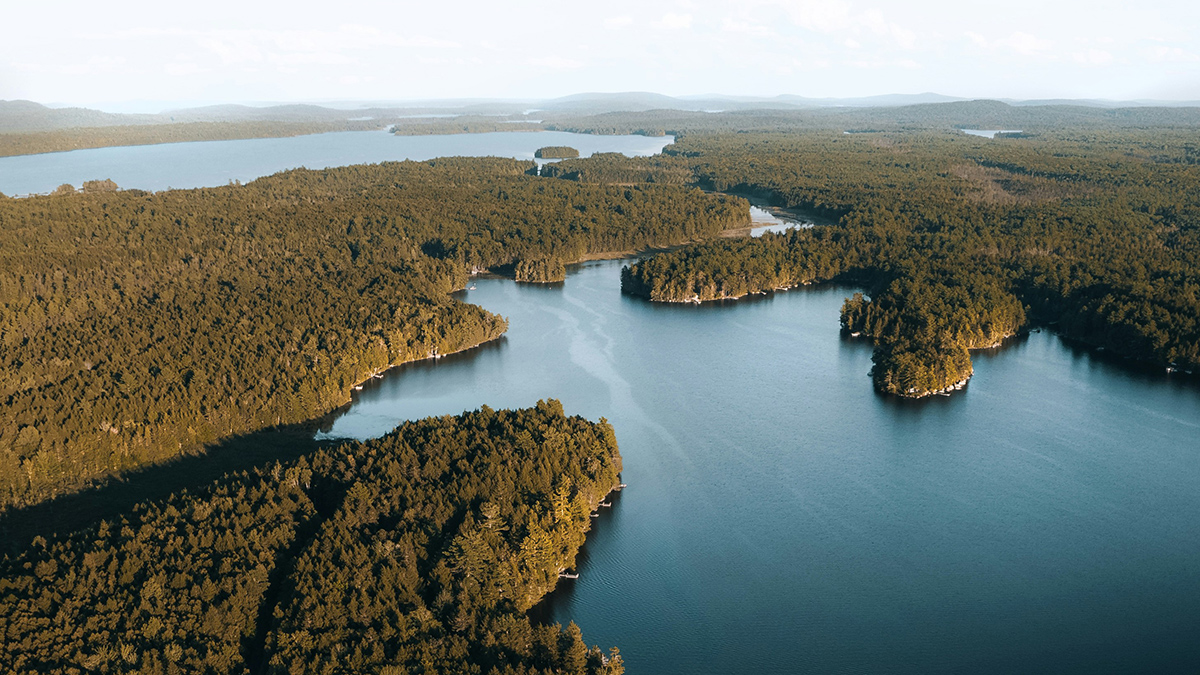
New England is one of the most forested areas in America, storing about 15 million tons of carbon annually. Many carbon offset programs reforest in the region.
“We’re not really considering the risks enough when we rely on forest carbon as a nature-based climate solution.”
These projects are responsible for disasters that can kill trees and release their stored carbon. However, a new study published in Biology of global change suggests they may be underestimating the destructive power of hurricanes. A single hurricane in New England could release at least 121 million tons of carbon from fallen trees, the study found, equivalent to the energy use of nearly 16 million homes in one year.
“I wanted to use this case study of New England and hurricane risk to outline the broader problem,” he said Shersingh Joseph Tumber-Davila, a forest ecologist at Dartmouth College and first author of the study. “We’re not really considering the risks enough when we rely on forest carbon as a nature-based climate solution.”
Carbon credits
When a company purchases a carbon credit, it purchases a small surplus of offsets, allowing offset programs to plant slightly more trees to absorb more carbon than is emitted. This way, the program remains CO2 neutral if trees are lost due to drought, fire, disease or other disasters. However, these “buffer pools” are relatively small. The largest carbon offset program in the United States, California’s Cap-and-Trade Program, reserves only 8% to 12% of trees as a buffer, and only 3% of trees for storm damage.
Previous studies have questioned these buffer pools, claiming that they do not adequately assess the threats forests face in a changing climate. This is the first study to analyze the potential effect that hurricanes can have on carbon offset forests.
To accurately map New England’s forests, Tumber-Dávila and his colleagues worked with the US Forest Service to create a map of different tree heights and types in New England. They also created a simulation of likely hurricane paths using the wind speed and direction of the ten tropical storms in the 20th century that hit New England while still classified as hurricanes. By combining these models, the group was able to calculate the number of trees likely to be downed in a typical hurricane, and the amount of carbon released.
“Each storm that hits the region has the potential to wipe out between 5% and 10% of above-ground forest carbon,” says Tumber-Dávila. This high percentage effectively turns back the clock, eliminating 10 years of slowly stored carbon.
In addition to this enormous potential for carbon loss, the researchers also took into account the possibility that hurricanes would become stronger over time. Climate simulations indicate that while hurricanes will not become more frequent, their wind speeds will likely increase and, specifically in New England, they can move further inland without losing steam. Taking these changes into account, the group estimated that over 30 to 60 years, up to 250 million tons of carbon could be released by one severe enough storm in New England.
However, all that carbon wouldn’t immediately end up in the atmosphere. Rotting wood from felled trees releases carbon more slowly than other types of disturbances, such as fire. About 25% of fallen trees in New England are harvested for use in wood products, which can slow carbon emissions. Researchers estimate that the slow release of carbon from a single hurricane could last as long as 100 years.
Make it meaningful
As of 2020, 7% of the carbon from California’s Cap-and-Trade Program was stored in New England forests, and 3% of that carbon was set aside for storm damage. A single storm can destroy that buffer pool.
“I think it is certainly worth setting aside more CO2 emissions from an offset project to insure against risks.”
“We need studies like this, and we need studies that are broader, national and global in scope to actually quantify the risks,” he said. Willem Anderegg, an earth scientist at the University of Utah who was not involved in the study. Asked whether there are carbon offset programs with a large enough buffer pool, Anderegg said: “Honestly, the short answer is no.”
Carbon offset programs are still important, Tumber-Dávila noted, but they lose their effectiveness if we underestimate the threats they face. “I think it is certainly worth setting aside more CO2 emissions from an offset project to insure against risks.”
—Sierra Bouchér, science writer
