

As Britain looks ahead to massive expansion of solar capacity – currently 70 GW by 2035 – competition in the supply chain is increasing. In particular, capacity expansions combined with the relative difficulty of attracting European engineering companies following Britain’s exit from the EU have led to a significant labor shortage.
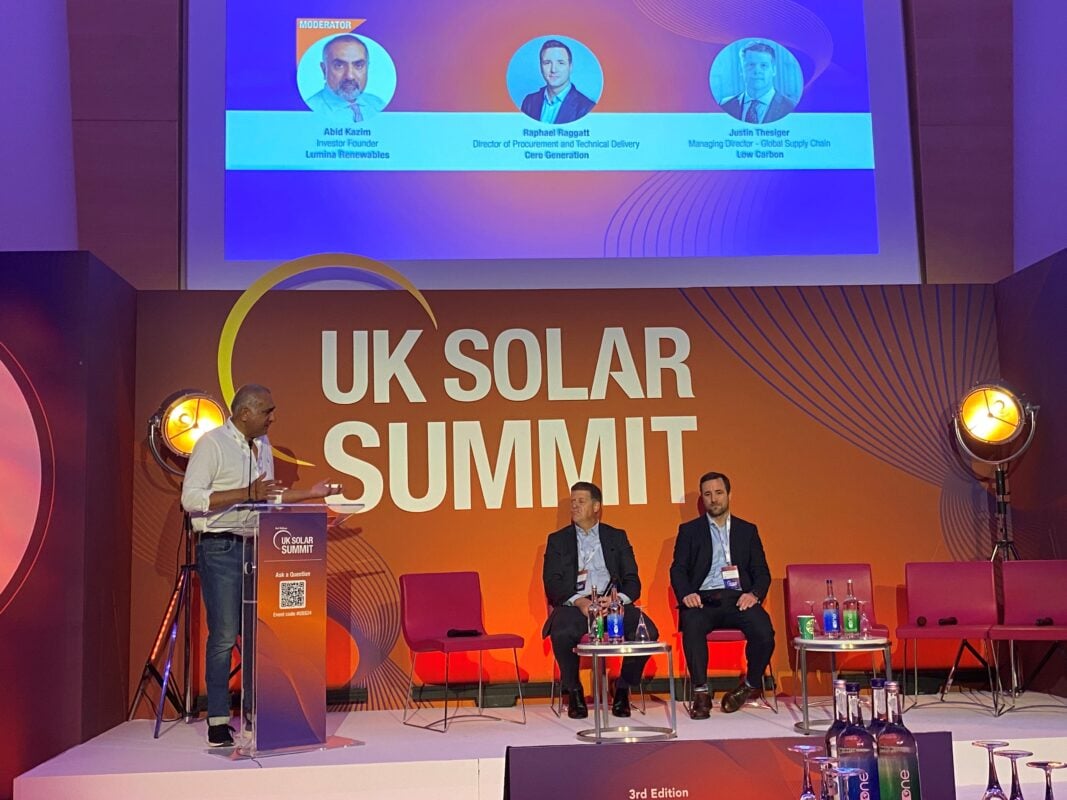
This is what panellists said at the opening session of day two of the UK Solar Summit in London, where the future of the UK’s solar supply chain was discussed.
Justin Thesiger, managing director for global supply chain at Low Carbon, said: “It would take about 200 people – give or take – to build a 50 MW PV plant. We are talking about 70 GW by 2035… we don’t have the skillset in this country to deliver the gigawatts we need”
Raphael Raggatt, purchasing director at Cero Generation, agrees. He said that as the UK solar market “has been gradually rebuilding in recent years, we are competing for the same labor with projects across Europe. You had Spanish and Greek contractors previously active in the UK market, but you are competing for those resources on projects now being built in Spain, Italy, Greece and elsewhere. With all the challenges in the UK (visas and such), if contractors have a choice of markets, they are more likely to choose an EU market than here.”
Raggatt is referring to the knock-on effects of Britain’s departure from the European Union.
Later in the discussion, Thesiger said Low Carbon is trying to plan its UK operations with EPC companies already present in Britain. “We’ve gone to non-British registered EPCs, and some have turned us away, purely on the basis that they said the bureaucracy, the red tape, the hassle of getting people into this country is too much, and they I I just ran away.”
In addition to this labor procurement problem, the UK solar industry also competes with other infrastructure developments such as housing development and railway extensions. For example, Labor leader Sir Keir Starmer announced a pledge for 1.5 million new homes if his party comes to power next month – this, the panellists said, would put further pressure on the already tight EPC market.
Panel moderator Abid Kazim, investor and founder of Lumina Renewables, added concerns about the emerging European Green Deal Industrial Plan which, when it begins to take full effect, will further increase competition for EPC contractors.
A seller’s market
In light of the challenges developers face in securing labor and EPCs, Kazim said solar energy in Britain has shifted from a “buyer’s market to a seller’s market”.
Raggatt said: “You now have to put a lot more effort into relationships with your contractors and with the supply chain in general. Contractors choose which projects they want to work on; you just need to develop that relationship. It’s like a marriage; you need to engage your supply chain contractors.”
He said the key to survival is a robust pipeline. “You can’t just hope to survive with two projects in a year; you have to have a pipeline for the future. It’s about making sure you can find the balance between what’s being delivered and how you can keep your supply chain happy.”
Thesiger said framework partnerships are becoming increasingly important. “To give [your contractors] visibility of your pipeline, making sure you give them continuity of supply and work. Otherwise they can’t keep their subcontractors, and then they can’t do your project.”
Production offer
For a short period the discussion focused on the production and delivery of modules. Reggatt said the low average selling price of modules over the past 18 months “saved the day… we rode that wave as it came down.”
Indeed, our sister site PV technology has mapped the decline in prices for solar panels and components in his country Price View items.
He continued: “I really hope there is no move towards production in the EU or Britain. We should be grateful that China built this entire supply chain to fuel its low-carbon economy. Let’s use it, let’s not fight it. We have enough fight in hand to achieve our net zero targets.”
However, some industry figures have argued that over-reliance on Chinese solar panels threatens the West’s energy security as the share of PV increases. Governments and trade associations in the US and EU have, to varying degrees, emphasized the importance of at least some spare capacity of domestic solar products to support supply against potential political or practical disruptions to supply.
