
Close Menu
  • News
  • Industry
  • Solar Panels
  • Commercial
  • Residential
  • Finance
  • Technology
  • Carbon Credit
  • More
    • Policy
    • Energy Storage
    • Utility
    • Cummunity
What's Hot

BYD unveils EV batteries that can be charged in 10 minutes – SPE

March 6, 2026

Growth in solar and wind capacity slowed last year, analysis shows

March 6, 2026

Tigo introduces a 725 W optimizer for powerful solar panels

March 6, 2026
Facebook X (Twitter) Instagram
Solar Energy News
Friday, March 6
  • News
  • Industry
  • Solar Panels
  • Commercial
  • Residential
  • Finance
  • Technology
  • Carbon Credit
  • More
    • Policy
    • Energy Storage
    • Utility
    • Cummunity
Solar Energy News
Home - Policy - More states in the US now require smart inverters, enabling more distributed solar energy – SPE
Policy

More states in the US now require smart inverters, enabling more distributed solar energy – SPE

solarenergyBy solarenergyJune 13, 2024No Comments2 Mins Read
Facebook Twitter Pinterest LinkedIn Tumblr Email
Share
Facebook Twitter LinkedIn Pinterest Email

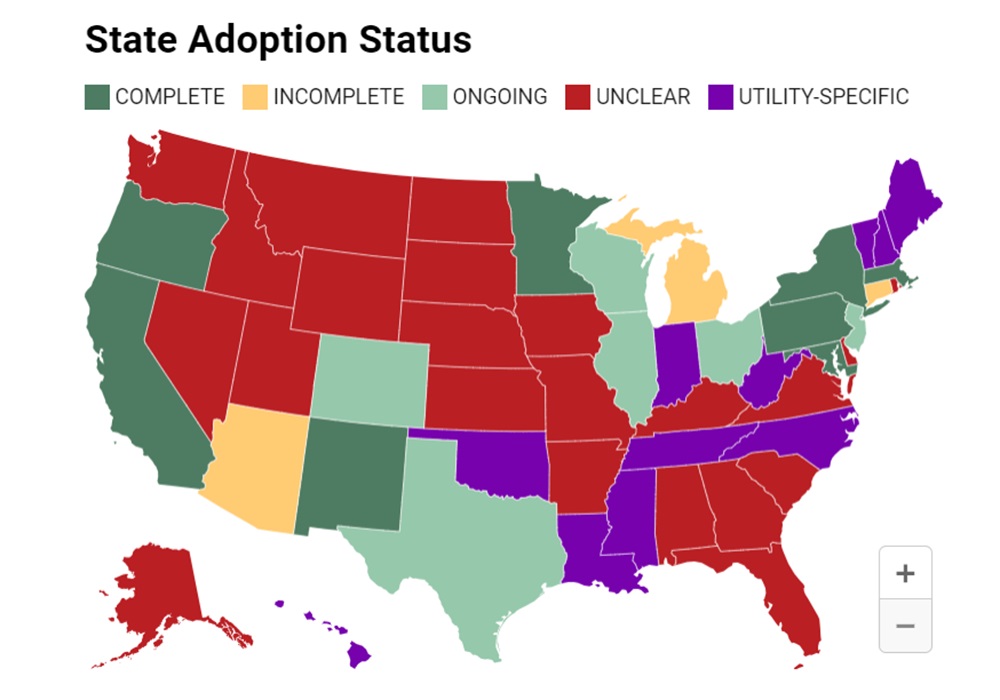
The Interstate Renewable Energy Council (IREC) has launched an initiative spreadsheet tracker and a map showing that eight states and select U.S. utilities now require smart inverters for new distributed solar and storage installations.

Installers working in those states and utilities must use inverters certified to meet the smart inverter standard known as IEEE 1547-2018. Inverters that meet the standard can do this regulate tension on a distribution circuit, and that capability makes it possible to install more solar on each circuit without grid-supplied voltage regulation hardware.

Pennsylvania and Minnesota adopted the smart inverter standard early this year, after Minnesota delayed its adoption based on the previously limited standard availability on the market of eligible inverters, an IREC spokesperson said.

Puerto Rico distribution company Luma adopted the standard this month; Puerto Rico last year led the nation in the amount of solar energy installed in homes per capita.

The ability of smart inverters to regulate voltage becomes increasingly important as the amount of distributed solar energy on a given circuit increases. For example, in Hawaii, which saw high levels of solar power on distribution circuits in 2021, a Sunrun executive said at the time that thanks to the smart inverter settings required by the utility HECO, which serves nearly the entire state, most customers “connect immediatelynew solar energy. California has had that too good luck with smart inverters, while Oregon adopted the standard this year and also made it easier for export-restricted distributed storage projects to obtain approval for interconnection.

Other states with smart inverter requirements do, according to the IREC adoption tracker New Mexico, Maryland and Massachusetts.

See also  Ecoprogetti supplies a 300 MW solar panel production line to the Indian SAEL – SPE

In New York, which imposed a statewide smart inverter requirement with varying deadlines for its utilities, several utilities have already adopted the standard.

Regulators in six other states are in the process of adopting smart inverter requirements: Colorado, Texas, Wisconsin, Illinois, Ohio and New Jersey.

In 11 other states, at least one utility has adopted the standard.

The tracker shows that grid operator PJM, which serves a region stretching from Chicago to New Jersey, has recommended an adoption date for smart inverters and inverter settings for the states and utilities in the region.

To compile the tracker, IREC examined the adoption status of smart inverters in every state and across more than 100 utilities. The tracker presents performance criteria or settings of the inverter specified by the various states and utilities. IREC plans to update the tracker every quarter.

Source link

distributed enabling Energy Inverters require smart solar SPE states
Share. Facebook Twitter Pinterest LinkedIn Tumblr Email
solarenergy
  • Website

Related Posts

BYD unveils EV batteries that can be charged in 10 minutes – SPE

March 6, 2026

Growth in solar and wind capacity slowed last year, analysis shows

March 6, 2026

Tigo introduces a 725 W optimizer for powerful solar panels

March 6, 2026
Leave A Reply Cancel Reply

Don't Miss
Technology

Unlocking the potential of radiant cooling for photovoltaic modules – SPE

By solarenergyNovember 19, 20240

Radiant cooling is an emerging technology that has the potential to improve the performance and…

Agrivoltaic energy for peppers

December 4, 2024

KAUST unveils details of 33.7% efficient perovskite-silicon tandem solar cell – SPE

August 12, 2024

Are thin-film panels the future for solar PV?

December 11, 2024
Stay In Touch
  • Facebook
  • Twitter
  • Pinterest
  • Instagram
  • YouTube
  • Vimeo
Our Picks

BYD unveils EV batteries that can be charged in 10 minutes – SPE

March 6, 2026

Growth in solar and wind capacity slowed last year, analysis shows

March 6, 2026

Tigo introduces a 725 W optimizer for powerful solar panels

March 6, 2026

Fox ESS, SMA, SAX Power, Kostal and BYD impress with high efficiency – SPE

March 6, 2026
Our Picks

BYD unveils EV batteries that can be charged in 10 minutes – SPE

March 6, 2026

Growth in solar and wind capacity slowed last year, analysis shows

March 6, 2026

Tigo introduces a 725 W optimizer for powerful solar panels

March 6, 2026
About
About

Stay updated with the latest in solar energy. Discover innovations, trends, policies, and market insights driving the future of sustainable power worldwide.

Subscribe to Updates

Get the latest creative news and updates about Solar industry directly in your inbox!

Facebook X (Twitter) Instagram Pinterest
  • Contact
  • Privacy Policy
  • Terms & Conditions
© 2026 Tsolarenergynews.co - All rights reserved.

Type above and press Enter to search. Press Esc to cancel.