

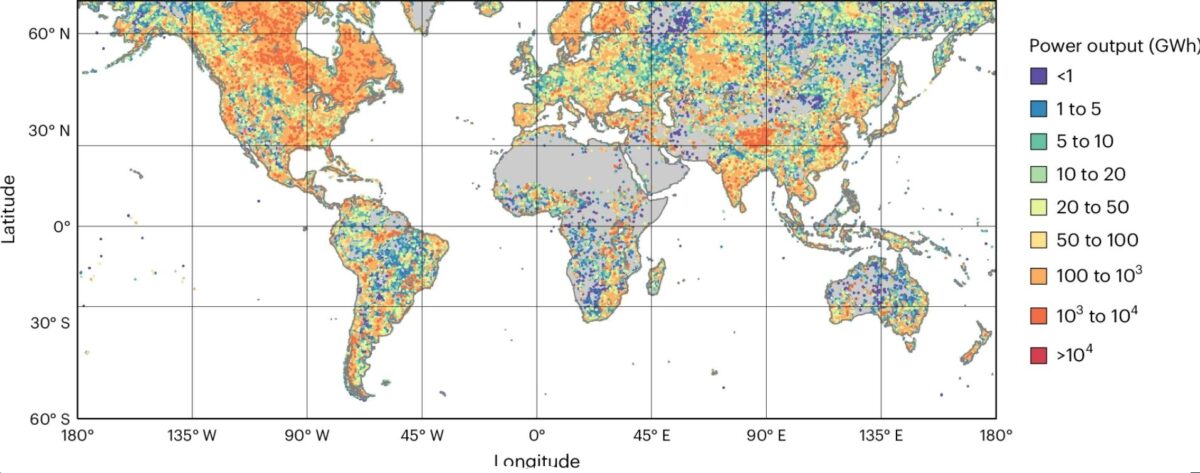
A British-based research team has calculated the global potential of deploying floating solar panels on almost 68,000 lakes and reservoirs. It turned out that some countries were able to generate most of their electricity needs with floating solar panels, while five countries were able to meet all their electricity demand.
Some countries could meet their entire electricity needs with floating solar panels, according to new research.
The research team, including researchers from Bangor and Lancaster Universities and the UK Center for Ecology & Hydrology, calculated the daily electrical output of floating solar photovoltaics on nearly 68,000 lakes and reservoirs around the world, using available climate data for each location.
Their data includes lakes and reservoirs where floating solar technology is most likely to be installed. All included sites were no further than 10 km from a population center, were not in a protected area, did not dry out, and did not freeze for more than six months per year. The researchers calculated the output based on a floating array that covers 10% of the selected area, up to a maximum of 30 km2.
The potential annual electricity generation from floating solar photovoltaics in the 67,893 water bodies was 1,302 TWh, equivalent to approximately four times the UK’s total annual electricity demand. The figure of 1,302 TWh represents a conservative surface coverage of 10%, while the total theoretical potential was estimated at 14,906 TWh, which quantifies the energy generation potential of floating solar photovoltaics on more than 1 million water bodies worldwide.
Although production in the analyzed areas fluctuated depending on altitude, latitude and season, five countries – Benin, Ethiopia, Kiribati, Rwanda and Papua New Guinea – were found to have the potential to meet their entire electricity needs using of floating photovoltaic solar energy. Other countries could come close, such as Bolivia and Tonga, which could meet 87% to 92% of their electricity demand.
Many countries, mainly from Africa, the Caribbean, South America and Central Asia, could meet between 40% and 70% of their annual electricity demand through floating solar photovoltaics. The average for all countries was 16%. The highest scoring European countries were Finland, with 17% of electricity demand, and Sweden and Denmark, with 16%.
“Even with the criteria we have set to create a realistic scenario for the deployment of floating solar photovoltaics, there are benefits to be achieved across the board, especially in countries with lower incomes and high levels of sunshine, but also in Northern European countries,” said lead author. Iestyn Woolway. “The criteria we chose were based on clear exclusions, such as lakes in protected areas, but also on what could reduce the costs and risks of deployment.”
The researchers do warn that further research is needed into the overall environmental impact of floating solar energy. They suggest that decisions to deploy arrays should take into account the intended function of water bodies and the way they are used, as well as the potential ecological impact. “We still don’t know exactly how floating panels might affect the ecosystem within a natural lake, under different conditions and in different locations,” Woolway added. “But the potential gain in energy generation from floating solar photovoltaics is clear, so we need to establish that research so that this technology can be applied safely.”
Their findings are available in the research paper “Decarbonization potential of floating solar photovoltaics on lakes worldwide,” published in natural water.
Last year, an international team of researchers assessed the potential of deploying floating solar energy in almost 115,000 reservoirs worldwide and found that this could reach 9,400 TWh.
This content is copyrighted and may not be reused. If you would like to collaborate with us and reuse some of our content, please contact: editors@pv-magazine.com.
