

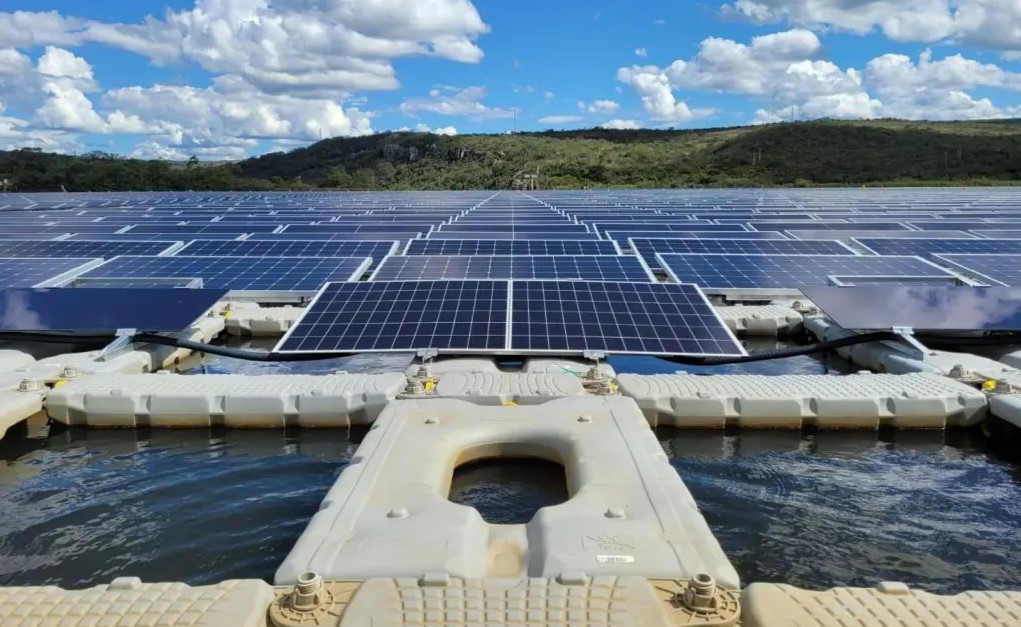
The Itaipu hydropower plant could nearly double its generating capacity if a large floating solar power plant were installed covering just 10% of the 1,350 square kilometer reservoir area, according to an estimate by energy consultancy and analysis firm PSR. . The installation of floating PV could be an alternative to repowering power plants, although this comes with legal and operational limitations.
The installation of floating solar power plants in reservoirs could be an opportunity to increase the efficiency and use of hydroelectric power plant infrastructure already in use as an alternative to repowering power plants, according to a report by consulting and energy analysis company PSR.
With the growing participation of solar and wind sources in the Brazilian electricity matrix, hydropower – which is still the main generation source in the country, with approximately 50% of the installed capacity (103 GW of large hydropower plants and 5.8 GW of SHPs) will ) — provides stability for system operation.
Many of the hydropower plants installed in Brazil are more than 40 years old: 44 GW were in operation at the end of 1984, according to data from Aneel’s Generation Information System, and 59 GW in 1994. There is therefore great potential for modernization or even existing turbines to replace. A 2019 study by Empresa de Pesquisa Energética estimated the technical possibility of 11 GW of additional installed capacity without the need to expand hydropower by re-powering plants, taking into account eligible plants already operating more than 25 years in operation.
In the May edition of its Monthly Energy Report, the consultancy PSR proposes to compare these repowering options with the installation of floating solar power plants on hydroelectric reservoirs, noting that both options face limitations and challenges.
Estimating floating solar potential on reservoirs
The Itaipu Hydroelectric Power Plant alone, which came into operation in 1984, could almost double its generating capacity by installing a floating solar power plant on 10% of the area of the reservoir, which is 1,350 square kilometers in size, according to the estimate released by PSR. The capacity of the floating system would be 13,500 MW in this ratio; the hydroelectric power station has an installed capacity of 14,000 MW.
The estimate takes into account 1.4 MWp direct current from the floating solar panels per hectare of habitable surface, or 1 MW alternating current per hectare, after transformation by inverters.
Another example mentioned in the Energy Report is the case of the Furnas hydroelectric power station. The consultancy integrated public data from ONS into its Hydroelectric Performance Scorecard and found that since 2006, when the scorecard was launched, the plant’s average annual energy has never reached its maximum level. physical energy guarantee, also called fixed energy (guarantee física).
According to ONS data, the plant’s average production since 1999 is 488 megawatts (aMW), around 16% less than fixed energy production. For the plant to achieve an average efficiency of 15% above the energy guarantee, an additional 180 aMW would be needed. PSR estimated that it would be necessary to install approximately 1 GW of floating solar to achieve this result, which would cover an area of 10 square kilometers or 0.7% of Lake Furnas, considering a ratio of 5 .5 between the floating solar system power ( MWac) and the average output (aMW).
Challenges of solar-hydro hybridization
This estimate considers that floating solar would offset low hydropower production due to low rainfall or other uses of water resources, such as irrigation. However, the challenges of water unavailability are less common, while hydropower plants face a lack of demand, for example caused by the priority given to the deployment of solar and wind energy over hydropower.
In other words, it would still be necessary to study the real-time operation of the hybrid power plant, taking into account its hourly operation, to know how the transmission network is used, the value of the energy that may not be generated (containment), the consequences for, among other things, the operation of the factory.
In addition, PSR points out that the hybridization of hydropower plants violates the restrictions imposed by Resolution 954/2021 of the Brazilian Electricity Regulator (ANEEL), which allows the installation of solar energy in reservoirs but segments and limits the possible limitations. gains in solid energy and incentives for the installation of floating technology in factories.
According to the consultancy firm, it makes little sense to limit the combination of energy between sources.
Hybridization with solar energy is also seen as an opportunity in the wind sector, with major players such as Casa dos Ventos and Statkraft betting on the combination.
Irrigation canals
Floating solar energy can also benefit water bodies other than hydroelectric reservoirs. Some countries are installing solar power plants in irrigation canals to reduce losses in drier and hotter areas. Energy Report notes that although ground-mounted solar systems are cheaper than systems installed on irrigation canals, a study by researchers at the University of California indicated that canal-based projects would have a better financial outcome, taking into account the water savings and increasing electricity production. and reducing land costs.
PSR suggests that the recent decline in technology costs would warrant a reassessment of the possibility of installing solar systems on irrigation canals in the Northeast or even on the major infrastructure of canals and reservoirs that are part of the São Francisco River Integration Project (PISF).
This content is copyrighted and may not be reused. If you would like to collaborate with us and reuse some of our content, please contact: editors@pv-magazine.com.
