

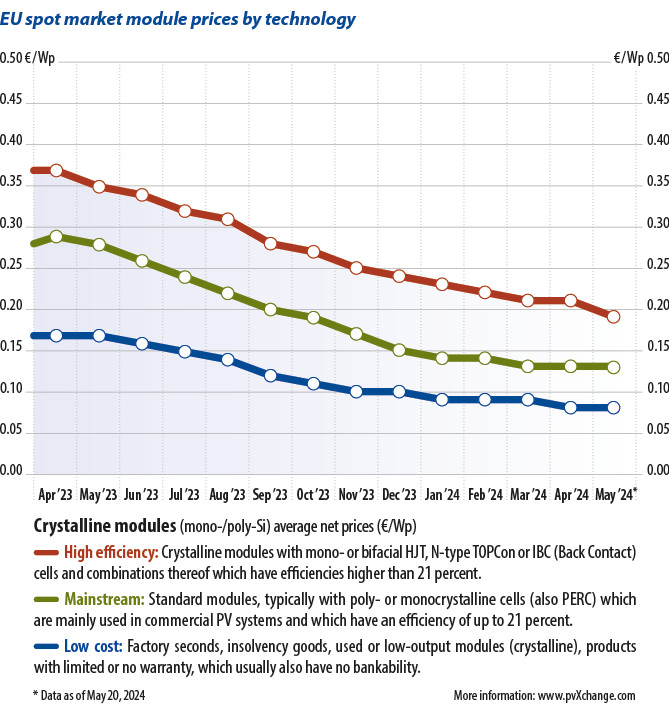
In May 2024, high-efficiency panels, mainly glass-glass modules equipped with tunnel oxide passivated contact cells (TOPCon), started to converge in price with the mainstream offering, writes Martin Schachinger of pvXchange. Production volumes for these negatively doped ‘n-type’ cells and modules have ramped up in China, while the increasingly restrictive customs situation in the United States may already be having an impact. For the European market, increasingly lower prices for the latest module technology would indicate that demand would continue to rise without a number of disruptive factors.
In Europe, large stocks of modules will still be produced in 2023, or sooner by distributors and installers themselves. If these are the smaller sizes commonly used for roof systems in Germany, they sell poorly due to the low power ratings. Building owners typically want high wattage and the latest technology installed in their systems, which makes it much more difficult to sell existing inventory.
Despite the supposed reduction in module production and European import volumes, it appears that more Asian panels are still reaching the European market than is currently in demand. This in turn causes inventories to increase even in the higher performance classes, putting additional pressure on module prices, especially on old modules that were produced and purchased at significantly higher prices.
The ability to devalue old inventory varies widely from company to company, resulting in vastly different prices for modules with passivated emitter back contact (PERC) cell technology. The overall price differences between model categories are becoming smaller.
Shelf heaters
It is very difficult to get rid of these older modules in markets outside Europe without accepting a huge loss in value. Africa and Southeast Asia are also likely to be oversaturated with modules, and Chinese-made products cannot easily be sold in the US market. One strategy that is becoming increasingly established is to enable concessions in the soft factors of the trade sector. There may be some wiggle room in the payment and delivery terms. Instead of offering the modules at a lower price, a line of credit is provided – often without requiring collateral – and delivery can be offered free of charge. That said, it’s doubtful this tactic will work in the long run. Many smaller companies are on the brink of insolvency and the possibility of bankruptcies cannot be ruled out. The pressure to sell should therefore not outweigh common sense and not tempt providers to take incalculable risks.
Some suppliers are also trying to turn to online marketplaces, where they hope to quickly sell to international customers without incurring sales and marketing costs. However, the competitive pressure is also great there and the goods can often only be sold at dumping prices.
Online business models pose even more risks. They rarely offer solid opportunities to get to know the potential business partner in advance; sellers just take what they can get. Misunderstandings can arise in business transactions, especially across national borders, and the platform operator is not always available for support and advice. The effort involved in an online transaction can quickly become greater than buying or selling within an established business relationship. Everything can go smoothly, but that doesn’t necessarily mean it will.
| Module class | €/Wp | Trend since April 2024 | Trend since January 2024 | Description |
|---|---|---|---|---|
| Crystalline modules | ||||
| High efficiency | 0.19 | -9.5% | -17.4% | Crystalline panels of 340 Wp and higher, with PERC, heterojunction, n-type, or return contact cells, or combinations thereof |
| Mainstream | 0.13 | 0.0% | -7.1% | Modules with typically 60 cells, standard aluminum frames, white back plates and 275 Wp to 335 Wp |
| Cheap | 0.08 | 0.0% | -11.1% | Factory seconds, insolvency goods, used or low efficiency modules and products with limited or no warranty |
Notes: Only duty-free prices for PV modules are shown, with prices quoted reflecting average prices on the European spot market. Source: pvXchange.com
Sales of projects
One way to put surplus old solar panels to good use is to install them in larger open space projects or on roof systems. Smaller sizes may not be a bad choice in areas with higher wind or snow loads. Although the material and installation costs increase slightly, the easier operation during installation compensates for this disadvantage. There is another undeniable advantage: the modules are already in stock. This guaranteed availability means that no delivery problems can arise and therefore no delays in the construction process. Add to that a few unsold inverters and cable reels and the components are there for a working PV system.
Once a system is installed and connected to the electricity grid, no one cares whether the solar panels are of the latest generation or not. The resulting asset can then be marketed better than the 400 W PERC modules in the current market situation. For companies that are not yet well equipped for project sales, this can also be done via an online broker portal.
About the author: Martin Schachinger has a degree in electrical engineering and has been active in PV and other renewable energy sources for almost 30 years. In 2004, he founded the online trading platform pvXchange.com, which allows wholesalers, installers and service companies to purchase solar panels, standard components and inverters that are no longer produced, but may be urgently needed to repair defective PV installations.
The views and opinions expressed in this article are those of the author and do not necessarily reflect those of the author pv magazine.
This content is copyrighted and may not be reused. If you would like to collaborate with us and reuse some of our content, please contact: editors@pv-magazine.com.
