

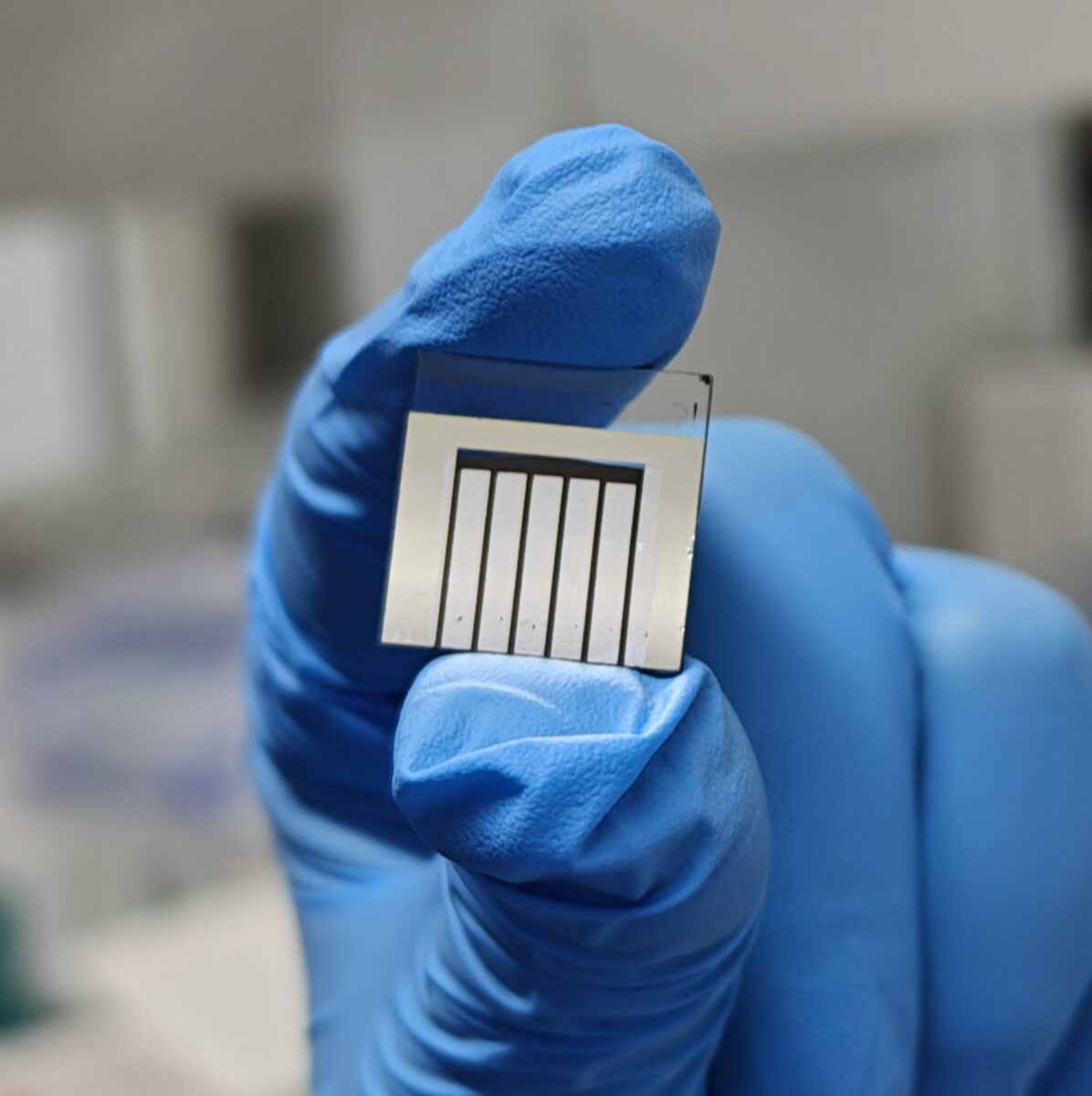
Researchers in China have built an inverted perovskite solar cell for the first time, based on a high-entropy hybrid perovskite material. The result is a device with improved open-circuit voltage and fill factor, thanks to reduced non-radiative recombinations and an optimized interface.
Researchers from Zhejiang University in China have developed for the first time an inverted perovskite solar cell based on a high-entropy hybrid perovskite material that reportedly improves device stability while offering excellent efficiency levels.
“Our work highlights the potential of a type of high-entropy structure, namely high-entropy hybrid perovskite (HEHP), in improving the efficiency and stability of perovskite solar cells,” said the study’s corresponding author, Jingjing Sue. pv magazine. “This interesting structure is characterized by highly disordered organic moieties to induce the entropy gain, and exhibits superior thermal stability and structural robustness over its single-component ordered counterparts. Given the rich chemistry of the organic moieties, we hope that this discovery can provide further opportunities to refine the properties of perovskites and other related materials.”
The research team explained that the new material has a multi-component perovskite structure, which ensures superior phase stability at high temperatures compared to conventional perovskites. The coexistence of multiple organic cations in the proposed material was confirmed by nuclear magnetic resonance (NMR) spectroscopy.
“The HEHP single crystal showed an ensemble of characteristic peaks of all constituent organic cations, which corresponded well with that of the equimolar mixture of all five organic cations,” the scientists said. “This single crystal could be better described as a hybrid structure composed of ordered inorganic frameworks and disordered organic interlayers.”
Using the HEHP, the researchers built a perovskite film that reportedly exhibits superior water and moisture-heat resistance. With this film, they then constructed a perovskite solar cell with a conventional architecture based on an indium tin oxide (ITO) substrate, a tin oxide (SnO2) electron transport layer (ETL), the perovskite absorber, a hole transport layer based on Spiro-OMeTAD, and a silver (Ag) metal contact. Performance was compared to a reference device with a similar perovskite film without the HEHP.
Tested under standard lighting conditions, the HEHP-based device achieved a power conversion efficiency of 25.7%, an open-circuit voltage of 1.17 V, a short-circuit current density of 25.8 mA cm2 and a fill factor of 85.2%. The reference device achieved an efficiency of 23.2%, an open-circuit voltage of 1.13 V, a short-circuit current density of 25.1 mA cm2 and a fill factor of 81.7%.
The HEHP-based cell was found to be able to retain more than 98% of its original efficiency even after 1000 hours.
Popular content
“We attributed the improvement in open-circuit voltage and fill factor to reduced non-radiative recombinations and an improved interface after the incorporation of HEHP,” the academics explained. “The superiority of HEHP over a single component in reducing electronic disturbances can be attributed to the coexistence of multiple types of A-site cations that can synergistically interact with different defects.”
The team is confident that the new perovskite material can be used in various perovskite compositions and cell architectures. “It can serve as a highly universal and fault-tolerant strategy to improve the performance of perovskite solar cells under different scenarios, which is crucial to improve the production yield of perovskite devices in future industrial mass production,” the report concluded.
The details about the new cell concept can be found in the study “High-entropy hybrid perovskites with disordered organic moieties for perovskite solar cells,” published in nature photonics.
This content is copyrighted and may not be reused. If you would like to collaborate with us and reuse some of our content, please contact: editors@pv-magazine.com.
