

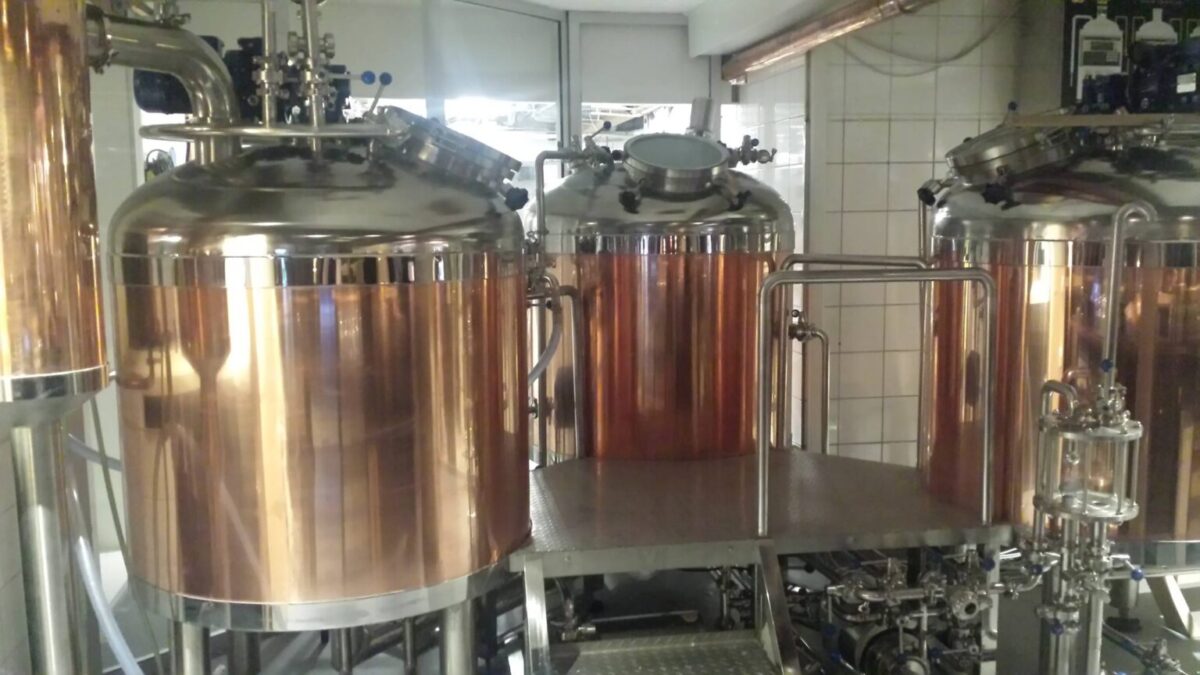
Researchers in Spain have explored the potential of using photovoltaic (PV) or photovoltaic-thermal (PVT) systems in microbreweries and have found that PVT systems can meet higher energy demands but have a longer payback period.
Researchers from the Spanish Andalusian Association for Research and Industrial Cooperation (AICIA) have investigated the potential use of photovoltaic-thermal (PVT) energy for beer brewing. Specifically, they looked at the use of PV systems in microbreweries, defined as breweries with an annual production of less than 5,000 hectoliters (hl).
“A PVT system has the potential to preheat brewing water and generate electricity,” the researchers explain. “Given the brewing process’s need for low-temperature heat and cold, a solar-supported multi-generation system appears to be suitable. Microbreweries generally do not have steam boilers and often rely on gas burners or electrical resistances for heat supply. In addition, small vapor compression chillers are common for cold production.”
For their study, the researcher constructed computer simulations using TRNSYS software, using actual heat and cold load profiles from a Spanish microbrewery in Jerez de la Frontera, southern Spain. It is believed that the brewery can produce 650 liters of beer in batches three times a week, which equates to an annual production of approximately 1,000 hl.
“The main energy-related components of the brewery include heat resistors (2 x 10 kW); an air-water cooler 7.5 kW, a chilled water tank 1.3 m3; and an air conditioner heat pump (ACHP), 3.5/3.2 kW (heat/cold),” the scientists specified.
Various scenarios have been created to deal with the electrical and heat loads. First, the simulation was performed with different panels. 350 W PV modules, 390 W unglazed PVT panels or 260 W glazed PVT modules were used. For each of them, three system sizes were considered: 3.9 kW, 10 kW and 15 kW. They were tested against the climatic conditions of Malaga and Madrid, Spain, and Stuttgart, Germany, together with the relevant economic metrics.
“Furthermore, two configurations of the PVT-plus-thermal storage were analyzed,” the academics said. “The first assumes that the storage tank has an internal coil where the liquid flows to/from the solar field. The working fluid in the storage tank is treated water, as it is an ingredient of the beer, at the temperature of the pipe network. The second configuration assumes that the working fluid in the tank is the same as that of the solar circuit (water), and through the internal coil flows the treated water that is used later in the process.”
The simulation showed that the PV system could cover between 6.9% and 28.2% of the electricity production in the 4 kW plant in Stuttgart and 28.2% in the 15 kW microbrewery in Malaga. For the PVT systems, the range was 12.4% to 27.1% in Malaga, 10.4% to 23.9% in Madrid and 5.8% to 16.9% in Stuttgart.
“If we consider only the thermal contribution of the PVT systems for the heat demand before cooking, between 12% and 47.6% can be covered with the PVT in Malaga, between 11.3% and 42.4% in Madrid , and between 4.9% and 27.6%. % in Stuttgart,” the scientists added.
Popular content
“The payback period for all PV systems, regardless of location, is approximately 4 to 6 years,” they concluded. “Despite Spain having higher solar radiation, in this study the costs of conventional energy being lower than in Germany offset the economic analysis. The payback period for PVT systems varies from 13 to more than 25 years.”
Their findings were presented in “PVT potential for a small-scale brewing process: a case study,” published in Advances in thermal science and engineering. Scientists from the Spanish Andalusian Association for Research and Industrial Cooperation (AICIA) and the University of Seville carried out the research.
The same research group recently investigated the use of solar energy to improve energy efficiency in two microbreweries in Andalusia, Spain. Their techno-economic analysis found that solar energy can help reduce the levelized cost of heat and cold (LCOH) of a microbrewery in Spain by up to 29.7%, ranging from €0.285/kWh to €0.332/kWh.
This content is copyrighted and may not be reused. If you would like to collaborate with us and reuse some of our content, please contact: editors@pv-magazine.com.
