

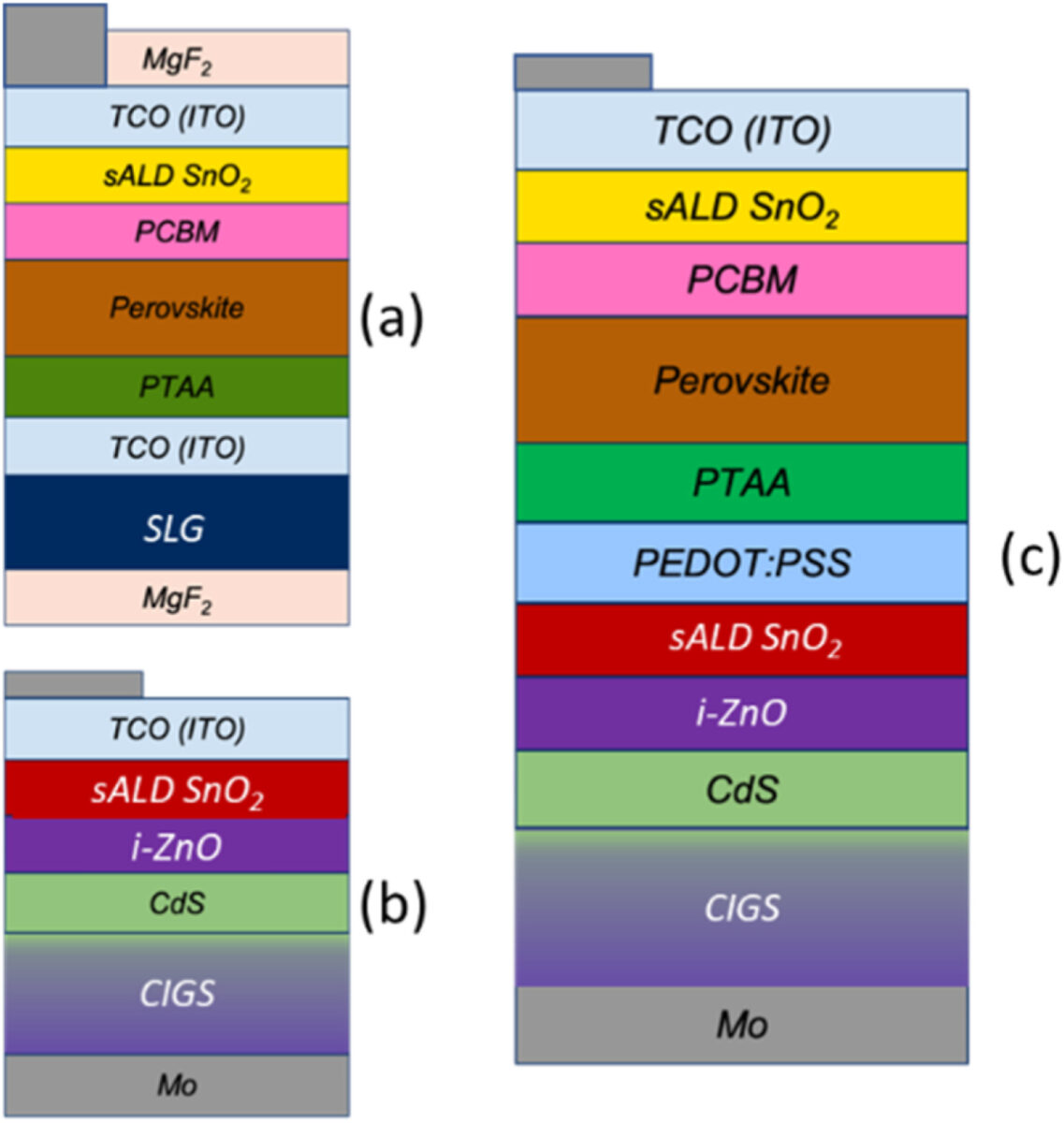
A Dutch and American research team performed optical and electrical simulations to understand loss mechanisms in two terminal (2T) tandem cells based on perovskite and commercially available copper-indium-gallium-selenide (CIGS) cells, and then established a roadmap to increase efficiency through four key changes.
A research team led by Delft University of Technology in the Netherlands has outlined a roadmap for the optimization of monolithic perovskite/CIGS tandem solar cells and found that these PV devices can reach a practical efficiency limit of 26.69%.
Using TCAD Sentaurus and GenPro4 modeling software, the scientists performed optical and electrical simulations of the materials and interfaces used in this type of tandem solar cells to better understand loss mechanisms and define a series of measures to improve efficiency.
The results were then calibrated by comparing simulated devices with three experimental devices: a tandem perovskite/CIGS solar cell; a single junction perovskite solar cell; and a CIGS single-junction solar cell supplied by Miasolé.
“The simulation platform is typically used in semiconductor research and development, but also in thin-film and PV research. The CIGS subcell was based on an advanced industrial device,” says researcher Paul Procel-Moya from the University of Delft. pv magazine.
The team noted that its work in this area differs from other numerical studies because its focus is on the fundamental mechanisms of action of the layers that include the tunnel recombination transition (TRJ) and coupling-related loss calculations.
The study involved investigating the energy alignment in TRJ layers to reveal the impact on external parameters of the baseline tandem solar cell, the exchange mechanisms between upper and lower cells, and the impact on the overall performance of the tandem system.
“Based on the key results, we propose a realistic roadmap for tandem solar cell improvement,” says Procel-Moya, pointing to a four-pronged strategy for improved performance. “We discovered in the simulation that the first phase should be tuning the coupling tunnel connection between the two cells. It is the first bottleneck.”
The first phase is to improve and optimize the energy alignment at TRJ, while the second is to improve light management by minimizing the current mismatch between the subcells and reducing reflection losses by, for example, adjusting the perovskite and metallization thickness. The third step is to improve the transport to the tin oxide transport layer of the upper cell. This step alone resulted in an estimated efficiency increase from 24.37% to 25.13%, according to the study. The fourth change is to improve passivation in the upper subcell.
Based on such adjustments, the researchers calculated that the reference tandem cell could achieve an efficiency of 26.69%. The team said it expects further “improvements in conversion efficiency are possible” by improving areas of the bottom cell, such as the absorber bandgap energy and the interface passivation of CIGS and molybdenum layers.
Feedback Procel-Moya received from other researchers currently conducting laboratory-scale experiments confirmed that the TRJ focus was good advice. Looking ahead, the team will continue to research the physics of semiconductors, PV and thin films, with an emphasis on stability, studying reverse bias at a theoretical level, according to Procel-Moya.
The research appears in “Optoelectric Modeling and Roadmap for 2T Monolithic Perovskite/CIGS Tandem Solar Cells,” published by Solar energy materials and solar cells. The team members came from Dutch institutions, the Delft University of Technology, the University of Twente, the Eindhoven University of Technology, the Netherlands Organization for Applied Scientific Research (TNO) and the American MiaSole Hi-Tech Corp.
This content is copyrighted and may not be reused. If you would like to collaborate with us and reuse some of our content, please contact: editors@pv-magazine.com.
