

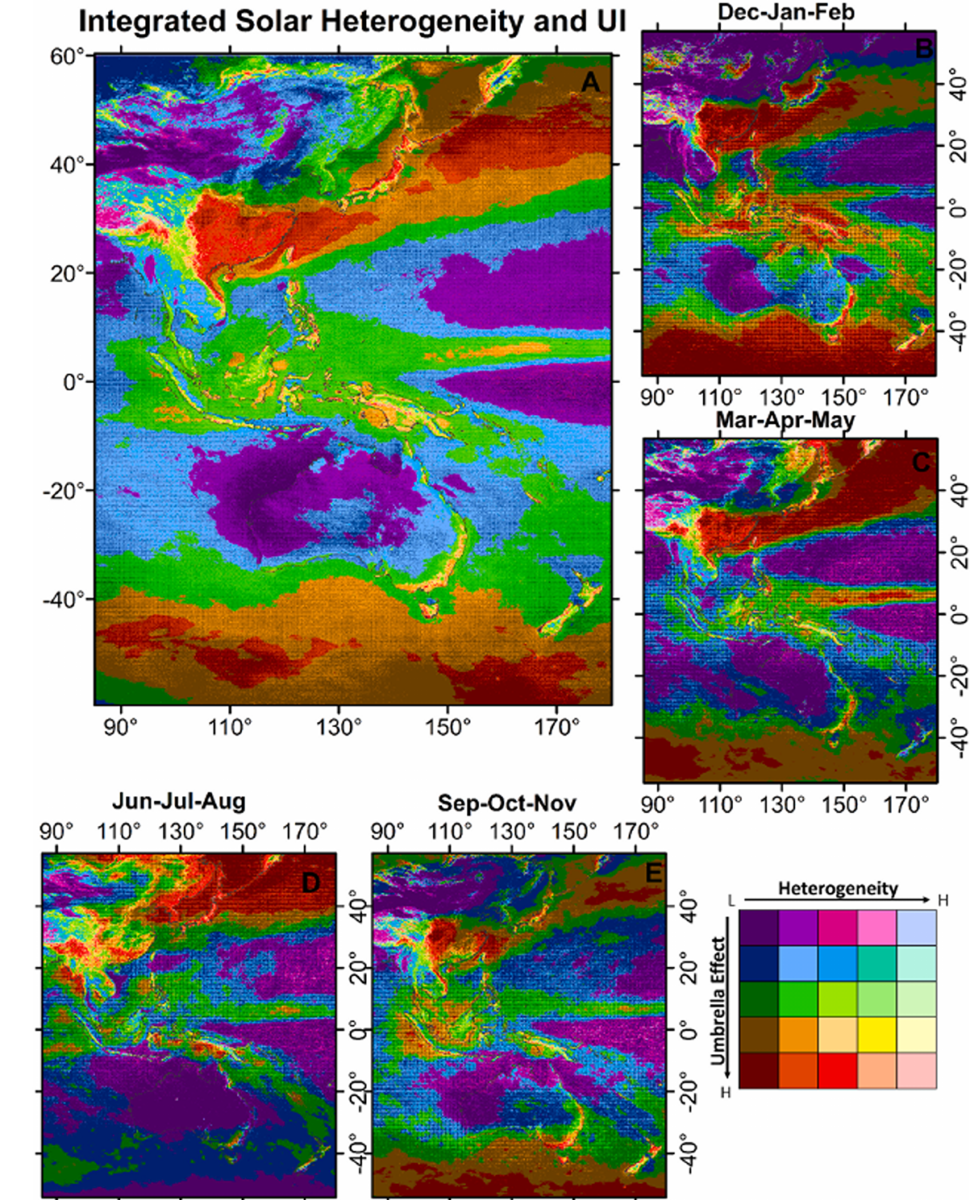
A research team from Japan and Indonesia used satellite data to investigate fluctuations in solar radiation in the Asia-Pacific region and draw conclusions about which areas are most suitable for future installations.
Researchers from Japan’s Chiba University and Indonesia’s Institut Teknologi Bandung have used solar radiation data to understand the best location for future solar power plants in the Asia-Pacific region.
The research article “Solar irradiance variability around Asia-Pacific: Spatial and temporal perspective for active solar energy utilization”, published in the July edition of Solar energy, investigates the variability of solar radiation in terms of spatial and temporal heterogeneity.
The study used solar radiation data from the Japanese geostationary satellites Himawari-8 and Himawari-9 and Amaterasss, a tool that estimates solar radiation using an ultra-fast calculation method with neural networks based on a radiative transfer model. The data obtained covered 2022 within 10-minute intervals, with a spatial resolution of 0.04 degrees, or approximately 4 km. The researchers also used a digital surface model to understand the variation in solar radiation at different altitudes.
Professor Hideaki Takenaka, the study leader, said the assessments based on spatiotemporal data “revealed features that would have been impossible to achieve using a traditional approach that relies on simple long-term averages or a typical meteorological year as typical data on the solar radiation. ”
Each region was divided into 0.2 degrees x 0.2 degrees or approximately 20 km x 20 km to determine its heterogeneity. Solar radiation heterogeneity in the Asia-Pacific was calculated to be approximately 0 to 135 W/m2.
The paper explains that solar heterogeneity showed seasonal variability, but locations near the equator experienced less fluctuations in solar radiation over time compared to areas at higher latitudes, largely due to the effects of rain and cloud activity . Meanwhile, locations with higher altitudes had greater heterogeneity due to high cloud activity, while the ocean recorded the smallest heterogeneity.
The paper also calculated the probability of an umbrella effect caused by clouds, known as the umbrella effect index, to be around 0 to 0.34 over the entire year. The researchers observed a higher umbrella index at high latitude locations in summer than in winter. A significant seasonal change was noted on the Tibetan Plateau, a vast, elevated plateau at the crossroads of eight Central, South and East Asian countries. This area had the lowest umbrella index compared to other seasons from July to August.
Given both the heterogeneity and the overarching effect index, the researchers were able to advise on where future solar panels would be well suited. “An excellent location for installing a solar power plant has low heterogeneity and overall effect time,” the research paper says. “Under these conditions, solar radiation in the region has a very high potential all year round due to low cloud cover. In the target area, 5.76% have these conditions. Based on the results, these conditions are found in the high-altitude desert and coastal areas.”
The scientists also found that 4.43% of the studied area has low heterogeneity values but high umbrella effect, and is therefore most unsuitable for solar installations.
The researchers also assessed the performance of more than 1,900 existing solar power plants using annual and seasonal data. This analysis showed that most existing solar power plants are located in very low overall time indices in areas with low solar heterogeneity. Such sites account for 39.17% of the total studied area. However, a significant portion of the existing plants did not appear to perform optimally from June to August, due to the umbrella effect caused by clouds. The researchers recommended that these zones not be completely dependent on solar energy to meet the increased demand during these months.
In a discussion of the most optimal format for future solar power plants, the research paper concludes that more widely distributed solar energy generation is superior to more localized efforts and highlights rooftop solar as a key way to increase energy efficiency. to achieve stability of the solar energy supply. the grid.
“Based on the spatial and temporal characteristics of solar radiation, we suggest that it should be possible to suppress rapid fluctuations in solar energy production by spreading small photovoltaic systems over a large area rather than relying on large solar power plants,” Takenaka said. “It is worth noting that these conclusions come from weather and climate research, and not from an engineering perspective.”
This content is copyrighted and may not be reused. If you would like to collaborate with us and reuse some of our content, please contact: editors@pv-magazine.com.
