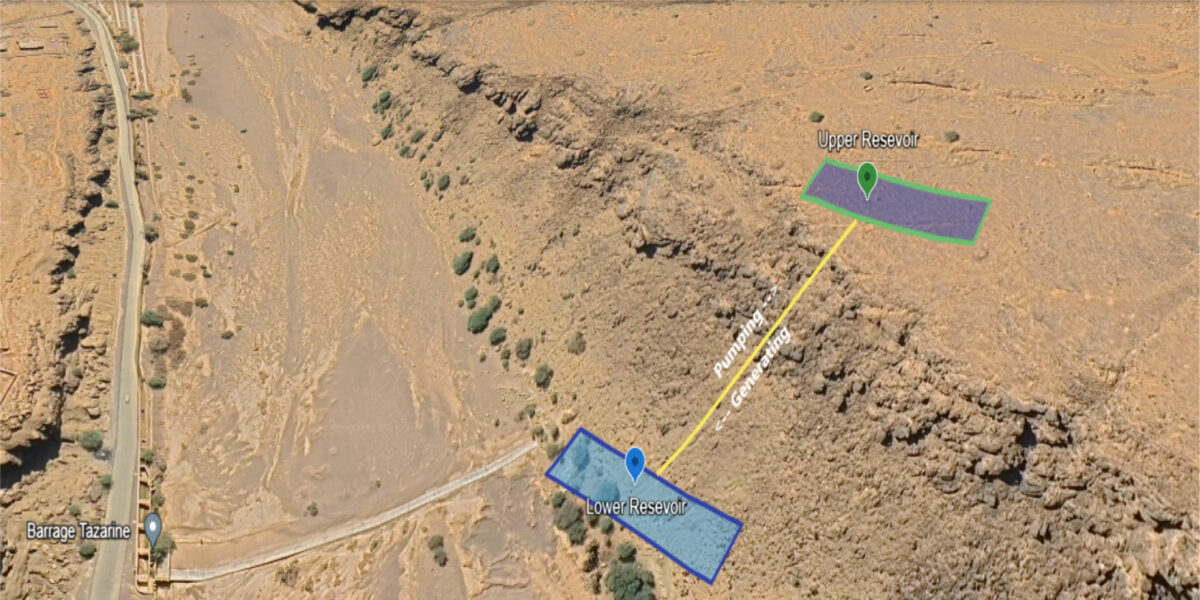
Researchers from Morocco’s Rabat School of Mines have proposed building a hybrid PV and wind power plant using pumped hydro storage (PHS) in the eastern province of Zagorap. Their proposal is based on a simulation study that optimized the system size in economic and technical terms.
“We proposed this technology because the owners of the area do not benefit much from the seasonal groundwater flowing through the valley, despite the presence of a dam,” the group said. “Accordingly, we will exploit this water to generate energy and achieve energy self-sufficiency. By harnessing this underutilized resource, we aim to provide sustainable energy solutions and drive economic and social progress in the region.”
The system simulation was carried out through the HOMER software and focused on the energy needs of three tribes in Tazarine village, namely Ait-Rebaa, Ait-Imnasef and Ait-Baha, with 90 small houses, 30 large houses and six mosques. , a village office and two schools. In total, the average energy demand there is 1,050.92 kWh per day.
The village was found to have solar radiation of 188.67 kWh/m2, at its lowest in November and highest in March at 228.37 kWh/m2. The average temperature throughout the year is 20.82 C and the wind speed averages 5.02 m/s. The clearance index is lowest in June and July, when it scored 0.63, and highest in December, at 1.15.
“The software of this hybrid system optimized each scenario generated by the different micro-grid configurations to meet the village’s demand at the lowest possible energy costs,” the academics said. “The results of the HOMER simulation and optimization procedures indicate that of the four scenarios, the system configurations were ranked from the most to the least economically profitable. The hybrid energy systems are classified as 1-PV/Wind/PHS, 2-PV/Wind, 3-PV/PHS and 4-PV.”
Image: Ecole nationale supérieure des mines de Rabat,Cleaner Energy Systems, CC BY 4.0
Each scenario combined different sizes of PV panels, wind turbines and PHS units. The solar panels were assumed to be monocrystalline panels of 350 W, with an efficiency of 18.04%, installed at a slope of 31 degrees. Each wind turbine was rated at 25 kW, and the PHS units were assumed to have a capacity of 245 kWh. This system could also import or export electricity from the grid and had a 20 kW power converter.
While in scenario 1-PV/Wind/PHS the system includes 101 kW of PV, four wind turbines and one PHS unit, scenario 2-PV/Wind has 244 kW of PV, four wind turbines and no storage. In the case of 3-PV/PHS, the system has a PV of 207 kW, no wind turbines, but three units of PHS. The 4-PV scenario includes only 1,478 kW of PV, without wind turbines or storage.
The analysis showed that in the first scenario the system could achieve the lowest levelized cost of energy (LCOE) of $0.03831/kWh, while the second, third and fourth scenarios would reach $0.058/kWh, $0.130/kWh and $0.289/kWh respectively . .
“In terms of Net Present Cost (NPC), the first scenario emerges as the optimal choice, with an NPC being approximately $262,596.2. The second scenario follows closely, with an average NPC of approximately $408,232.00. While the third scenario leaves you with an average NPC of approximately $648,911.00. The fourth scenario stands out with a significant NPC, which amounts to approximately $1.47 million,” the researchers said.
The operations and maintenance (O&M) costs for scenarios 1 through 4 were found to be $3,064, $4,448, $18,391, and $26,817, respectively. The capital costs were found to be $212,393, $329,647, $398,361 and $1.08 million respectively. “Operation and maintenance costs are also minimized, while the system achieves an impressive 86% efficiency in energy consumption versus production,” the team added.
“In scenario 1, the combined energy generation, excess production and electricity consumption are 613,145 kWh/year, 67,781 kWh/year and 530,193 kWh/year respectively,” it further explains. “Scenario 2 follows with approximately 883,247 kWh/year, 323,454 kWh/year and 548,557 kWh/year. Building on scenario 3, the values are 503,794 kWh/year, 77,549 kWh/year and 3,387,112 kWh/year. Finally, scenario 4 records a total of 2,859.21 kWh/year, 2,460,626 kWh/year and 393,016 kWh/year, depending on the pricing model.”
The scientists presented their findings in the article “Optimization and design to catalyze sustainable energy in Morocco’s Eastern Sahara: a PV/Wind/PHS hybrid energy system for rural electrification”, published in Cleaner energy systems.
This content is copyrighted and may not be reused. If you would like to collaborate with us and reuse some of our content, please contact: editors@pv-magazine.com.
Popular content