

Researchers in Austria have developed a new predictive control algorithm that can reportedly improve comfort levels in homes equipped with heat pumps. The algorithm also enables price predictions based on analysis of day-ahead electricity prices.
Researchers from the Austrian University of Natural Resources and Life Sciences in Vienna have presented a new, low-tech model-predictive control (MPC) algorithm for the grid-friendly operation of heat pumps. It is based on an algorithm introduced last year that was aimed at optimizing thermal comfort. In the meantime, the group has improved the algorithm to also take into account day-ahead electricity prices.
“The construction of thermally well-insulated buildings with thermal mass, coupled with heat pumps, is crucial to promote the transition to an energy-efficient sector. A particularly grid-friendly system should be equipped with an intelligent control system in combination with a decentralized renewable electricity generation source (e.g. solar photovoltaics),” the group said. “However, this approach makes it clear that the interaction of buildings with the electricity grid is unavoidable and that intelligent control is necessary.”
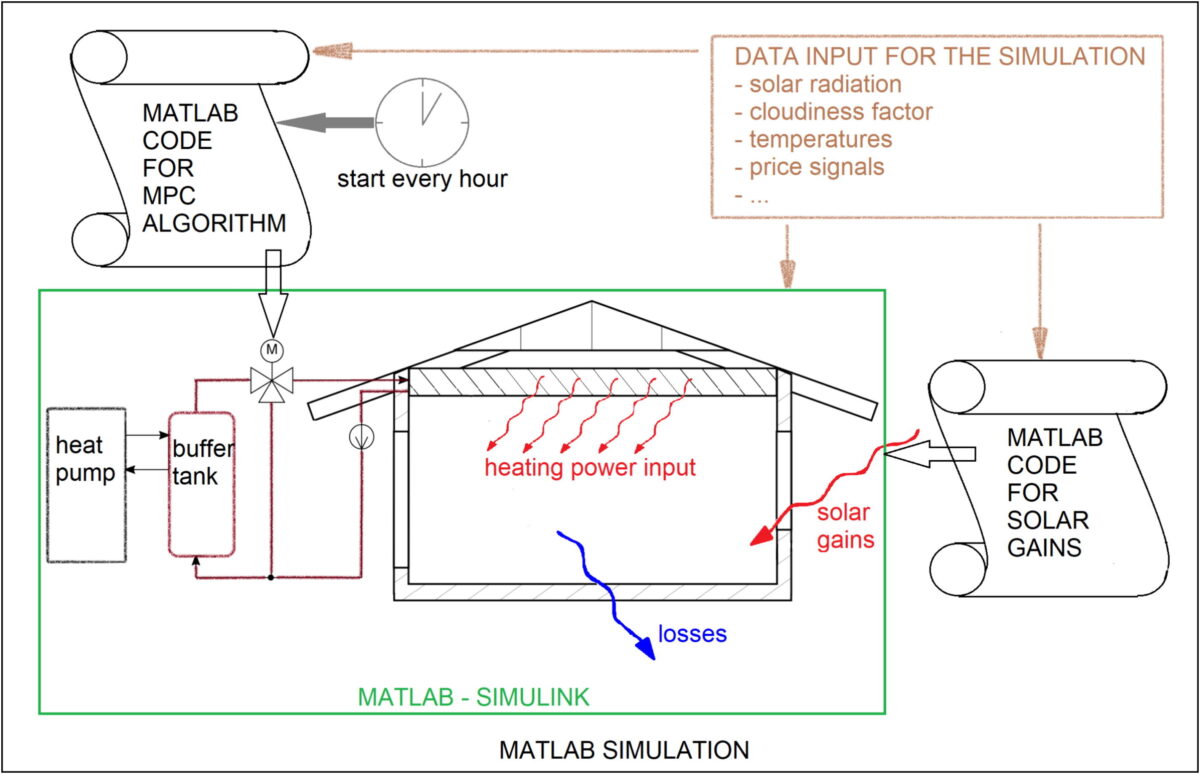
The original model consisted of two components: the modeling of the house with its thermally activated components (TAB) and a forecast-based control concept based on the analysis of weather forecast data. Its extension included the consideration of price signals based on real electricity market prices or simple logic.
The new price component calculates heating costs based on the forecast thermal demand, the heat pump’s coefficient of performance (COP) and the forecast electricity rates. It also includes parameters such as the deviation factor and power factors, which allow a more precise combination of thermal comfort and cost savings. The addition has been validated on a Matlab/Simulink simulation framework before December 2020.
“The validation of the new cost function, including deviation and power factors, is positive,” the academics said. “The comparison with the results of the original algorithm is satisfactory and grid-supporting operation of heat pumps, taking price signals into account, is therefore possible. This validation is supported by the analysis of existing studies.”
Following the positive results of the validation, the group tested the improved MPC in a case study. That included real weather monitoring data from Vienna, Austria, in 2023, along with the corresponding real exchange rate-based day-ahead prices. In addition, the average network costs, taxes and levies of the Austrian market have been added to the calculation.
The simulation was carried out on an energy-efficient building, with approximately 60 kWh/m2 and various thermally activated components (TABs). The heat pump in this home had a coefficient of performance (COP) of 4 and was assumed to be connected to a hot water buffer tank. The room temperature was set at 22 C for the entire month of the simulation. In total, they examined four scenarios: the first took thermal comfort into account; the second included real energy prices; the third assumed prices were 20% lower; and the fourth (No. 4) assumed they were higher at the same rate.
“The required heating energy is highest for the base scenario, while scenario no. 4 requires approximately 100 kWh less energy. Moreover, the energy costs for the base case are the highest for all three cost variations, while the results with the new cost function lead to lower energy costs,” the group said. “Compared to the base case, the cost reduction for smaller electricity price fluctuations (reduced by 20%) is 6.65%, while larger price fluctuations (amplified by 20%) lead to a cost reduction of 12.5%.”
Concluding their research, the academics said that “this algorithm is a tool to increase the efficiency of heating and cooling technologies and reduce building energy costs. Moreover, the implementation of the first developed low-tech MPC in existing buildings proved the easy implementation (via single-board computer) and possible wide application of such a low-tech algorithm.”
Their findings were presented in “Extension of a low-tech MPC algorithm for grid-supported heat pump operation”, published in Energy and Buildings.
This content is copyrighted and may not be reused. If you would like to collaborate with us and reuse some of our content, please contact: editors@pv-magazine.com.
