

In a new weekly update for pv magazineOPIS, a Dow Jones company, provides a brief overview of the major price trends in the global PV industry.
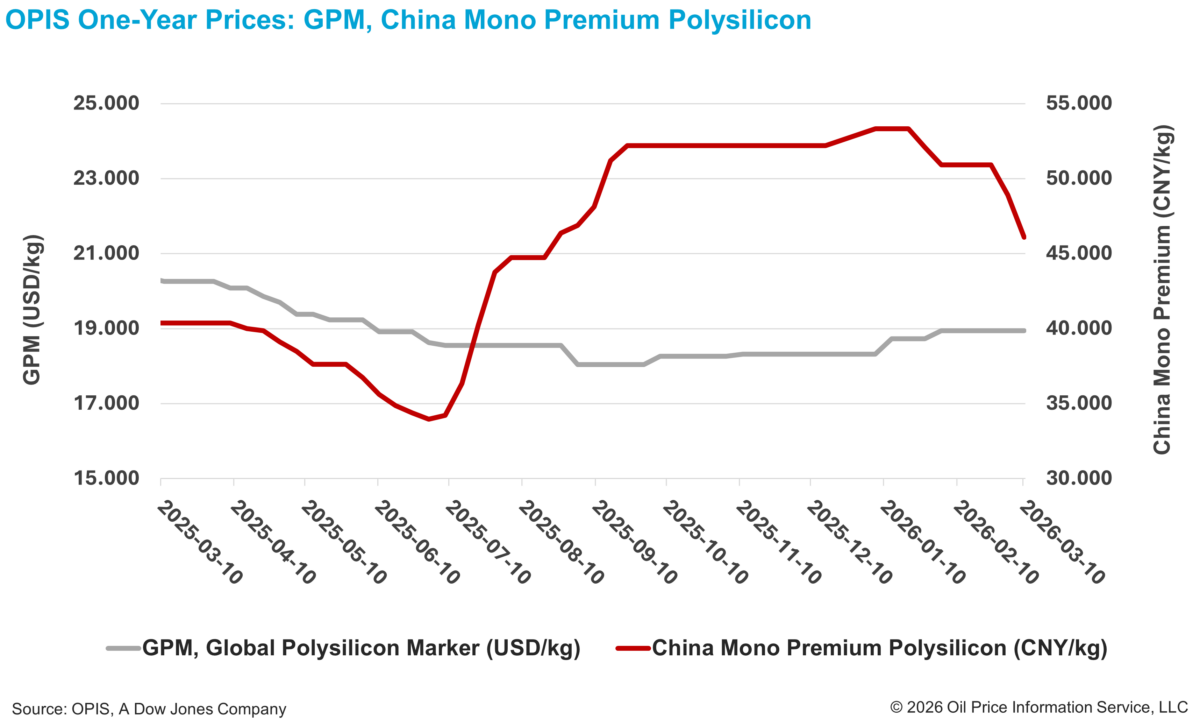
The China Mono Premium – OPIS’ rating for mono-grade polysilicon used in the production of n-type ingots – fell 5.79% week on week to CNY46.083 ($6.71)/kg, or CNY0.097/W, according to the OPIS Global Solar Markets Report published on March 10.
Since the beginning of the year, the China Mono Premium has fallen by more than 13%.
According to industry insiders, the polysilicon market is negotiating orders for delivery in late March, with some buyers reportedly only willing to place orders around a psychological price level of CNY40/kg. A trade participant said a polysilicon price of CNY40/kg would still not allow wafer makers to avoid or minimize cash losses, adding that this level does not necessarily represent the floor price.
Another participant noted that while some leading manufacturers continue to quote around CNY50/kg to slow the pace of declines, transaction prices of second- and third-tier producers have rarely exceeded CNY45/kg since the end of the Lunar New Year.
A major Chinese polysilicon producer announced last week that its total production in 2025 was approximately 123,700 tonnes (MT), with an expected increase to 140,000-170,000 MT in 2026. The company announced that cash costs for polysilicon in the fourth quarter of 2025 had fallen to CNY 33.95/kg, while the full cost was approximately CNY 43.46/kg. An industry insider noted that given the company’s relatively limited inventory, the plan to moderately increase production in 2026 could help reduce overall costs – a strategy aimed at minimizing losses through more rational production management.
Nevertheless, inventories in the broader market remain significant. Industry insiders widely acknowledge that stocks of more than 500,000 tonnes could persist, with stocks not likely to normalize until 2028-2030.
A market source said that as producers’ cash flows become increasingly tied up in inventories, major manufacturers may be forced to sell at or near cash costs, at prices that do not fully cover depreciation, labor, working capital or taxes. The source added that under such circumstances, the China Photovoltaic Industry Association’s (CPIA) recommendation that retail prices not fall below full cost would be difficult to achieve.
Although no official announcement has been made, industry reports indicate that the CPIA recently released a document estimating the average total cost of polysilicon in January 2026 at approximately CNY54,125/kg. The association noted that some companies were selling CNY43-45/kg – 17%-20% below that benchmark – and characterized such prices as unfair competition that was beyond the reasonable range of the industry.
Meanwhile, the global polysilicon market has shown signs of stabilization in recent weeks, with fewer updates on new trading activity compared to previous months.
According to the OPIS report, the Global Polysilicon Marker (GPM) – the OPIS benchmark for polysilicon produced outside China – was estimated at $18,942/kg, or $0.040/W, unchanged from the previous week.
Market participants attributed the recent stabilization in part to the US preliminary ruling on countervailing duties (CVD) targeting solar cells and modules imported from India, Indonesia and Laos. One participant noted that while barriers to solar products from these regions entering the U.S. have increased, expansion of manufacturing capacity downstream in emerging markets remains limited, potentially weakening global demand for polysilicon.
The delayed release of findings from the US Section 232 investigation into the national security implications of polysilicon and its derivatives has also increased uncertainty in the global polysilicon market. Despite earlier indications from insiders that the decision would not be delayed beyond March, recent reports suggest the announcement could now be delayed beyond April 2026.
Industry insiders added that while the outcome of Section 232 is unlikely to have a direct impact on polysilicon prices in China, the overall stringency of the policy will likely reflect the broader US-China relationship. One market participant noted that imposing relatively moderate restrictions on polysilicon and its derivatives could benefit non-US polysilicon producers by creating a more accommodative downstream market environment, potentially supporting demand.
OPIS, a Dow Jones company, provides energy prices, news, data and analysis on gasoline, diesel, jet fuel, LPG/NGL, coal, metals and chemicals, as well as renewable fuels and environmentally friendly feedstocks. It acquired price data assets from Singapore Solar Exchange in 2022 and now publishes the OPIS APAC Solar Weekly Report.
The views and opinions expressed in this article are those of the author and do not necessarily reflect those of the author pv magazine.
This content is copyrighted and may not be reused. If you would like to collaborate with us and reuse some of our content, please contact: editors@pv-magazine.com.
