

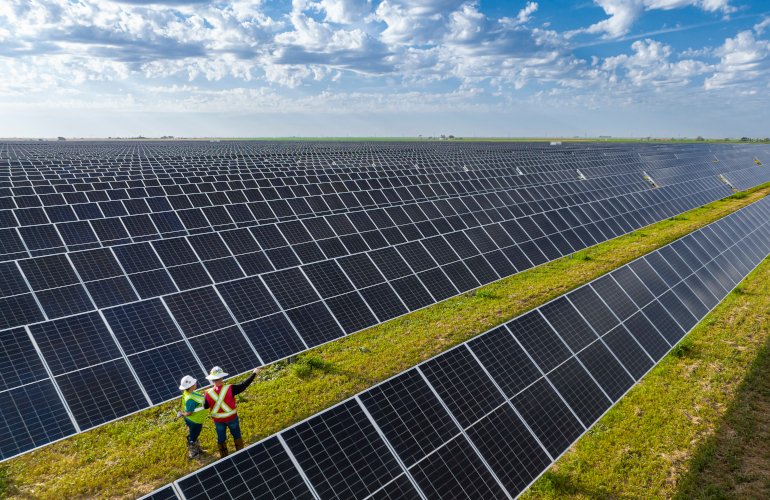
The U.S. solar industry installed 43 GW of new capacity in 2025, remaining the fastest-growing source of new electrical capacity added to the grid for the fifth consecutive year. Solar energy and energy storage represent 79% of new capacity in President Donald Trump’s first year back in office.

Credit: Primoris Renewable Energy
The “US Solar Energy Market Insight Annual Review 2025” report released today by the Solar Energy Industries Association (SEIA) and Wooden Mackenzie finds that more than two-thirds of all solar capacity installed in 2025 was built in states won by Trump. Texas, Indiana, Florida, Arizona, Ohio, Utah and Arkansas are among the top 10 states for solar energy additions in 2025.
Despite regulatory measures focused on clean energy and changing tax policies, the US is still expected to add 490 GW of new solar capacity by 2036, bringing cumulative installed capacity to nearly 770 GW.
“Solar and storage continue to dominate new capacity additions to the electric grid, despite policy headwinds. American households and businesses of all sizes are demanding solar plus storage because they provide fast, affordable power to meet rapidly increasing demand,” said Darren Van’t Hof, interim president and CEO of the SEIA. “Washington must provide policy certainty so that the market can function and keep pace with growing energy demand. Without this certainty, fewer solar energy systems will be built and Americans will pay the price with higher energy bills.”
The report forecasts include scenarios showing how policy changes could impact the solar market. Final guidance on Foreign Entity of Concern provisions, the outcome of ongoing trade actions and the ability of projects to obtain permits will determine how much solar capacity ultimately comes online. The housing sector in particular is facing headwinds as the segment’s federal investment tax credit expires in 2025.
“It is clear that solar will remain the dominant source of new energy capacity in the United States, even as gas generation continues to grow,” said Michelle Davis, head of solar at Wood Mackenzie and lead author of the report. “The strong growth in demand combined with the rising costs of new gas-fired power stations will ensure that solar energy can remain competitive, even without tax breaks.”
2025 was still a monumental year for domestic solar and storage production. Since opening a wafer production facility in the third quarter, the United States now has the capacity to produce every major part of the solar supply chain. In 2025, cell production capacity continued to grow and module production increased by more than 50%, with an online capacity of 65.5 GW.
Texas led all states with 11 GW of new installations. A total of 11 states set new annual installation records by 2025, and 12 states added more than 1 GW of new solar capacity. Deployment in Indiana and Utah in particular has grown, with Indiana deploying nearly 3 GW, up from 1.6 GW in 2024.
News item from SEIA & Wood Mackenzie
