

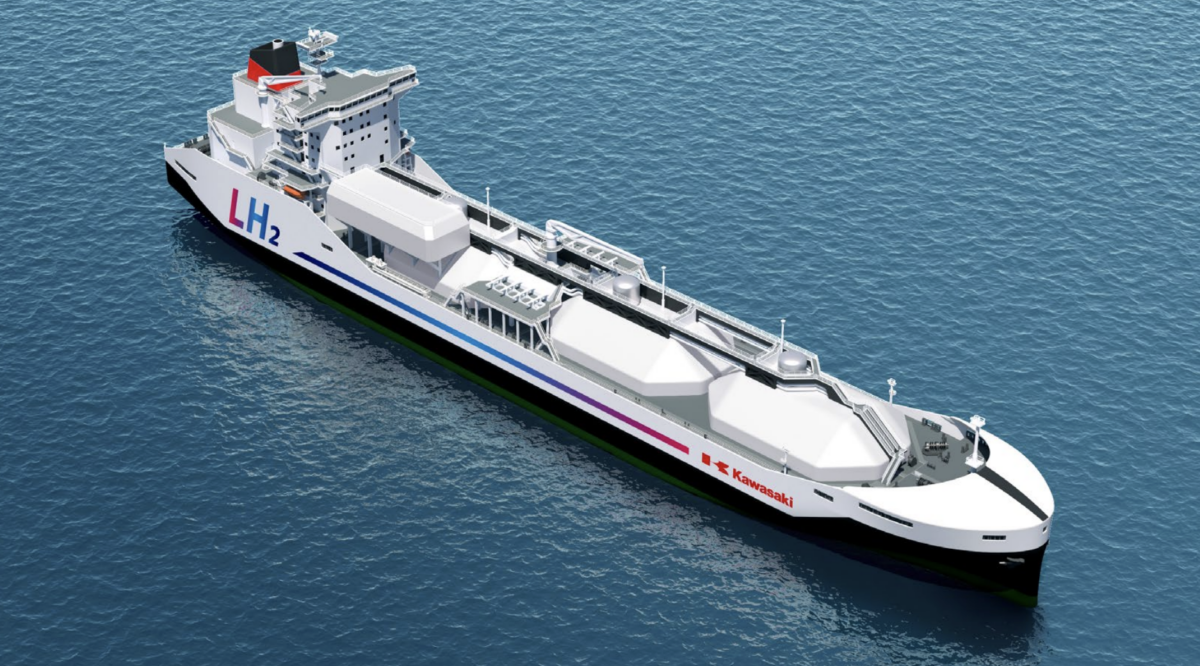
Kawasaki Heavy Industries and Japan Suiso Energy will build a 40,000 cubic meter vessel designed to meet global hydrogen demand in the 2030s.
Japan’s Kawasaki Heavy Industries and Japan Suiso Energy (JSE) have signed a contract to build the world’s largest liquid hydrogen tanker.
The ship is expected to have a capacity of 40,000 cubic meters. It will be built at Kawasaki’s Sakaide factory in Kagawa Prefecture, Japan.
Kawasaki Heavy Industries said in a statement that the project will meet global hydrogen demand in the 2030s and form the basis of the future hydrogen supply chain.
The aircraft carrier will be approximately 250 meters long, have an electric propulsion system running on diesel and hydrogen, and reach a speed of approximately 18 knots (33.3 km/h). It will be equipped with cargo tanks for liquefied hydrogen and use a high-performance insulation system, which will reduce the formation of vaporization gas caused by the ingress of natural heat, allowing large-scale transportation of cryogenic liquid hydrogen.
The ship will also have a cargo system that can load and unload large volumes of liquid hydrogen. Kawasaki Heavy Industries said double-walled vacuum jacketed lines will keep materials at an extremely low temperature, allowing efficient and safe transfer between the onshore facility and the onboard liquid hydrogen tanks.
Kawasaki Heavy Industries built the world’s first liquid hydrogen tanker in 2021, with a capacity of 1,250 cubic meters. A year later, it took part in a pilot demonstration of liquid hydrogen exports between Australia and Japan.
The company has since established and is currently working on a liquid hydrogen receiving terminal known as Hy touch Kobe Kawasaki LH2 terminala liquid hydrogen base under construction in Ogishima, Kawasaki, Kanagawa Prefecture.
JSE is the operator of the The New Energy and Industrial Technology Development Organization (NEDO) Green Innovation Fund project, supported by the Japanese government, aims to demonstrate loading and unloading of liquefied hydrogen from ship to base, and conduct ocean trials, by the end of March 2031.
This content is copyrighted and may not be reused. If you would like to collaborate with us and reuse some of our content, please contact: editors@pv-magazine.com.
