

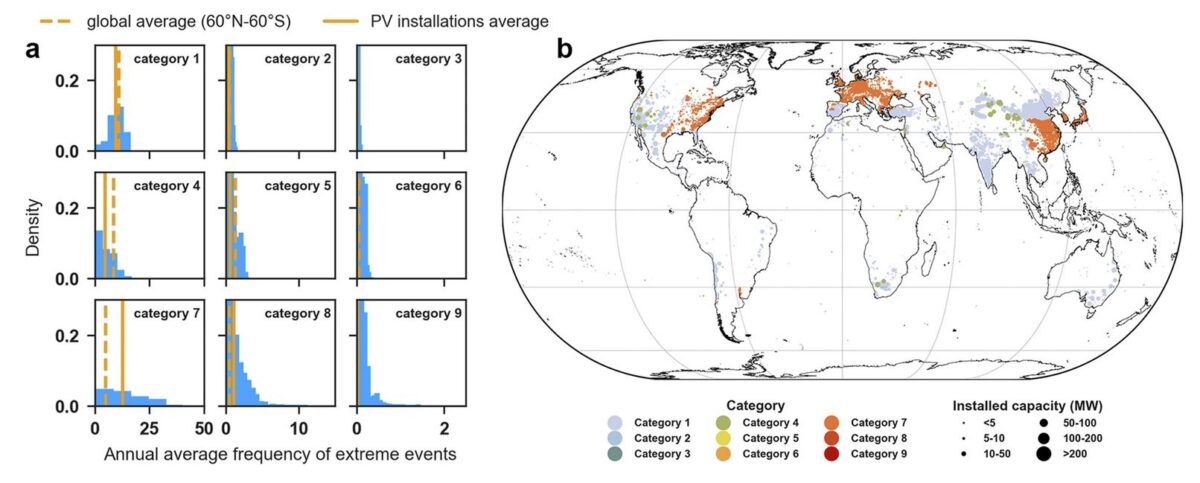
New research from China shows that regions with dense PV installations, such as Southern China, Central and Northern Europe, Central and Eastern America and Japan, are most exposed to weather-related events with extremely low production. The researchers proposed a mitigation strategy to reduce the impact of these events on PV energy generation.
A group of researchers in China have examined the impact of weather-related Extremely Low Production (ELP) events on the global fleet of PV systems in different regions and concluded that more investments may be needed to improve the effectiveness of the systems to guarantee.
“Our results highlight the critical need to prepare for ELP events, which pose greater challenges than conventional power differentials,” the scientists emphasized. “Characterized by long durations or high intensities, ELP events can lead to power shortages that exceed the capacity of conventional reserves, especially in some regions with dense PV installations where high intensity events of long duration have occurred.”
The research team analyzed daily PV energy generation on a global scale over the period 1986-2021 using the ERA5 tool, which provides hourly estimates of a wide range of atmospheric, terrestrial and oceanic climate variables. It then identified nine types of ELP events based on intensity and duration and analyzed the frequency of the events and the total number of low production days for each type.
The academics defined an ELP day as a day when PV power is lower than 90% of all days in the observation period and an ELP event as a series of consecutive days when electricity production is lower than 10%.
The analysis, which does not include residential PV systems, showed that areas with a higher potential for solar energy generation tend to record low- or medium-intensity events, while areas with relatively low solar energy potential PV energy generation are generally more exposed to high-intensity events. However, it also showed that most of the world’s PV installations are located in areas with low PV energy generation potential and are therefore significantly affected by weather variations.
“Our results show that regions between 60°N and 60°S experience an average of 27 ELP events annually, with 17% of these events having high intensity,” the researchers pointed out. “Regions with dense PV installations – including Southern China, Central and Northern Europe, Central and Eastern America and Japan – are particularly affected. In these areas, which together host approximately half of the world’s PV installations, 44% of ELP events are high-intensity.”
They also found that PV systems in these regions are exposed to a 2.7 times higher frequency of high-intensity events than the global country average.
As a mitigation strategy to reduce the impact of ELP events on PV energy generation, the team proposed using a daily backup supply for each site, while integrating PV sources with wind energy and hydropower. “Additionally, transmission infrastructure and grid connections offer potential solutions to mitigate ELP events, especially for countries with numerous distributed PV installations, as extreme weather is significantly less likely to affect multiple regions simultaneously,” it explains.
However, the academics also warned that implementing these strategies could be costly as they may require upgrading technology and long service periods. “Maintaining a daily backup facility equal to the average event intensity could recover 39% to 81% of events across locations,” they pointed out.
Their findings are available in the article “Photovoltaic installations are widely deployed in areas where there is a risk of extremely low production”, published in Communication Earth & Environment.
This content is copyrighted and may not be reused. If you would like to collaborate with us and reuse some of our content, please contact: editors@pv-magazine.com.
