

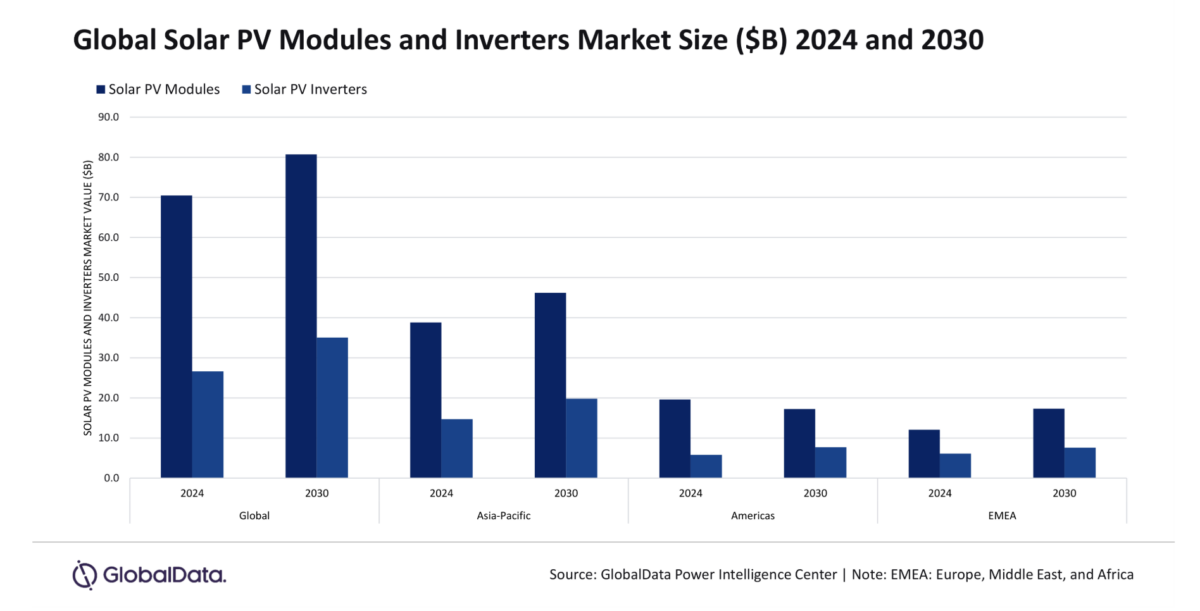
British analysts GlobalData predict that growth in the global solar panel and inverter market will be driven by the Asia-Pacific region until the end of the decade.
The global solar panel and inverter markets are on track to reach a combined value of $115.8 billion by 2030, according to forecasts from the British data analytics and consultancy firm. Global data.
The latest from the analysts report expects the global solar panel market to reach $80.7 billion by the end of this decade, while the solar inverter market is expected to reach $38.8 billion.
GlobalData says the increase will be largely driven by strong policy initiatives in the Asia Pacific (APAC) region, with the APAC solar module market expected to reach a value of $46.2 billion by 2030, up from $38.8 billion in 2024.
Other contributing factors include falling technology costs, national renewable energy targets, net-zero emissions targets and the expansion of solar energy production and innovation in major economies, according to GlobalData’s analysis.
The company adds that recent trade policy changes such as US tariffs are reshaping supply chains and accelerating localization efforts in the APAC region.
Bhavana Sri Pullagura, senior power analyst at GlobalData, explained that tariff adjustments and anti-dumping/countervailing duties on modules and cells from some Southeast Asian countries have significantly changed supply chains and increased module prices in the US market. “The projected decline in solar panel values in America, despite continued installation growth, is primarily due to significant price erosion due to oversupply and declining production costs,” Pullagura said.
GlobalData also found that the rapid evolution of the global solar inverter market is fueled by increasing demand for utility-scale projects and hybrid solar-plus-storage systems, as well as stricter grid compliance and cybersecurity regulations, especially in Europe and the US.
While the APAC region remains the main manufacturing hub for solar inverters, GlobalData says the Middle East and Africa are emerging as growth areas that require high-capacity and storage-ready inverters for large-scale projects.
Pullagura noted that while the APAC region is expanding capacity and local production of solar panels and inverters, Europe, the Middle East and Africa are focusing on quality, domestic production and strategic sourcing. “These developments will continue to impact supply chains, technology adoption and investment flows across the solar sector,” Pullagura added.
Earlier this year, GlobalData predicted that the world’s cumulative solar capacity will exceed 4.8 TW by the end of 2030, and will be far exceeded. 7.5 TW in 2035.
This content is copyrighted and may not be reused. If you would like to collaborate with us and reuse some of our content, please contact: editors@pv-magazine.com.
