

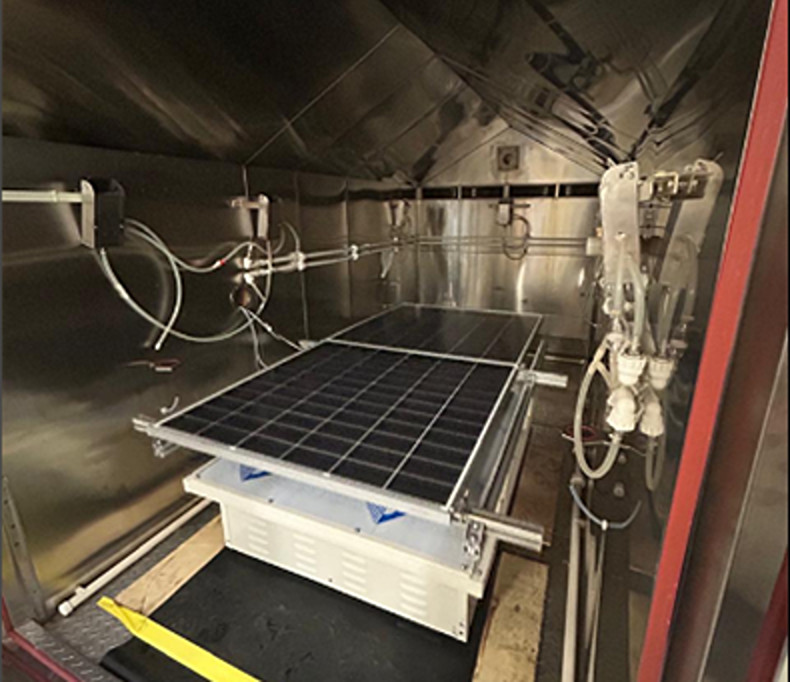
Researchers from the UAE and Singapore have investigated how wind-induced vibrations increase mechanical stress in PV panels and found that these vibrations can lead to microcracks, more serious mechanical failures, misalignments and ultimately system collapse.
An international research team investigated the impact of wind-induced vibrations on solar panels and found that wind-induced stress can have significant mechanical consequences for PV arrays, especially those with large panels.
“The first torsion frequencies of the tracker system in the range of 4 Hz to 5 Hz were observed due to twist and torsion using modal analysis,” the study’s lead author Sagarika Kumar said. pv magazine. “Such movements can lead to microcracks, more serious mechanical failures, misalignments and ultimately system collapse.”
“The existing PV module certification program may not fully address the impact of these new environmental challenges large surface area modules, leaving significant gaps,” Kumar added. “Our research aims to address these gaps.”
The scientists proposed an action plan, structured in two collaborative phases, designed to gain a robust understanding of wind-induced impacts on PV systems. The first phase focused on the analysis of PV systems, including modal analysis, static and dynamic load simulations under varying wind conditions, and flow-induced vibration modeling. The second phase focused on wind fluid-based analyses, integrating historical wind data interpretation, computational fluid dynamics (CFD) modeling and wind tunnel testing of scale models.
“To complement these efforts, we aim to investigate the effects of novel mechanical stress conditions on PV modules through targeted laboratory experiments,” the scientists said. “This collaborative and iterative approach helps refine the test parameters for accelerated indoor vibration and load testing. Ultimately, the findings will help develop recommendations for wind-induced failure testing, with potential for adoption by the International Electrotechnical Commission (IEC).
The team also conducted a structural load analysis to assess the static wind pressure corresponding to varying wind speeds. It assumed a northerly wind measured at a speed of 10 m/s, corresponding to a Category 1 hurricane, and a wind speed at the tracker height level of approximately 33 m/s. This analysis showed that inducing static loading at the back of the module can result in a displacement of approximately 5.1 cm.
“The current IEC 61215-2 tests include a static and a dynamic mechanical load test,” Kumar pointed out. “However, they do not represent enough the observed mechanical stress, which is why we are currently investigating asymmetric and torsional loading conditions as the next step.”
To better represent the real-world scenarios explored in their work, the academics proposed a protocol including mid-frequency vibration tests and dynamic load tests with non-uniform load distribution.
The vibration test frequency is carried out for 8 hours in accordance with IEC 60068-1 and 60068-2-6 standards. During the test, the module undergoes a “horse-galloping movement” with frequencies from 3.5 Hz in a climate chamber. The module is mounted with a 60% overhang to simulate the worst mounting configurations. Considering combined environmental stresses, the protocols integrate the effects of temperature and humidity.
In addition, the vibration test includes thermal cycling to simulate thermomechanical fatigue, where 9 cycles are performed, followed by vibration testing for up to 8 hours. “However, this testing protocol is still in the research phase and may require further development,” Kumar said.
The dynamic load test evaluates the effect of torsion galloping on the module using a two-corner clamp method with compressive loads up to 1000 Pa. This loading is twice that of the simulated results, to simulate a Category 1 hurricane in an accelerated framework. The cycles are set to 1,000, based on IEC 61215:2021.
“While current testing protocols provide a foundation, they may miss the nuanced circumstances associated with extreme weather events,” she added. “Our research seeks to advance this foundation by introducing medium-frequency vibration and dynamic loading tests specifically designed for wind-induced stresses, including asymmetric and torsional loading conditions.”
The research team included scientists from the Renewable and Sustainable Energy Research Center at the Technology Innovation Institute in Abu Dhabi, UAE, and the Solar Energy Research Institute of Singapore (SERIS). The findings have been published in the article ‘Testing of Wind-Induced Vibrations on Solar Photovoltaic Modules’.
This content is copyrighted and may not be reused. If you would like to collaborate with us and reuse some of our content, please contact: editors@pv-magazine.com.
