

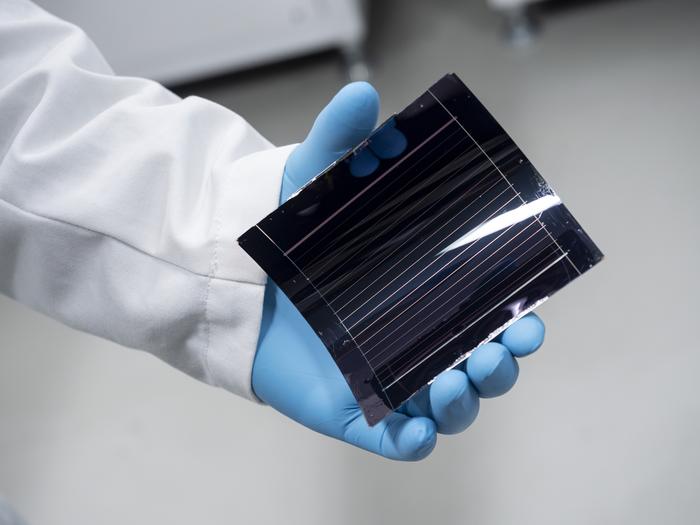
Despite the promise of good conversion efficiency and relatively low costs, copper-indium-gallium-diselenide (CIGS) photovoltaic technology has never been able to compete with crystalline silicon and has been largely limited to the niche market for building-integrated solar photovoltaics (BIPV).
High-efficiency laboratory processes for CIGS have thus far failed to scale economically to high-throughput industrial production. For example, record CIGS cells are achieved under tightly optimized growth conditions with narrow compositional and thermal windows. Such precision is manageable on small laboratory substrates, but becomes increasingly difficult on large areas where maintaining uniform stoichiometry, phase purity, and defect control requires complex vacuum infrastructure and careful inline monitoring. Small deviations lead to secondary phases and recombination-active defects, which directly affect the yield.
“On an industrial scale, the economy is not only determined by efficiency, but also by throughput, returns and capital intensity,” said CIGS specialist Mirjana Dimitrievska. pv magazine. “Multi-stage co-evaporation or complex sputter-selenization routes are slower and more equipment-intensive than regular silicon processing. Combined with strong price pressure from crystalline silicon, these factors limit the economic translation of laboratory performance to large-scale production.”
According to Dimitrievska, the main limitations are the complexity and scale of production. CIGS requires multicomponent control of Cu, In, Ga and Se, often under high vacuum conditions, which increases capital expenditure and process sensitivity. Yield losses due to shunts, non-uniformity and interface defects increase the effective cost per watt.
“At the same time, crystalline silicon has achieved tremendous economies of scale and dramatic cost savings over the past decade,” she continued. “This constantly changing benchmark has narrowed the window in which CIGS could deliver a cost advantage. Without very high module efficiency and stable, high-throughput production, matching silicon’s cost structure remains a challenge.”
Another major challenge in CIGS development is the difficulty of replacing cadmium sulfide (CdS) buffer layers with cadmium-free alternatives, which impacts environmental compliance and commercial viability.
“CdS plays a multifunctional role in CIGS devices,” says Dimitrievska. “In addition to forming the junction, it passivates the absorber surface and provides favorable band alignment that supports high open-circuit voltage and fill factor. Replacing CdS with cadmium-free alternatives such as zinc oxysulfide, (Zn(O,S)), zinc magnesium oxide (ZnMgO) or indium sulfide (In2S3) is technically feasible, but these layers often introduce tighter band alignment tolerances and greater sensitivity to processing conditions.”
“While removing cadmium improves the environmental profile and regulatory perception, any instability or loss of efficiency at the interface directly impacts bankability,” she added. “The absence of a universally robust drop-in replacement has therefore delayed the full industrial transition, despite clear environmental motivations.”
Another significant technical problem is that the density of defects increases significantly when moving from small laboratory cells to full-size modules. “Scaling up to module sizes increases the likelihood of local compositional fluctuations, thickness variations and temperature gradients during growth. Larger areas also require monolithic interconnection through scratches, which introduces additional edges, interfaces and potential shunt paths. These factors statistically increase defect density and non-uniformity,” said Dimitrievska.
“Higher defect density improves non-radiative recombination and can create leakage paths, reducing open-circuit voltage and fill factor. Additional resistive losses due to transparent conductive oxides and compounds further widen the efficiency gap between cells and modules,” she also stated.
CIGS sensitivity to moisture ingress and alkali migration also complicates long-term module reliability compared to crystalline silicon. If CIGS absorbers benefit from controlled incorporation of alkali, usually sodium, to achieve high efficiency, mobile species and metastable defect states can develop under bias, illumination, or humidity, affecting junction properties. Moisture ingress, especially at edges or poorly sealed areas, can accelerate interface degradation.
“Crystalline silicon modules are largely limited by packaging-related degradation mechanisms, while CIGS reliability also depends on maintaining stable absorber and interface chemistry,” said the CIGS expert. “When encapsulation and process control are optimized, long-term stability is achievable, but the margin for processing variation is smaller.”
According to Dimitrievska, CIGS is particularly suitable for applications where lightweight, flexibility or aesthetic integration offer added value. These include building-integrated solar photovoltaics, curved or facade elements, lightweight roof installations with load limitations, transportation-related surfaces, portable energy systems and certain aerospace or high-altitude applications.
“In such markets, performance per weight or per available area may exceed absolute cost per watt. Rather than competing directly with commodity silicon in large-scale, large-scale installations, CIGS startups can focus on differentiated segments where form factor and tunable properties provide system-level benefits,” she said.
According to the latest reported data, the world record for a CIGS module is in the 20% range, which puts this technology close to competing thin-film technologies and approaching the lower end of mainstream crystalline silicon modules.
“However, absolute efficiency is only part of the commercial equation,” he said. “For competition in the broad commodity market, approaching the high teens of up to 20% on full-area modules with consistently high efficiency is beneficial because it improves power yield per area and helps reduce system balance costs. Durability, long-term stability, encapsulation quality, resistance to environmental stress, and predictable field performance are equally critical. A module that has marginally higher efficiency but suffers from significant early life degradation, moisture sensitivity, or unpredictable outdoor behavior will commercially uncompetitive.”
In specialized markets, such as lightweight or flexible applications, building integrated PV, curved surfaces or portable energy sources, slightly lower efficiencies may be acceptable if the product delivers unique values such as lower W/kg, formability, aesthetic integration and reliable long-term performance. In these cases, system value metrics such as lifetime energy delivered per installed price and reliability in challenging environments can outweigh peak efficiency figures.
Another critical factor affecting CIGS technology is that it is more susceptible to issues in the rare earth supply chain. “CIGS does not rely on rare earth elements,” says Dimitrievska. “However, it depends on indium and gallium, which are by-product metals obtained mainly from zinc and bauxite processing. Their supply is therefore linked to wider mining activities and may be sensitive to geopolitical and market fluctuations.”
“For very large deployment scales, the availability and price volatility of these critical elements can become limiting factors,” she continued. “For niche or moderate markets, current supply chains are generally manageable, but long-term terawatt-scale expansion would require careful resource planning and recycling strategies.”
Dimitrevska and a group of her colleagues at the Swiss Federal Laboratories for Materials Science and Technology (Empa) recently investigated how CIGS can be optimally combined with perovskite solar technologies in tandem cells and modules.
The scientists argue that the research community must move beyond chasing incremental efficiency gains and instead prioritize the resilience, stability and sustainability of photovoltaic materials. They also emphasize the need for long-term field studies to assess real-world performance.
“Silicon is not the best semiconductor for solar cells,” Dimitrievska emphasizes. “However, this technology has been in development for more than 70 years and has already been highly optimized thanks to continued research and investment. If research and industry work together, the same can be achieved for perovskite and CIGS.”
The research results are presented in “Lessons from copper-indium-gallium sulfo-selenide solar cells for the advancement of perovskite photovoltaics”, published in nature energy.
This content is copyrighted and may not be reused. If you would like to collaborate with us and reuse some of our content, please contact: editors@pv-magazine.com.
