

In a new weekly update for pv magazineOPIS, a Dow Jones company, provides a brief overview of the major price trends in the global PV industry.
Chinese prices for TOPCon M10 solar cells fell for the third week in a row, tracking declines in upstream polysilicon and wafer prices as production costs continued to fall. Demand remained bearish, with market participants still assessing price prospects ahead of the April 1 cancellation of China’s export tax rebate on solar products.
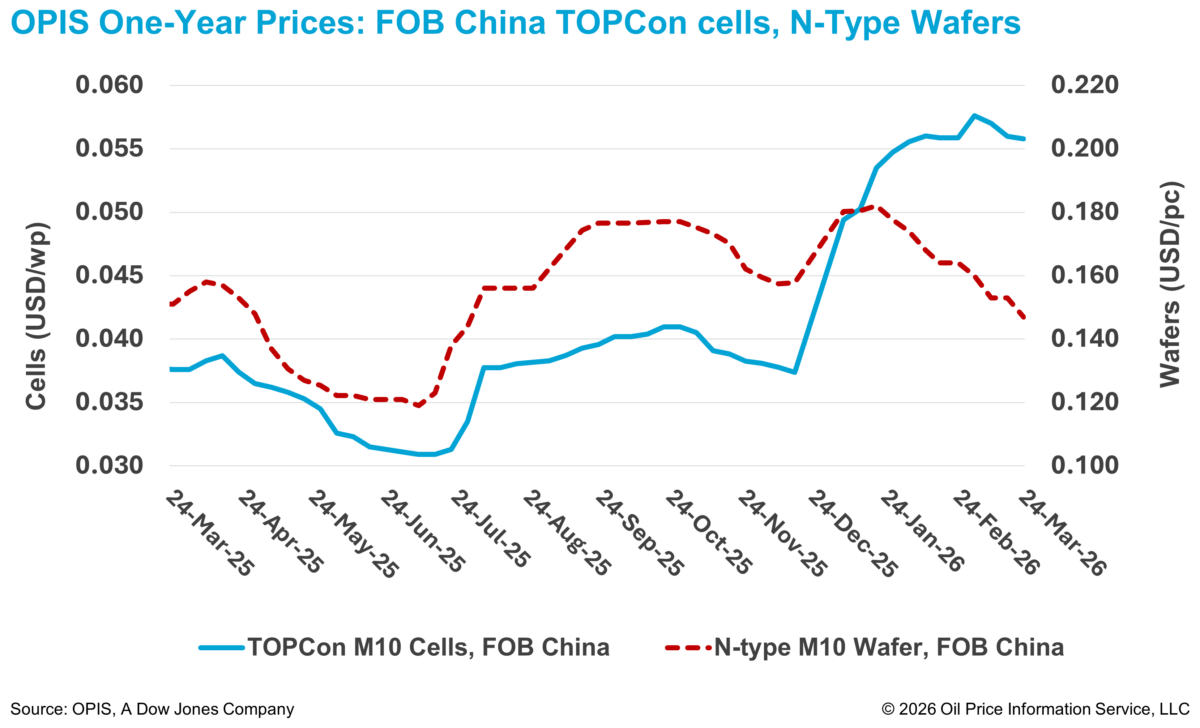
According to the OPIS Global Solar Markets Report released on March 24, Free-On-Board (FOB) China TOPCon M10 cell prices fell 0.36% this week to $0.0558/W, with weaker price guidance between $0.0535-0.0581/W. Meanwhile, FOB China prices for n-type M10 wafers fell 3.92% to $0.147/piece during the same period.
According to the National Bureau of Statistics, China’s solar cell production for the January-February period was about 98.3 GW, down 7.8% year-on-year. Market analysts said major cell manufacturers were only operating at around 40% capacity in January, leaving more than half of installed capacity unused. Producers would proactively cut production to reduce inventories and stabilize prices.
In addition, the rise in silver paste prices in January has put pressure on margins and discouraged further production, which may also have weighed on overall production, industry participants said. However, that cost pressure has since eased, with silver prices down more than 20% from their January peak.
Upstream wafer producers and traders continued to cut prices to reduce inventories and recover cash, putting further pressure on wafer prices, the China Nonferrous Metals Industry Association (CNMIA) said.
On the demand side, end-market installation demand remained weak, while continued pressure on cell prices weighed on overall wafer demand, CNMIA said. Waffle makers have maintained normal production and currently have no plans to reduce business rates, keeping supply relatively low, the trade association said.
Meanwhile, cell exports increased year-on-year. A market analyst said China’s cell exports totaled about 14 GW in January and February, compared with about 12.8 GW in the same period in 2025, according to data from global think tank Ember.
While cell prices continued to decline, module prices received relatively more support, partly due to higher costs for BOM inputs, market sources said. A module manufacturer said higher natural gas prices have made solar glass production more expensive, while higher oil prices are driving up costs for ethylene vinyl acetate (EVA) and polyolefin elastomer (POE) encapsulation films used in module assembly.
Still, a market source told OPIS that they expect module prices to continue to follow cell price movements, as cell prices represent a significant portion of the total module production costs.
According to buyer sources, module purchasing activity has largely come to a standstill in the first quarter of 2026 due to price volatility resulting from a rush to secure orders ahead of the export tax rebate.
Market participants said some buyers believe the price spike from February to March is likely to be temporary and could subside in the second quarter of 2026 once commodity demand declines.
OPIS, a Dow Jones company, provides energy prices, news, data and analysis on gasoline, diesel, jet fuel, LPG/NGL, coal, metals and chemicals, as well as renewable fuels and environmentally friendly feedstocks. It acquired price data assets from Singapore Solar Exchange in 2022 and now publishes the OPIS APAC Solar Weekly Report.
The views and opinions expressed in this article are those of the author and do not necessarily reflect those of the author pv magazine.
This content is copyrighted and may not be reused. If you would like to collaborate with us and reuse some of our content, please contact: editors@pv-magazine.com.
