

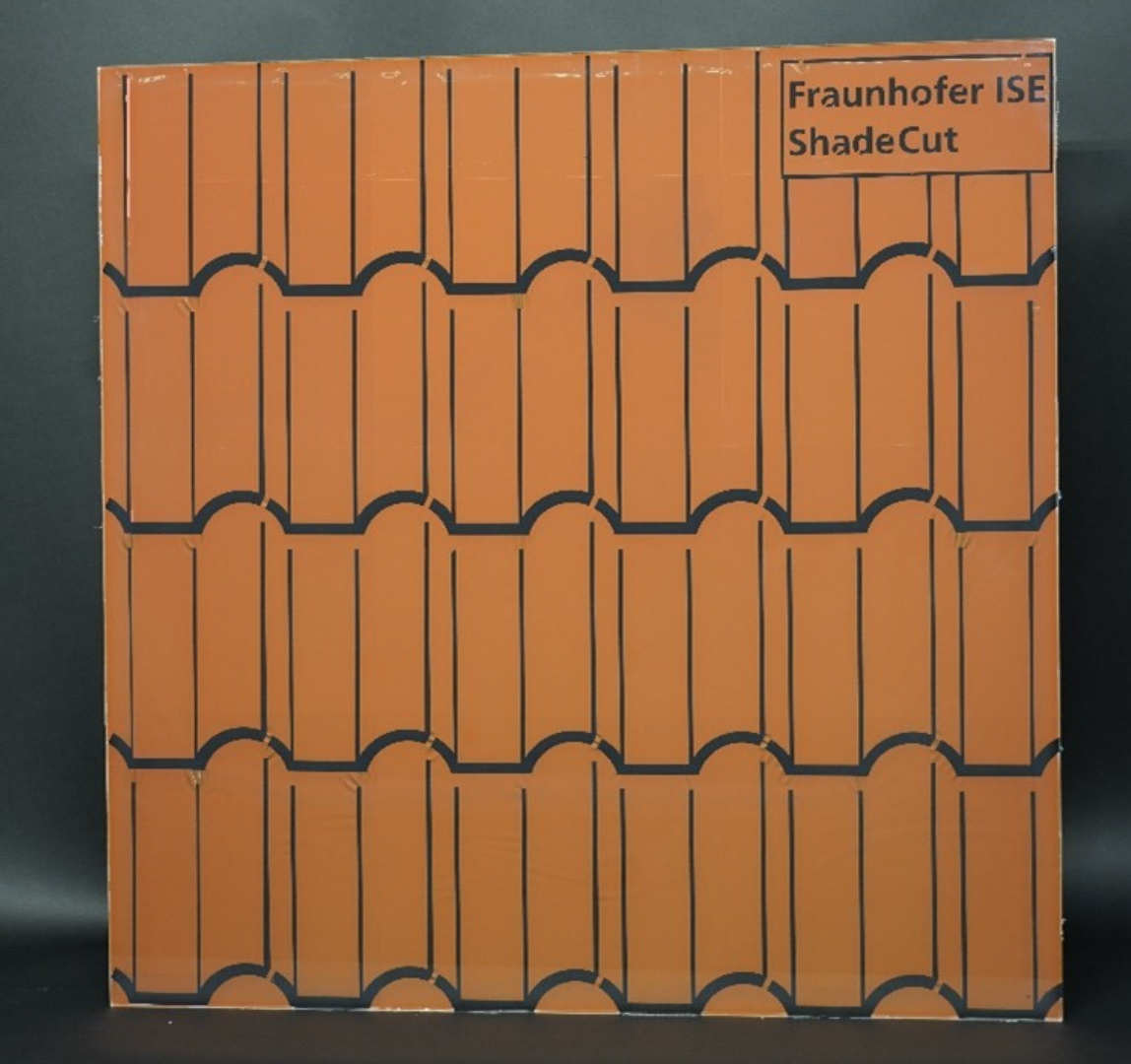
Scientists at the Fraunhofer Institute for Solar Energy Systems ISE have developed a film-based system that applies color patterns and cutouts to PV modules using the institute’s MorphoColor technology, allowing modules to imitate roof tiles, brickwork and facades with an efficiency loss of around 5%.
Researchers at the Fraunhofer Institute for Solar Energy Systems ISE have developed a technique for applying colored films with transparent cutouts to solar panels, allowing complex visual patterns while retaining approximately 95% of the power of an uncoated module.
The ShadeCut technology uses laser or CAD-controlled processes to cut patterns into films with MorphoColor coating – a structural color system developed at Fraunhofer ISE that produces color through low-loss optical interference instead of pigmentation, inspired by the microstructure of Morpho butterfly wings. The coating is applied via a vacuum process to the back of the module cover glass, or to flexible encapsulation film or backplate.
“Through targeted structuring and cutouts on a color-producing film, we can integrate color effects and complex patterns directly into solar panels and facade elements,” says Marco Ernst, developer of ShadeCut and researcher at Fraunhofer ISE. Additional layers of film can be added to create further structural complexity or additional colors.
The technology is applicable to standard PV and thermal solar modules. Dr. Martin Heinrich, group leader for encapsulation and integration at Fraunhofer ISE, said the system is particularly suitable for building-integrated PV applications, including facades, roof-integrated modules and balustrades, including on historic buildings.
“Modules with ShadeCut can look like brickwork or roof tiles and blend in perfectly in color,” he says.
Independent measurements confirm the 95% power retention rating. Fraunhofer ISE will present modules equipped with ShadeCut film cartridges at The Smarter E/Intersolar 2026, stand A1.440, in June 2026.
In February, Fraunhofer ISE announced efficiency records for III-V tandem modules, including a III-V germanium PV module with an efficiency of 34.2%. In January, the institute said solar panel efficiency could exceed 35% by 2050 through tandem PV structures.
This content is copyrighted and may not be reused. If you would like to collaborate with us and reuse some of our content, please contact: editors@pv-magazine.com.
