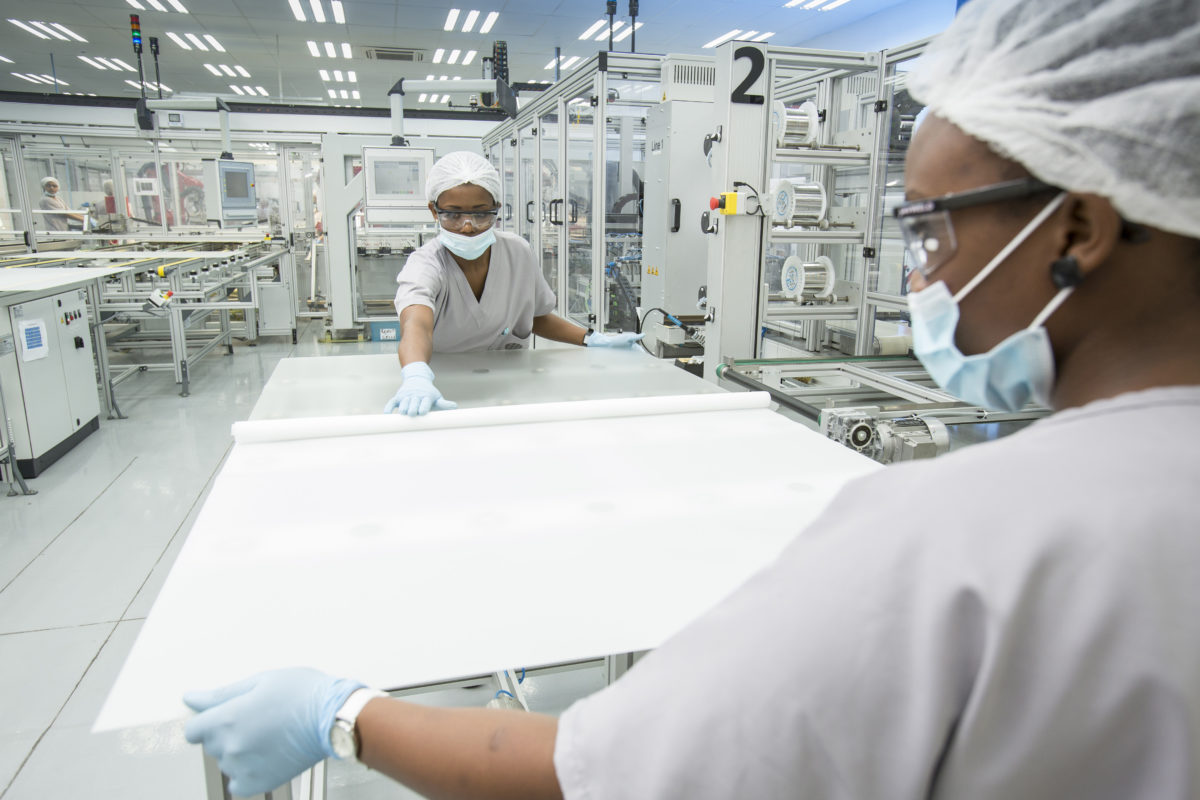
A High Court in South Africa has ordered the country’s Ministry of Mineral Resources and Energy to provide full documentation relating to three solar tenders awarded to local solar manufacturer ARTsolar in 2021 and 2022, after the company questioned whether preferred bidders had followed local content requirements for PV modules set out in the tenders. ARTsolar told pv magazine The legal team is currently reviewing the documentation received.
South African solar manufacturer ARTsolar is reviewing documentation relating to three public tenders after alleging that local content requirements of the tenders had not been followed by the independent power producers (IPPs) that awarded contracts.
The Durban-headquartered manufacturer filed an application in the Gauteng High Court in October 2024, alleging there had been “consistent and rampant circumvention of local content requirements” among preferred bidders and that the South African Department of Mineral Resources and Energy (DMRE) and the Department of Trade, Industry and Competition (DTIC) had failed to enforce the provisions.
ARTsolar’s application named a total of 26 respondents, including several ministers, South Africa’s electricity utility Eskom, the country’s National Transmission Company and the 18 IPPs and associated joint ventures awarded contracts within the three tenders.
The tenders in question are the Risk Mitigation Independent Power Producer Procurement Program (RMIPPPP), awarded in 2021, and bid windows five and six of the flagship Renewable Energy Independent Power Producer Procurement Program (REIPPPP), awarded in 2021 and 2022.
ARTsolar’s claim explains that each tender had a minimum local content threshold, requiring a percentage of laminated PV modules to come from local sources. It says this requirement would have formed part of the implementation agreements signed between DMRE and each preferred bidder, adding that DTIC was responsible for ensuring compliance with these local content requirements.
Image: ARTsolar
At its founding affidavit, ARTsolar chairman Bebinchand Seevnarayan wrote that it “It is becoming clear that many of the successful IPPs have failed to meet these local content requirements, and it is suspected that they have instead purchased cheaper, foreign-produced PV panels.”
“The DTIC’s inability to enforce local content requirements creates a significant problem because it allows preferred bidders to save costs by purchasing cheaper, foreign-produced PV panels, thereby avoiding the higher costs associated with meeting local content obligations,” Seevnarayan wrote. “Despite this non-compliance, these bidders continue to benefit from the full contract value, which was intended to cover the costs of meeting the local content requirements. Furthermore, Eskom is obliged under the power purchase agreements (PPA) to purchase the electricity generated by these projects at the maximum contract value. This means that although the bidders have reduced their costs by ignoring the local generation obligations, they continue to make significant profits from the PPA over the life of the agreement.”
Seevnarayan said he turned to the court to restore transparency, enforce the rule of law and protect the local manufacturing industry from being sidelined in favor of cheaper foreign imports.
“In addition to the harm to ARTsolar and other local PV manufacturers, these practices have a far-reaching impact on public interests, damaging our economy, local jobs, tax revenues, industrial growth, skills development and South Africa’s ability to tackle the energy crisis,” Seevnarayan claimed.
In a court order published in December and seen by pv magazinethe High Court of South Africa ordered the government to produce the full record of decisions relating to the local content requirements for the tenders.
Local press in South Africa reported that some of the 27 respondents to the claim opposed the release, arguing that some of the documentation was sensitive. The court order stipulates that all documentation considered confidential by defendants has been made available to ARTsolar’s legal representatives and an independent expert.
ARTsolar general manager Viren Gosai said pv magazine the company began receiving the requested confidential and non-confidential documents in February. “The information has been passed directly to our legal team and is currently being reviewed and assessed as part of the legal process,” Gosai confirmed.
Gosai added that ARTsolar’s assessment application aims to assess whether applicable localization and procurement requirements have been met in the award and implementation of the projects. “Our position is that these projects must comply with applicable procurement and localization requirements in accordance with the rule of law, as these obligations formed part of the procurement conditions and contractual framework under which the projects were awarded,” he explained.

Image: ARTsolar
Gosai continued that the local industry has made substantial investments to ensure it can meet the required standards, specifications and demand associated with these programs.
“ARTsolar has recently created more than 300 jobs and invested significantly in upgrades to machinery, technology and manufacturing capabilities at its Durban facility, anticipating demand arising from localization commitments associated with these programs,” he shared. pv magazinebefore encouraging stakeholders involved in the projects to exercise appropriate supervision and due diligence in relation to localization and procurement obligations.
“We continue to support South Africa’s sustainable energy goals and believe that proper implementation of localization frameworks can make a meaningful contribution to sustainable industrial growth, investment security and job creation in the long term,” Gosai said.
Last year, ARTsolar announced a partnership with the Chinese JA Solar, with the intention of expanding local production of solar panels.
This content is copyrighted and may not be reused. If you would like to collaborate with us and reuse some of our content, please contact: editors@pv-magazine.com.
Popular content