

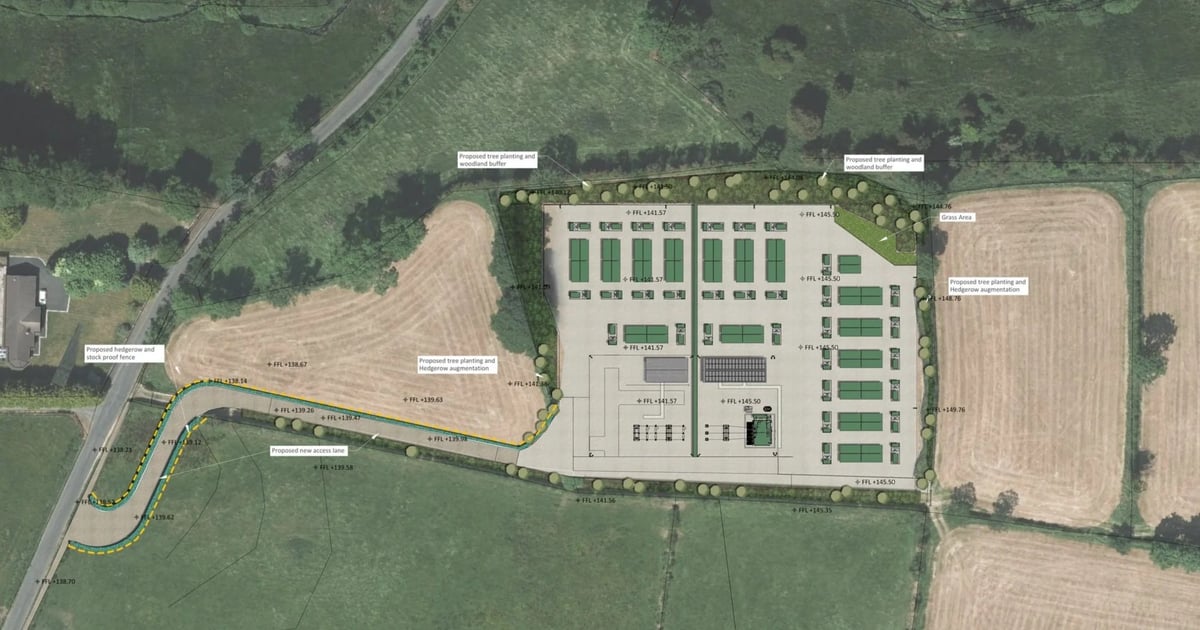
A 150MW/300MWh battery energy storage system (BESS) has been approved for development in County Antrim, Northern Ireland.
The project was proposed in July 2025 by Northern Ireland developer Valor Power.
A LinkedIn message by Donna Lyle, deputy director of planning consultancy Turley Belfast, states that planning permission was granted by Antrim and Newtonabbot Borough Council at a meeting on the evening of February 16. The planning portal has not yet been updated to reflect this.
According to Lyle’s post, the project will “play a key role in supporting the SONI-identified Kells Grid Cluster, helping to strengthen grid stability, enable greater integration of renewables and support the continued decarbonization of the electricity system.”
Located off Lisnunnan Road in Kells, the 2-hour BESS is 800 meters south of the Kells substation and will support planned renewable generation in the Kells Grid Cluster, which Northern Ireland grid operator SONI planned to enable multiple grid connections with minimal visual impact.
Valor Power’s facility will have 30 battery units, each consisting of two containers and a Power Conversion System (PCS), delivering approximately 5MW/10MWh per unit. Construction also includes a 110 kV substation and a control room (which will see rooftop PV panels installed, according to the application).
There were relatively many social objections to the project: 37 of the 40 responses to the plan proposal were objections (and one was without obligation).
A response from Dunsilly councilor Stewart Wilson suggests the BESS would pose a threat to public safety, citing fire risk, and also notes the visual impact of the project and its impact on local character.
Antrim and Newtonabbot Council’s planning committee has previously approved two BESS sites in the area, with one 100MW site approved in August 2025 and a 79MW facility approved in October 2025.
The Environmental Impact Assessment (EIA) report states that Valor’s proposed development is not close enough to those other sites to have a cumulative impact.
It also notes that there is scope for the development to be visually prominent, but that ultimately it is considered ‘unlikely that the proposal will have unacceptable impacts on interests of recognized importance, subject to best practice and established mitigation techniques’.
