

Researchers from Qatar found that bifacial 2P horizontal, single-axis tracking PV systems in desert conditions produced up to 13.5% more electricity than fixed-tilt systems during long-term field tests in Qatar. The research also showed strong seasonal and technology-dependent performance, with the benefits of trackers varying depending on irradiation and weather conditions.
Researchers from Hamad Bin Khalifa University (HBKU) in Qatar compared the performance of bifacial, two-in-portrait (2P) horizontal PV systems with horizontal single-axis trackers (HSAT) with fixed-tilt systems under desert conditions in the Middle East and found that the bifacial arrays can generate up to 13.5% more electricity than their counterparts.
“This study assessed the impact of module technology, ground coverage ratio (GCR), string configuration and environmental conditions on energy yield,” said corresponding author Maulid M. Kivambe. pv magazine“With seven tracker rows, variable pitch, 34 strings, 13 commercial PV module variants, multiple placements relative to the torsion tube and fixed-tilt string references, the testbed is among the largest HSAT research facilities in the world.”
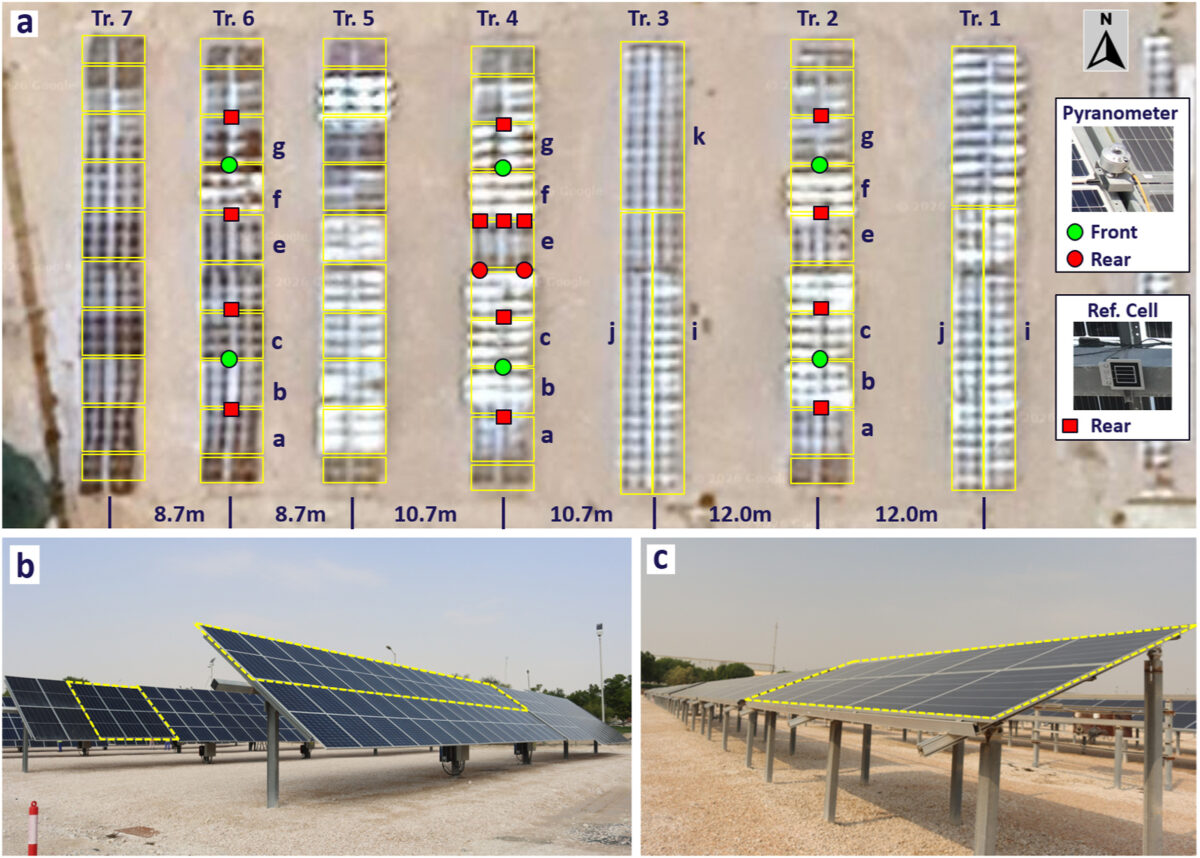
The 20-month field tests were conducted at HBKU’s Qatar Environment and Energy Research Institute (QEERI), where the horizontal single-axis tracking PV system has been in use since 2020. The location has very high solar radiation and is classified as a desert climate under the Köppen-Geiger photovoltaic system. The installation includes seven rows of SOLTEC-SF7 trackers with varying ground coverage ratios and multiple PV string configurations using 13 different module technologies. It uses single-axis astronomical tracking and asymmetric backtracking to reduce shadows and optimize energy harvest.
The temperatures at the back of the modules were monitored using embedded sensors, while multiple irradiance components such as plane-of-array irradiance (POA), global horizontal irradiance (GHI), diffuse horizontal irradiance (DHI), and back irradiance were measured using calibrated pyranometers and reference cells. A fixed tilt system served as a benchmark, installed at a 22° south-facing slope with similar string configurations and row spacing as the tracking system. Both systems operated on a natural gravel surface representative of desert conditions.
The tests showed that the tracker-based system achieved an annual average gain of 15.5% in plane-of-array irradiance and 13.5% in specific energy yield compared to the fixed-tilt configuration, with peak performance in early July 2024, when daily energy yield gains reached approximately 36%.
However, the tests also showed that the benefits of trackers were highly seasonal, with benefits mainly from February to September under conditions of high direct irradiation. From October to January, the fixed-tilt system was found to outperform the tracker-based array by up to 7.2% due to lower sun angles and reduced tracker effectiveness.
DC power analysis confirmed that the tracker-based system better captures early morning and evening radiation in summer, while fixed tilt performs better around noon in winter. Under cloudy conditions, performance differences decreased because diffuse irradiance dominates and is captured similarly by both systems.
Overall, the analysis showed that the tracker-based systems deliver higher annual yields, but their benefit is highly dependent on solar geometry and weather conditions, with performance varying depending on irradiance composition.
“Among the technologies evaluated, silicon heterojunction (HJT) modules generated the highest total energy yield, especially under conditions of high irradiance and elevated ambient temperatures as expected, due to their superior temperature coefficients and high bifaciality factors,” the scientists explained. “N-type PERT and high-efficiency bifacial PERC modules also showed strong performance, indicating that high bifacial response can partially compensate for less favorable temperature coefficients.”
They also found that the layout of the strings relative to the torque tube had minimal impact on energy yield, indicating a high degree of layout flexibility for tracker-based systems in desert installations.
Their findings are available in the study “The impact of module technology, ground coverage ratio and string configuration on the performance of bifacial PV systems on horizontal single-axis trackers in desert environments”, published in Renewable energy.
This content is copyrighted and may not be reused. If you would like to collaborate with us and reuse some of our content, please contact: editors@pv-magazine.com.
