

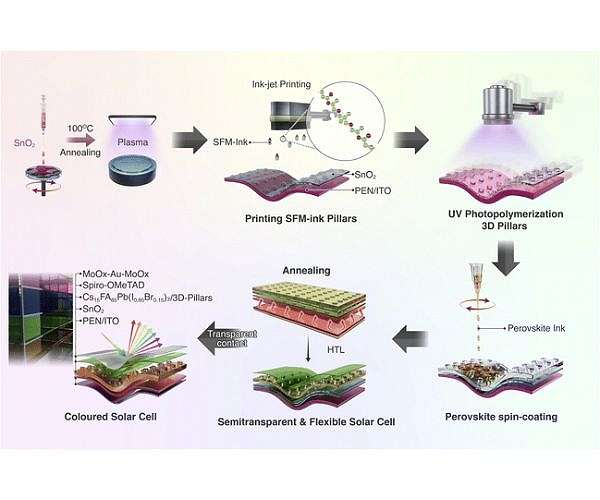
Researchers from the Hebrew University of Jerusalem have developed a semi-transparent, flexible perovskite solar cell that generates electricity while providing control over both light transmission and perceived color for use in windows, building facades and curved surfaces.
The research was led by Prof. Lioz Etgar and Prof. Shlomo Magdassi from the Institute of Chemistry and the Center for Nanoscience and Nanotechnology at the Hebrew University, with a team led by Dr. Vikas Sharma. Their group produced a device that works like an energy-generating film, as designers adjust transparency and color to suit architectural requirements.
At the heart of the design is a pattern of microscopic polymer pillars, created by 3D printing, that form openings that control how much light passes through without altering the perovskite absorbing layer. The manufacturing route avoids high temperatures and toxic solvents, making it compatible with flexible substrates and reducing environmental impact during production.
“Our goal was to rethink how transparency is achieved in solar cells for applications in Building Integrated Photovoltaics,” said Prof. Shlomo Magdassi. “By using 3D printed polymeric structures, we can precisely control how light moves through the device in a way that is scalable and practical for real-world use.”
The team demonstrated that the device’s color can be adjusted by changing the thickness of a transparent electrode layer, which reflects selected wavelengths while the solar cell continues to generate power. This method allows independent tuning of optical appearance and electrical performance, so that solar panels can be integrated into visible surfaces without sacrificing functionality.
“What is particularly exciting is that we can customize both the appearance and the degree of transparency of the device,” said Prof. Lioz Etgar. “That makes this technology particularly relevant for solar windows and for adding solar functionality to existing buildings.”
In laboratory measurements, the flexible perovskite solar cells achieved an energy conversion efficiency of up to 9.2 percent with an average visible transparency of approximately 35 percent. The devices also maintained stable output after repeated bending and long-term use, meeting key requirements for deployment in building environments.
The researchers next plan to focus on improving long-term durability through encapsulation and barrier layers that protect the perovskite from moisture and other degradation routes. This work aims to move the technology to commercial building-integrated solar photovoltaics and other applications where form factor and transparency are critical.
Research report:Semi-transparent perovskite solar cells with color tuning and 3D pillar structure
