

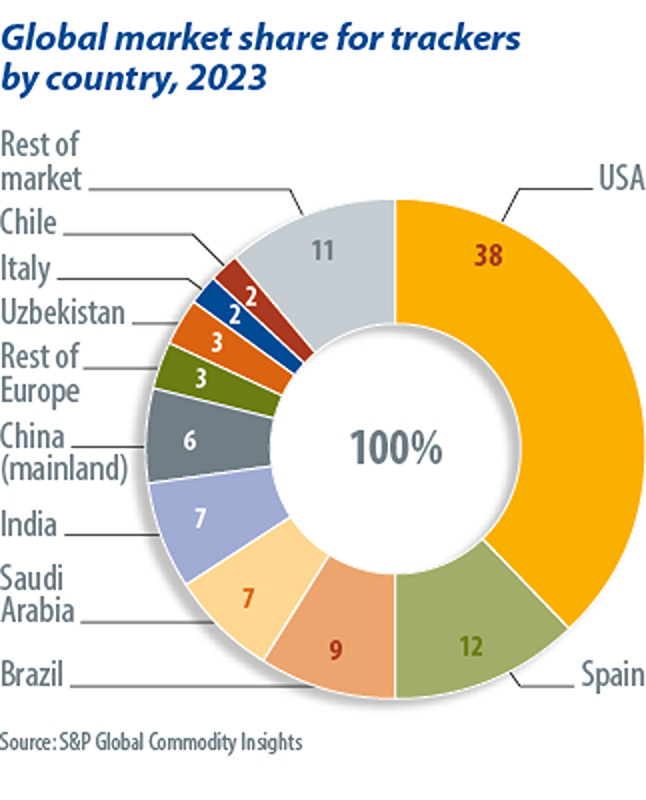
Shipping volumes in the global solar tracker market are growing as innovation in project development drives demand. Joe Steveni of S&P Global Commodity Insights looks at the factors shaping the commercial landscape for trackers, from agricultural voltaics and undulating terrain to Indian ambition and the US Inflation Reduction Act.
Printed edition from pv magazine 24/7
The global solar tracker market reached 94 GW in deliveries in 2023, up from 73 GW in 2022. This was driven by growth outside the three largest tracker markets: the United States, Spain and Brazil. The Saudi Arabian and Indian markets in particular saw high year-on-year growth, driven by increased demand from developers and a rebound in utility-scale installations. These markets ranked fourth and fifth in terms of tracker shipments (see chart above).
Most tracker shipments are concentrated within the 45 degree latitude. This is because using trackers requires north-south oriented rows that track the sun from east to west. By using trackers instead of fixed tilt systems, you lose the ability to tilt the solar panels north or south towards the sun. The use of trackers therefore reduces yield further from the equator.
Dual-in-portrait (2P)-oriented tracker products mount twice as many solar panels per tracker row length. About 15% of tracker shipments in 2023 globally were 2P, but in Europe that number rose to 30%. This is due to land restrictions in certain European markets, as 2P requires fewer poles per kilowatt peak of generation capacity. Some projects also signed contracts a few years ago when 2P products were more commonly used, which helps explain this preference.
Stimulate innovation
Innovation continues to drive the solar tracker market. In the field of agrivoltaics, you often see projects with tracker rows eight to fifteen meters apart, with a special vertical ‘harvesting’ position, so that agricultural vehicles can access the land. There are additional restrictions that determine the minimum height of trackers. For fruit farms, there are overhead trackers that determine how much sunlight reaches the product. These take into account more inputs, such as the crop, temperature and evaporation levels, and must have a more complex tracking algorithm.
Another area of innovation is prefabrication, which was initially used to reduce labor requirements and improve installation speed. New products are emerging that require only a few days per megawatt of generation capacity to be installed by ten to twenty unskilled workers. These products typically do not use poles and are designed to fit a precise number of modules in one shipping container. Importantly, these products can be repackaged into a container and moved to another location. This is extremely useful for off-grid applications where future electricity demand is unpredictable, such as on-site electricity generation in mines.
Tracker suppliers are also releasing terrain-following products suitable for undulating land. This reduces the amount of excavation and filling required to level the ground and ensures projects do not require varying lengths of foundation piles. This also opens up the possibility of developing projects in hilly locations.
Global growth
S&P Global predicts 752 GW of tracker installations between 2024 and 2030, with an increasing number coming from the Asia Pacific and Europe, Middle East and Africa regions. Mainland China is expected to slowly increase tracker adoption and shift from the historical preference for fixed tilt as confidence in tracker technology grows. Saudi Arabia already has high adoption of trackers. Strong growth in the utility segment, complemented by potential green hydrogen locations by 2030, will further drive the supply of trackers. India is starting to see increasing adoption of trackers with growing confidence in the technology, driven by relationships between major tracker suppliers and local engineering, procurement and construction companies. India is also close to the equator and has low labor costs, making it ideal for trackers, due to the lower installation, operation and maintenance costs associated with labor. However, utility-scale installations in both Spain and Brazil are expected to decline by 2030, due to grid problems and falling prices for power purchase agreements, respectively.
S&P Global said the United States will account for 39% of tracker installations over the 2024-2030 period (see chart at right). Currently, the Inflation Reduction Act (IRA) in the United States provides incentives in the form of tax credits, often called “adders,” to increase domestic production. The IRA breaks down the estimated cost percentages for various components of a utility-scale solar project. The three main segments are modules, trackers and inverters; 66%, 9% and 25% of the equipment respectively. These segments are further divided into subcategories. To qualify for a tax adder, developers must have 40% of their project equipment manufactured in the United States, a figure that later increases to a higher percentage. To meet this new demand from developers, some tracker vendors have launched “IRA-friendly” products, more of which are manufactured in the United States. Nextracker, Array Technologies, GameChange, PV Hardware, FTC Solar, OMCO Solar and Nevados all have US manufacturing facilities.
The solar tracker industry will experience strong growth and rapid transformation in the coming years. With evolving markets and production locations, suppliers will need to continuously innovate to make previously unviable projects feasible. This dynamic landscape presents exciting opportunities for the industry to push boundaries and drive solar adoption.
This content is copyrighted and may not be reused. If you would like to collaborate with us and reuse some of our content, please contact: editors@pv-magazine.com.
