

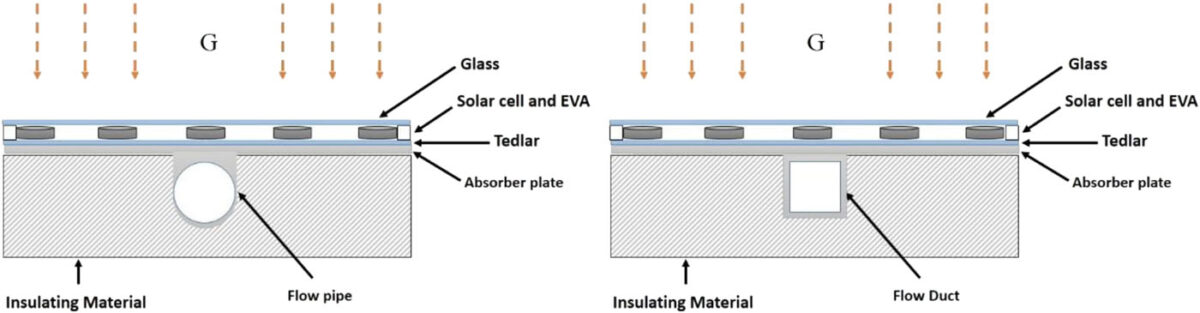
Scientists have modeled eight different types of PVT systems, some with glass covers and some without. They found that the worst efficiency was achieved in uncovered systems with parallel circular tubes.
A group of international researchers have investigated how different designs affect photovoltaic-thermal (PVT) module efficiency.
The scientists modeled eight different types of PVT systems in software and compared them under the same conditions.
“This study aims to compare how well different designs of combined photovoltaic and thermal collectors work in producing electricity and heat,” they said. “They were compared under conditions of radiation of 1,000 W/m2, an ambient temperature of 40 C, an inlet water temperature of 45 C and a wind speed of 1 m/s.”
Based on the first law of thermodynamics and numerical modeling in MATLAB, the academics designed eight models. Four of these were PVT collectors without a glass cover and four with a glass cover. In each of these groups, the four thermal collectors were modeled with a spiral of round tubes or parallel rectangular tubes, parallel square tubes and parallel round tubes. In all parallel settings the module also had a metal plate. Water was the working fluid in all cases.
To validate their models, the academic group measured the results using two 40W PV modules they obtained. “The results show a good match between the parameters calculated in the current work and the experiments, and since the error in each test is less than 4%, the mathematical modeling used is correct,” they said.
First they compared a simple, non-thermal PV module with a coated and uncoated PVT unit. In this case, the PV panel has achieved a power of 50.35 W, an electrical efficiency of 9.8% and a temperature of 75 C at the back. The coated PVT module delivered 53.7W of power with an efficiency of 11.2%, with back temperatures of 42.3C. The uncoated unit recorded 59.2W, 11.2% and 41.2C respectively .
“Adding a glass cover to the PVT collector will make it more efficient at heating,” they add. “However, when the PVT collector does not have a cover, the photovoltaic module cools better and is more efficient in producing electricity than the regular photovoltaic module and PVT collector.”
When they compared all eight PVT modules of the different configurations, they found that the one with round parallel tubes and a glass cover had the best overall efficiency of 68.90%, followed by covered parallel rectangular tubes at 67%. The lowest performance was from the bare parallel circular tubes at 53.43%, while the bare spiral tube achieved slightly better results at 54.73%.
The results are presented in “Design and theoretical study of a new configuration of photovoltaic/thermal (PVT) solar collectors”, published in AIP progress. It consisted of scientists from the Algerian University Yahia Fares of Medea and the University of Medea, the King Fahd University of Petroleum and Minerals in Saudi Arabia, the Al-Albayt University of Jordan, the Islamic University of Iraq, Najaf, the Islamic University from Al Diwaniyah, the Islamic University of Babylon, Al-Ayen University, Al-Nisour University College and the Afghan University of Kabul.
This content is copyrighted and may not be reused. If you would like to collaborate with us and reuse some of our content, please contact: editors@pv-magazine.com.
