

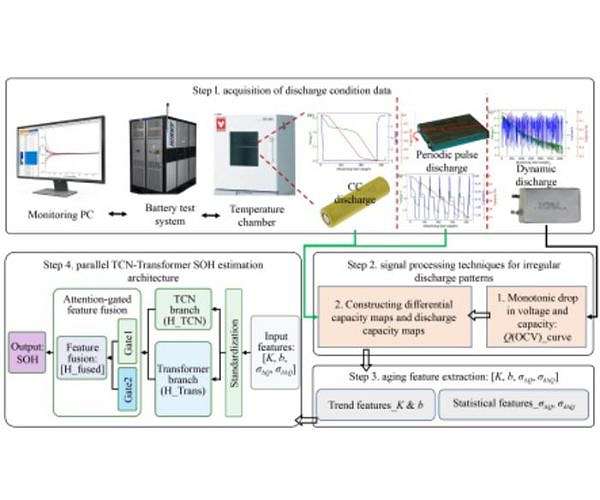
As electric vehicles and networked storage expand globally, engineers are looking for better ways to track how lithium-ion batteries age under real-world driving and operating conditions. A new study supported by Jilin University and China FAW Group reports a deep learning-based method that monitors battery health with errors of less than 1 percent, even when current and voltage vary in complex patterns.
The work appears in the journal ENGINEERING Energy and focuses on health status, a measure of how much usable capacity remains compared to a new cell. Conventional approaches often assume stable operating conditions and can struggle when confronted with non-monotonic voltage curves, irregular charging profiles or partial charge data, all of which are typical of vehicles in daily use.
The research team developed a model they call Parallel TCN Transformer with Attention Gated Fusion or PTT AGF. This architecture runs two analysis streams in parallel, using a Temporal Convolutional Network to learn short-term local patterns in the data, while a Transformer module captures long-range temporal dependencies and broader aging trends.
To feed these networks, the method extracts four health-related features from dynamic load segments that strongly correlate with actual health status. The authors report that the correlation coefficients between these developed indicators and laboratory-measured health values are higher than 0.95, providing a compact but information-rich description of the battery’s condition.
An attention-dependent fusion block then combines the outputs of the TCN and the Transformer. This mechanism assigns adaptive weights to each feature stream, allowing the model to emphasize the patterns that are most informative at a given point in the battery life, while downplaying noise or less relevant signals.
The team validated PTT AGF against three benchmark datasets from MIT, CALCE and Oxford covering different cell chemistries, capacities and cycling protocols. Across these tests, the model produced a root mean square error of less than 1 percent in all operational scenarios, a margin that the authors say outperforms many existing recurrent and convolutional neural network-based methods.
On the CALCE data the reported error is about 0.44 percent, and on the MIT dataset the error is about 0.77 percent. The model also maintained high accuracy when only partial segments of the loading curve were available, demonstrating its robustness when data are incomplete or measurements are noisy.
In addition to raw accuracy, the researchers also examined how the attention mechanism behaves as the batteries age. They found that the learned attention patterns map onto known degradation mechanisms, suggesting that the model is not only predictive but also provides some interpretability about which parts of the signal reflect capacity loss and internal changes.
According to the team, this combination of feature engineering, parallel deep learning and attention-driven fusion could support more reliable battery management systems in electric vehicles and energy storage systems. Better health status tracking can enable safer operation, more accurate range prediction, and optimized charging strategies that extend battery life and reduce costs for manufacturers and users.
Research report: Parallel deep learning with attention-dependent fusion for robust battery status monitoring under dynamic operating conditions
