Radiant cooling is an emerging technology that has the potential to improve the performance and longevity of PV modules. Researchers from the Lyon Institute of Nanotechnology explain how this technology can reach commercial maturity.
The partial conversion of sunlight into electricity by solar panels results in heating, where the temperature can reach 50-60 C, which significantly reduces both their efficiency and their lifespan. Controlling this heat is essential to maintaining the performance and sustainability of photovoltaic systems as they expand globally.
Imagine a world where solar panels achieve unprecedented efficiency by harnessing the natural cooling power of the air. This is not a futuristic concept; Radiant cooling is an emerging technology that has the potential to improve the performance and longevity of PV modules, making this vision a reality.
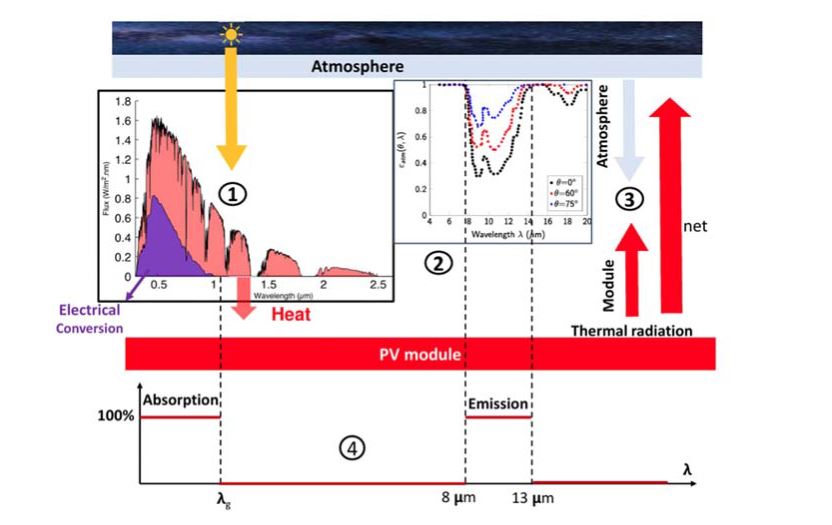
Because PV systems have large surfaces facing the sky, they are ideal candidates for this technique, which takes advantage of Earth’s atmospheric transparency in the 8-13 μm range to improve radiant heat transfer. Improving radiant cooling systems in practice
(RCS) involves fine-tuning the optical absorption and thermal emission in the infrared range while minimizing the absorption of sub-bandgap photons.
To achieve this, several scientific and technical challenges must be overcome. These include maintaining high absorption in silicon solar cells over the spectral range of 0.3-1.1 μm through improved PV module optical designs and optimizing thermal emission in the infrared range beyond the band gap (λg=1 .1 μm).
Image: Lyon Institute of Nanotechnology
However, the real appeal of radiant cooling lies in its simplicity and durability. Unlike conventional cooling methods that often require energy and complex systems, radiant cooling works passively, driven by interaction with the environment. It fits perfectly with the principles of renewable energy: clean, efficient and endlessly renewable.
Recent developments in radiant cooling show promise for improving the efficiency of PV modules. For example, photonic crystals from silica have been shown to reduce the temperature of silicon PV absorbers by up to 13°C. Similarly, pyramid structures made of polydimethylsiloxane (PDMS) have proven effective in improving broadband thermal emission, further improving cooling efficiency.
Building on these innovations, recent research has shown that applying a multi-layer coating of titanium oxide (TiO2) and silicon oxide (SiO2) can reduce the temperature of PV modules by 3 C and increase power by 4.6 W/m².
Another promising approach includes a V-shaped, double-sided radiant cooling design, which has been shown to reduce PV module operating temperatures by up to 10.6 C, leading to a significant 0.80 V increase in output voltage.
These findings highlight the diverse strategies being explored to optimize thermal management in PV systems, paving the way for more efficient and sustainable solar energy solutions.
In conclusion, radiant cooling is more than just a technological innovation; it illustrates how natural forces can be harnessed to promote renewable energy. By harnessing the cooling power of the air, passive thermal management will be essential to maximizing the potential of our solar resources, ensuring that the energy captured from the sun is used as efficiently as possible.
Authors: M. Amara, E. Drouard
This article is part of a series contributed by RD20a global initiative of leading research institutes from the G20 countries and regions with the aim of strengthening international cooperation in R&D and promoting innovation towards a carbon-neutral society.
Articles under this column are contributed by individual RD20 member institutions and are the sole property of the designated author(s).
For more information: https://rd20.aist.go.jp/
The views and opinions expressed in this article are those of the author and do not necessarily reflect those of the author pv magazine.
This content is copyrighted and may not be reused. If you would like to collaborate with us and reuse some of our content, please contact: editors@pv-magazine.com.
Popular content