

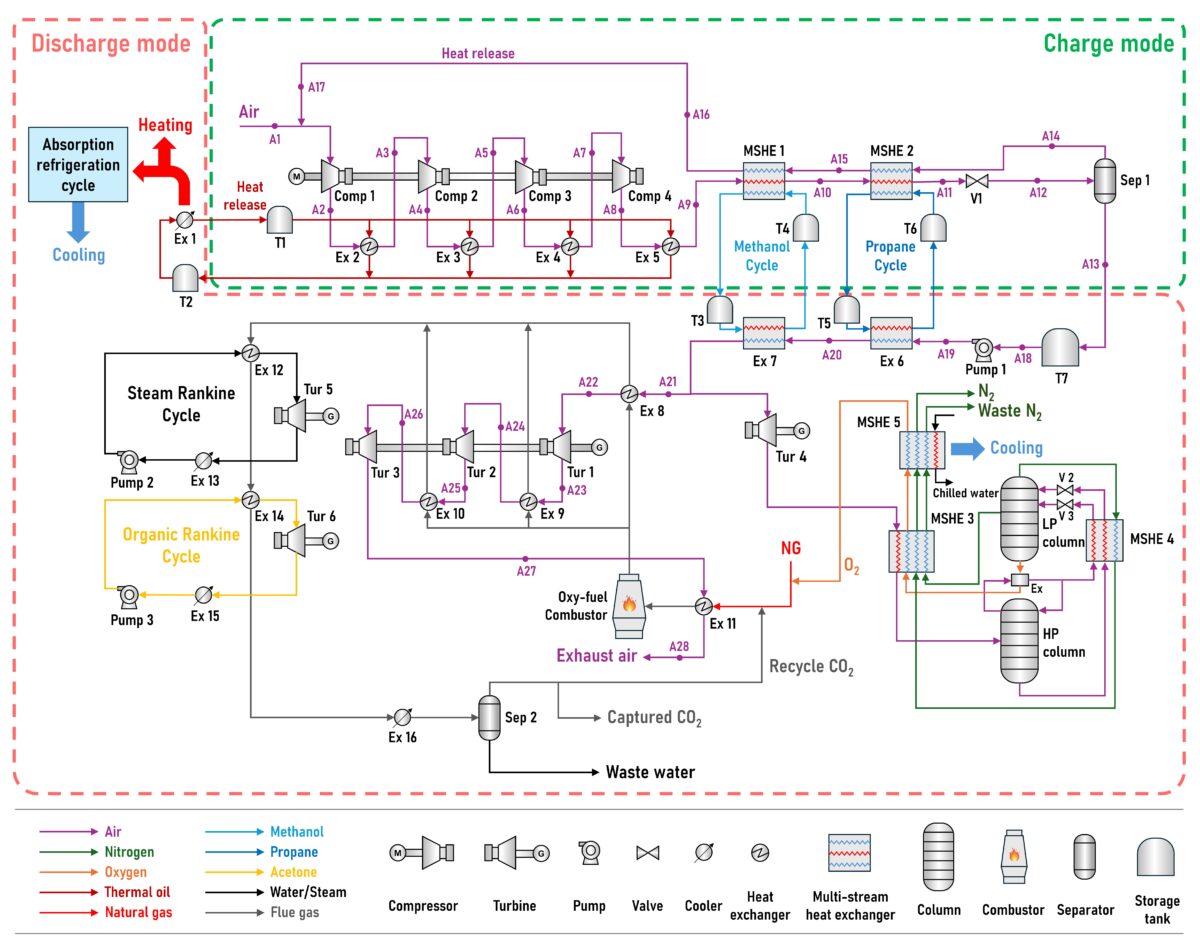
Korean scientists have designed a liquid air energy storage (LAES) technology that reportedly overcomes the main limitation of LAES systems: their relatively low round trip efficiency. The new system improves efficiency by increasing power through thermal energy generation using natural gas as an external fuel during energy release.
Researchers at Dongguk University in South Korea have designed a standalone liquid air energy storage system (LAES) that reportedly shows significant improvements in both energy efficiency and economic performance compared to conventional LAES.
“LAES systems have attracted significant interest in the energy storage sector due to their high energy density and geographic independence,” the study’s lead author Jinwoo Park said. pv magazine. “However, a major limitation of these systems is their relatively low return efficiency compared to other energy storage systems, such as pumped hydro storage (PHS) and compressed air energy storage (CAES).”
Although previous studies have examined how to improve the round-trip efficiency of LAES systems by integrating external thermal systems or using external fuels, several critical challenges still remain, according to Park.
“First, the integration of the LAES system with external thermal systems requires adjacent thermal power plants or industrial facilities,” he added. “This requirement limits the inherent advantage of LAES systems, which is their ability for independent installation and operation. Secondly, integration with high temperature and cryogenic heating systems, which is essential for maximizing the efficiency of LAES systems, can limit the ability to reuse heat for other applications as these systems often rely on waste heat to improve their efficiency . Finally, the use of external fuels is associated with CO2 emissions, even though it can increase the efficiency of LAES systems. Many studies overlook these associated emissions, which can lead to environmental problems and pose a significant barrier to the development of sustainable energy systems.”
In the newspaper “Liquid air energy storage system with oxygen combustion for clean energy supply: comprehensive energy solutions for power, heating, cooling and carbon capture”, published in Applied energyPark and his colleagues explained that the proposed system improves efficiency by increasing power production through thermal energy generation using natural gas as an external fuel during energy release. To generate thermal energy, the oxygen-fuel combustion method is used and a cryogenic air separation unit (ASU) separates part of the stored liquid air into nitrogen and oxygen. The separated oxygen is then used as an oxidant in the combustion reaction. Furthermore, economic benefits can be achieved by selling the nitrogen produced as a by-product.
“The flue gas released from the oxygen-fuel combustion process is dehumidified to facilitate the efficient capture of CO2,” Park said. “In addition, the heat generated during the air compression process is stored in a thermal fluid and then used for direct heating and cooling via the absorption refrigeration cycle (ARC).”
The research group conducted an energy and economic analysis of the system and compared its performance with that of a conventional LAES system, with both systems designed with a capacity to store 100 MW of power. During discharge mode, the conventional system was found to generate 51.41 MW, while the proposed system can produce 118.19 MW, which represents an improvement of 129.9% over the conventional system. In addition, the proposed system can provide 38.64 MW for heating and 81.07 MW for cooling. Although the exergy efficiency of the proposed system is 1.32% lower than that of the conventional system, this decrease is reportedly offset by a significant improvement in return efficiency, which is 56.7% higher.
“The overall performance of the proposed system is superior, primarily due to the increased power and improved return efficiency,” Park said. “These improvements highlight that the proposed system has the potential for more efficient energy storage and use, making it a promising solution for future energy needs.”
The research team also found that the total cost of the conventional system is $553.65 million, while the total energy sales are $245.08 million, resulting in a negative cost balance. Moreover, the net present value (NPV) is negative at $258.34 million, indicating that the system is not economically viable. According to the scientists, this is mainly due to the low efficiency of the system, which, according to the scientists, causes operating costs to exceed turnover because insufficient power is supplied in relation to consumption. In contrast, the proposed system has total costs of $832.20 million and total revenues of $1,708.38 million, resulting in a positive cost balance.
“The proposed system shows an economically viable NPV of $636.51 million and an internal rate of return (IRR) of 25.67%,” Park added. “The total cost of the proposed system increased by 47.58% compared to the conventional system. Specifically, capital costs increased significantly by 71.55% due to several factors: the improved power of the turbines, adjustments to the heat exchange system to improve efficiency, and the installation of additional equipment. Operating costs also increased by 37.01% due to the additional use of natural gas as an external fuel. Despite these cost increases, electricity sales have more than doubled thanks to significant improvements in system efficiency. In addition, the additional income from the sale of nitrogen and the supply of cooling and heating contributed to a remarkable increase of 597.07% in total turnover.”
According to the research group, the new system effectively addresses limitations identified in previous studies, such as challenges
when integrating other thermal systems and using external fuels. In particular, it overcomes the limitations of existing thermal integration methods, which rely on dedicated thermal power plants or industrial facilities, and addresses the CO2 emissions associated with external fuel use.
“In conclusion, the proposed LAES system represents promising technology for the future of sustainable energy supply and is expected to provide valuable insights for the development of efficient energy systems to achieve a carbon-neutral society,” affirmed Park.
This content is copyrighted and may not be reused. If you would like to collaborate with us and reuse some of our content, please contact: editors@pv-magazine.com.
