

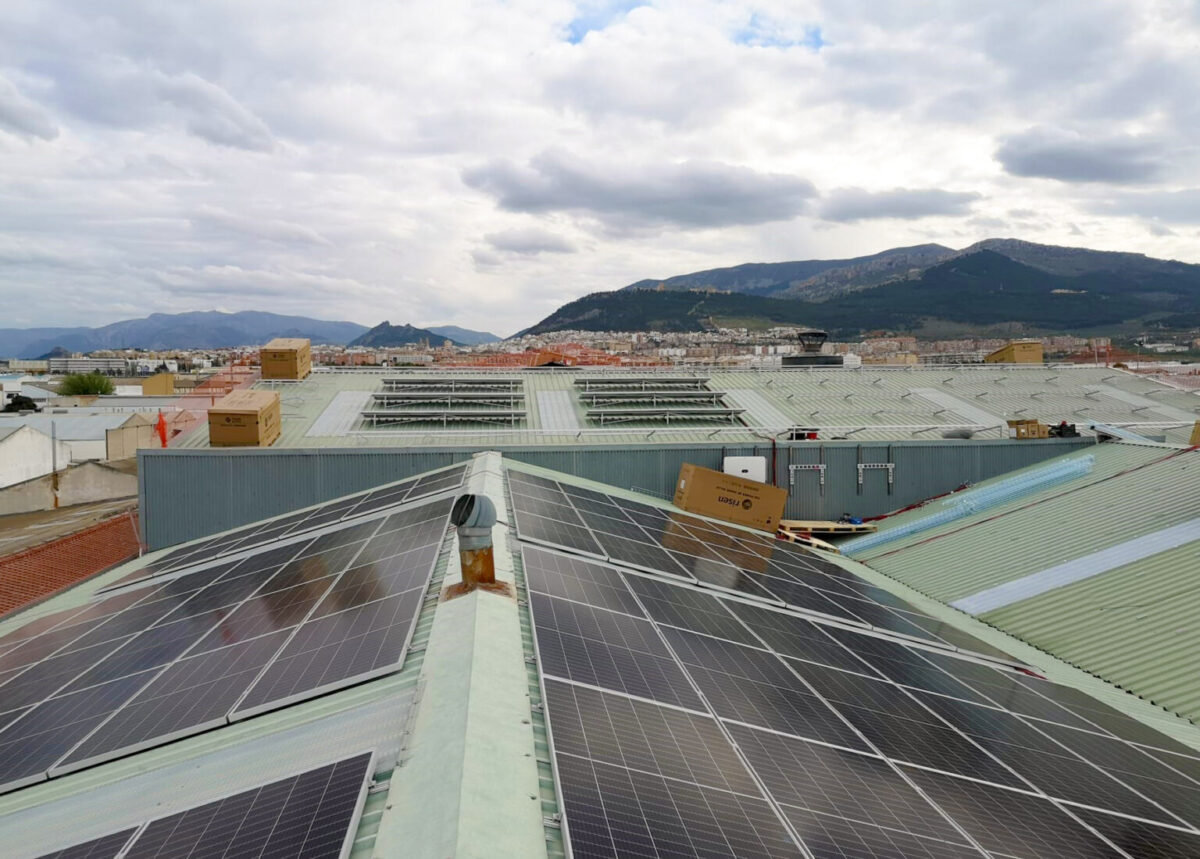
Researchers in Italy have investigated the potential of deploying energy communities based on east-west PV systems and concluded that these projects, despite their lower energy yields compared to south-oriented installations, show higher shared energy values. However, they also warned that the presence of a net metering system is critical to making the east-west layout the preferred option.
A group of researchers led by the Politecnico di Torino in Italy investigated the optimal orientations and tilt angles for PV systems used in energy communities and found that east-west oriented arrays deliver higher shared energy values than south-oriented installations.
It is generally accepted that the east-west orientation is more suitable for high latitudes with little solar radiation, allowing the use of sunlight in the first and last hours of the day. However, these projects can also be the ideal solution in tropical locations or in areas with limited available space, such as commercial rooftops.
First, the east-west solar panel configuration produces a more stable and consistent output throughout the day compared to a conventional south-facing installation. In addition, it reduces the central power peak around noon and extends the duration of solar production in the early and late hours of the day, with the solar panels starting to produce at sunrise and continuing to produce until sunset. This makes the systems preferred by grid operators, because the power is supplied more evenly throughout the day; but it also stimulates household self-consumption in the afternoon, when users are at home more often.
In addition, shadow areas between rows of solar panels are avoided. Installations with south-facing solar panels, on the other hand, produce shade from the front rows on the back rows. Third, the more compact installation of solar panels in east-west arrays increases the density of energy production per m2. This is especially attractive on small roofs where this system allows up to 30% more density per square meter.
Another notable point is the greater tolerance for wind. With a slope angle of 15 degrees and an east-west configuration, wind pressure is drastically reduced compared to a south-facing configuration, which is much more vulnerable to northerly winds. An aspect derived from the previous point is that east-west solar systems, due to less exposure to wind, require much less counterweight to secure the solar panels to the roof. This makes installation possible on less robust roofs, or on roofs with other facility installations.
In the newspaper “Shared energy in sustainable energy communities: the benefits of east- and west-facing photovoltaic installations,” published in Energy reportsthe Italian research group explained that the tilt angle of PV is often neglected in the scientific literature on energy communities, and stated that the novelty of their work consisted in outlining geometric parameters on roofs on the synchronism between generation and demand profile for different orientations and tilt angles . They also specified that their modeling was based on the assumption that the energy community’s PV systems have the ability to sell excess power to the grid under a net metering regime, and that the community is formed by households sharing the same common interconnection point. .
Through a Monte Carlo simulation model, the group analyzed an energy community of 60 users dependent on PV systems totaling 150 kW, with the arrays owned by 30 users. “All results from the simulations are presented with a 95% confidence interval, highlighting the statistical reliability of our findings,” the academics said. “Additionally, assuming the PV systems are aligned with the orientation of the roof on which they are installed, all PV systems have the same orientation and tilt angle.”
The analysis showed that while the simulated community using south-facing PV systems can achieve higher energy yields, the community based on east-west arrays offers the benefit of higher shared energy values, which the scientists said depends on a better synchronicity between PV energy demand and generation during the early morning and late afternoon. “The energy consumed virtually by the energy community itself reaches the highest value for south-facing PV orientation, at the expense of a higher injection peak into the grid,” they further explained. “This is an important aspect in contexts where absolute energy sharing within the energy community is explicitly encouraged, such as in Italy.”
However, they also pointed out that their findings may not apply to high PV penetration scenarios without net metering systems in place. “Our research was limited to one location. While this specificity allows for detailed analysis, results may be affected by variations in PV output from other regions,” they also warned. “The results argue for a more inclusive approach to the design and planning of energy communities. Rather than an overemphasis on south-facing PV installations, a wide range of orientations and slopes should be considered.”
This content is copyrighted and may not be reused. If you would like to collaborate with us and reuse some of our content, please contact: editors@pv-magazine.com.
