Close Menu
  • News
  • Industry
  • Solar Panels
  • Commercial
  • Residential
  • Finance
  • Technology
  • Carbon Credit
  • More
    • Policy
    • Energy Storage
    • Utility
    • Cummunity
What's Hot

Vistra adds Enphase batteries to the Texas VPP program

March 6, 2026

ACME Solar signs 450 MW PPA in India, commissions new 38 MW/82 MWh BESS – SPE

March 6, 2026

Freight costs are rising due to military attacks in the Middle East

March 6, 2026
Facebook X (Twitter) Instagram
Solar Energy News
Friday, March 6
  • News
  • Industry
  • Solar Panels
  • Commercial
  • Residential
  • Finance
  • Technology
  • Carbon Credit
  • More
    • Policy
    • Energy Storage
    • Utility
    • Cummunity
Solar Energy News
Home - Solar Industry - New model to generate high-resolution annual solar energy potential maps
Solar Industry

New model to generate high-resolution annual solar energy potential maps

solarenergyBy solarenergyDecember 23, 2024No Comments3 Mins Read
Facebook Twitter Pinterest LinkedIn Tumblr Email
Share
Facebook Twitter LinkedIn Pinterest Email

Researchers in Iran have used digital elevation models to improve the accuracy of solar energy potential maps. Their model aims to identify the best areas for solar panel deployment in urban areas.

December 23, 2024
Emiliano Bellini

Researchers from the University of Isfahan in Iran claim to have improved the precision of digital elevation models (DEMs) in creating high-resolution annual solar energy potential maps.

DEMs are 3D images of the bare Earth’s surface of land, shown without trees, buildings, or other objects. In terms of their application in creating solar energy maps, these images take into account elevation, slope, aspect and shadow effects, among other things. DEMs such as SRTM, ALOS, ASTER and Copernicus are available online as open access tools and are currently widely used to generate solar maps.

“Thanks to their extensive spatial coverage, they enable the production of solar energy potential maps in most less developed areas, at a lower cost,” the scientists explained. “However, the low resolution of these DEMs compared to those obtained from LiDAR data reduces the accuracy of extracting maps of solar potential, which poses limitations for the precise location placement of solar panels, especially in urban areas and in the area of ​​highways,” she added. noting that the LiDAR method, which measures distances by using a laser on a target, has high costs and significant storage requirements.

The research group proposed to overcome these limitations by using deep learning networks to improve the resolution of DEMs. The work mainly consisted of training the DEMs to improve the spatial resolutions of the solar energy maps and identify the best areas for deploying solar panels in urban areas.

See also  Senate approves the budget law without the excise duty of solar energy
Structure of the single-scale EDSR super-resolution network used in the study

Image: University of Isfahan, Helyion, Common License CC BY 4.0

The academics used the enhanced deep super-resolution network (EDSR) to improve the resolution of the LiDAR-derived solar map. The EDSR is a convolutional neural network suitable for improving the spatial resolution of images and widely used in computer vision tasks.

The performance of this network in improving the accuracy of the generated solar energy maps was compared with that of the U-Net network, a convolutional network technique used for fast and accurate segmentation of images.

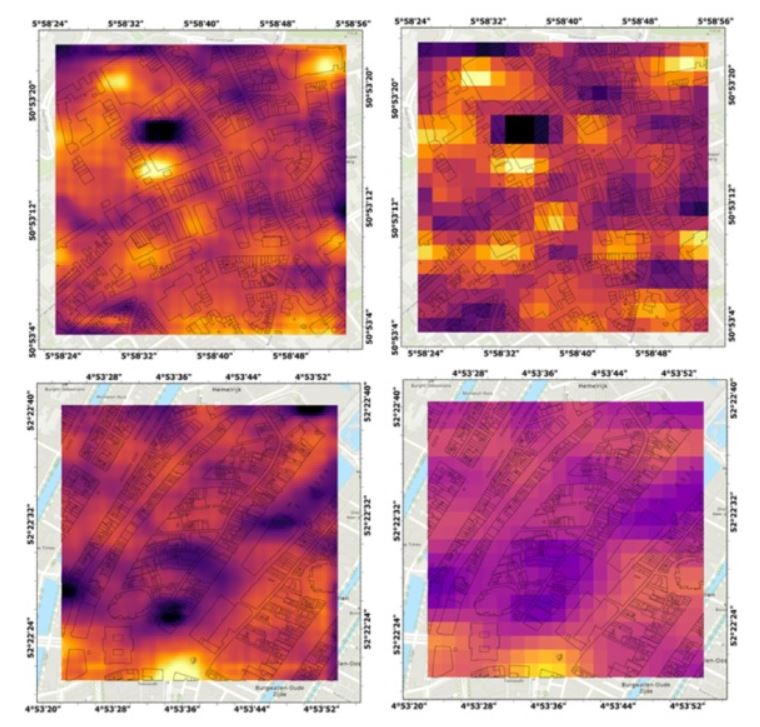
The scientists found that the EDSR model was the most accurate and stable at improving the accuracy of solar potential maps. They then used the model to improve the resolution of a Copernicus DEM-derived solar energy potential map from 30 m to 6 m.

“A comparative analysis between the Copernicus DEM-based map and the EDSR-enhanced map, using a LiDAR-based reference, showed that the EDSR model not only improved the resolution of the map, but also the accuracy of the estimate of solar energy improved, especially in urban areas and along major highways,” the research team emphasized. “Finally, the enhanced 6 meter resolution map was assessed for its effectiveness in identifying suitable buildings for solar panel installation.”

The details of the modeling are available in the paper “Improving the resolution of solar potential maps derived from global DSMs for rooftop solar deployment using deep learning”, published in Helyion.

This content is copyrighted and may not be reused. If you would like to collaborate with us and reuse some of our content, please contact: editors@pv-magazine.com.

See also  Improving the performance of vertical bifacial PV systems with luminescent free-space solar concentrators

Popular content

Source link

Annual Energy generate highresolution maps model potential solar
Share. Facebook Twitter Pinterest LinkedIn Tumblr Email
solarenergy
  • Website

Related Posts

ACME Solar signs 450 MW PPA in India, commissions new 38 MW/82 MWh BESS – SPE

March 6, 2026

Freight costs are rising due to military attacks in the Middle East

March 6, 2026

A deep learning model tracks the status of the EV battery with high precision

March 6, 2026
Leave A Reply Cancel Reply

Don't Miss
Policy

Metal producer signs PPA in Zambia – SPE

By solarenergyAugust 28, 20240

Jubilee, a UK-based diversified metals producer, has signed a three-year power purchase agreement (PPA) with…

Seris launches Solar Asset Management Spinoff – PV Magazine International

April 7, 2025

Vietnam is more cost competitive than India in PV module production, says IRENA

February 5, 2026

Can Solar Help Combat Urban Light Pollution? (2025)

July 16, 2025
Stay In Touch
  • Facebook
  • Twitter
  • Pinterest
  • Instagram
  • YouTube
  • Vimeo
Our Picks

Vistra adds Enphase batteries to the Texas VPP program

March 6, 2026

ACME Solar signs 450 MW PPA in India, commissions new 38 MW/82 MWh BESS – SPE

March 6, 2026

Freight costs are rising due to military attacks in the Middle East

March 6, 2026

Solis launches new portfolio of residential storage systems – SPE

March 6, 2026
Our Picks

Vistra adds Enphase batteries to the Texas VPP program

March 6, 2026

ACME Solar signs 450 MW PPA in India, commissions new 38 MW/82 MWh BESS – SPE

March 6, 2026

Freight costs are rising due to military attacks in the Middle East

March 6, 2026
About
About

Stay updated with the latest in solar energy. Discover innovations, trends, policies, and market insights driving the future of sustainable power worldwide.

Subscribe to Updates

Get the latest creative news and updates about Solar industry directly in your inbox!

Facebook X (Twitter) Instagram Pinterest
  • Contact
  • Privacy Policy
  • Terms & Conditions
© 2026 Tsolarenergynews.co - All rights reserved.

Type above and press Enter to search. Press Esc to cancel.