
Close Menu
  • News
  • Industry
  • Solar Panels
  • Commercial
  • Residential
  • Finance
  • Technology
  • Carbon Credit
  • More
    • Policy
    • Energy Storage
    • Utility
    • Cummunity
What's Hot

Lithuanian grid operators can now shut down solar power plants without cybersecurity measures

June 8, 2026

Dutch solar owners asked to switch off during peak periods to ease the distribution crisis

June 7, 2026

The hydrogen flow: Toyota demonstrates its racing prototype on liquid hydrogen

June 7, 2026
Facebook X (Twitter) Instagram
Solar Energy News
Monday, June 8
  • News
  • Industry
  • Solar Panels
  • Commercial
  • Residential
  • Finance
  • Technology
  • Carbon Credit
  • More
    • Policy
    • Energy Storage
    • Utility
    • Cummunity
Solar Energy News
Home - News - Self-charging solar supercapacitors introduced in Korea
News

Self-charging solar supercapacitors introduced in Korea

solarenergyBy solarenergyJanuary 1, 2025No Comments2 Mins Read
Facebook Twitter Pinterest LinkedIn Tumblr Email
Share
Facebook Twitter LinkedIn Pinterest Email

Self-charging solar supercapacitors introduced in Korea


A joint research effort led by Jeongmin Kim, senior researcher at Daegu Gyeongbuk Institute of Science and Technology (DGIST), and Damin Lee, researcher at RLRC of Kyungpook National University, has achieved a groundbreaking milestone in the field of energy storage. The team successfully developed Korea’s first self-charging supercapacitor system by integrating solar energy technology with advanced supercapacitors, opening a new horizon for renewable energy applications.

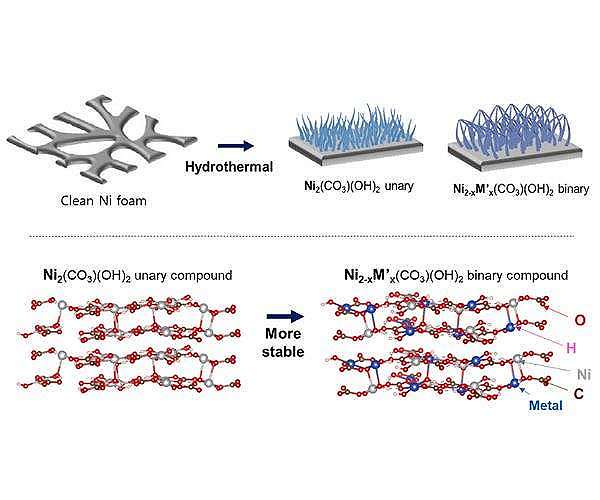
The researchers addressed the limitations of traditional energy storage devices by using transition metal-based materials for the electrodes. Specifically, they designed electrodes using a nickel-based carbonate and hydroxide composite material, further improving performance through the incorporation of metal ions such as Mn, Co, Cu, Fe and Zn. This innovation led to significant improvements in conductivity, stability and overall efficiency.

The resulting device showed an impressive energy density of 35.5 Wh kg, far exceeding previous benchmarks of 5-20 Wh kg. In addition, the power density reached 2555.6 W kg, which is more than double the previous average of about 1000 W kg. This advancement enables rapid energy delivery, making it suitable for high-power applications. Long-term durability was also validated, with minimal degradation observed during repeated charge-discharge cycles.

To take the innovation further, the team developed a hybrid energy system that combines silicon solar cells with supercapacitors. This integration enables real-time solar energy capture and storage, achieving a storage efficiency of 63% and an overall system efficiency of 5.17%. The combined system represents an important step toward commercializing self-charging energy technologies.

“This study is a significant achievement as it marks the development of Korea’s first self-charging energy storage device that combines supercapacitors with solar cells. By using transition metal-based composite materials, we have overcome the limitations of energy storage devices and presented a sustainable solution.” energy solution,” said Jeongmin Kim, senior researcher at DGIST. Damin Lee from Kyungpook National University added: “We will continue to conduct follow-up research to further improve the efficiency of the self-charging device and increase its commercialization potential.”

See also  Gore Street will roll out Arenko software across 18 projects

Research report:Design of high-performance binary carbonate/hydroxide Ni-based supercapacitors for photo-storage systems


Source link

introduced Korea Selfcharging solar supercapacitors
Share. Facebook Twitter Pinterest LinkedIn Tumblr Email
solarenergy
  • Website

Related Posts

Lithuanian grid operators can now shut down solar power plants without cybersecurity measures

June 8, 2026

Dutch solar owners asked to switch off during peak periods to ease the distribution crisis

June 7, 2026

Letter from China’s PV Industry: Arctech wins 2.1 GW solar deal

June 5, 2026
Leave A Reply Cancel Reply

Don't Miss
News

Quality control in synthetic photosynthesis validates the mimicry of natural light

By solarenergyOctober 29, 20240

Quality control in synthetic photosynthesis validates the mimicry of natural light Humans can do many…

Iberdrola deploys Spain’s largest battery systems – SPE

January 29, 2026

Asymmetrical cascade inverter at 49 level for PV applications

April 15, 2025

German network agency will soon release the BESS network reimbursement framework – SPE

April 1, 2026
Stay In Touch
  • Facebook
  • Twitter
  • Pinterest
  • Instagram
  • YouTube
  • Vimeo
Our Picks

Lithuanian grid operators can now shut down solar power plants without cybersecurity measures

June 8, 2026

Dutch solar owners asked to switch off during peak periods to ease the distribution crisis

June 7, 2026

The hydrogen flow: Toyota demonstrates its racing prototype on liquid hydrogen

June 7, 2026

Era of electrification exposing Australia’s weakest link

June 6, 2026
Our Picks

Lithuanian grid operators can now shut down solar power plants without cybersecurity measures

June 8, 2026

Dutch solar owners asked to switch off during peak periods to ease the distribution crisis

June 7, 2026

The hydrogen flow: Toyota demonstrates its racing prototype on liquid hydrogen

June 7, 2026
About
About

Stay updated with the latest in solar energy. Discover innovations, trends, policies, and market insights driving the future of sustainable power worldwide.

Subscribe to Updates

Get the latest creative news and updates about Solar industry directly in your inbox!

Facebook X (Twitter) Instagram Pinterest
  • Contact
  • Privacy Policy
  • Terms & Conditions
© 2026 Tsolarenergynews.co - All rights reserved.

Type above and press Enter to search. Press Esc to cancel.