

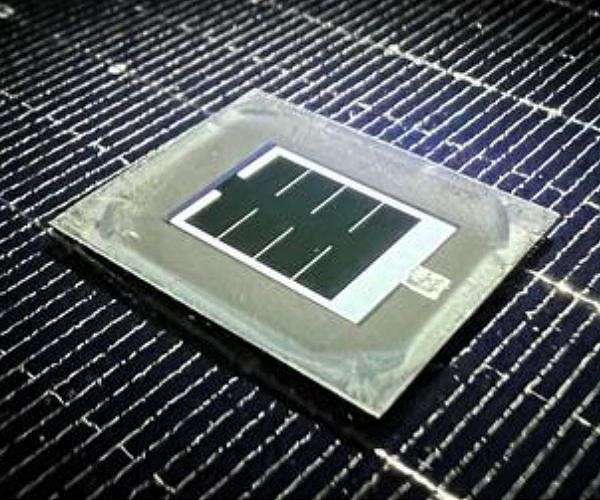
Small grooves unlock a new potential in the production of solar cells
A breakthrough in solar energy technology has been reached by researchers from the University of Sheffield, in collaboration with the British company Power Roll Ltd. Their study, published in *ACS Applied Energy Materials *, introduces an innovative method for producing flexible solar cells without the use of rare earth metals, which offer a more affordable and efficient approach to solution capacity.
The newly developed solar cells use a perovskiet semiconductor and are manufactured using an embossing technique that etching microscopic grooves in plastic film. These grooves are then filled with the perovskiet material, resulting in lightweight and flexible solar films that can be applied to unconventional surfaces, such as roofs that cannot support conventional solar panels. With their lower costs and adaptability, these cells have the potential to speed up the implementation of solar energy, in particular in the development of regions where access to the traditional solar infrastructure is limited.
The most important innovation in this technology is the back cell format of the recurrence of solar cells, which differs from traditional layered solar cells. By placing all electrical contacts at the back of the cell, this design simplifies production and improves efficiency. The research team used a hard X-ray-nanoprobe microscope at diamond light source in Oxfordshire to analyze the structure and composition of the solar cells in unprecedented details. This analysis helped in identifying empty, defects and crystal limits within the semiconductor material, so that the first time that such imaging techniques have been applied to this type of sun technology.
In contrast to conventional solar cells that depend on expensive and scarce materials such as Indium, this new approach, widespread components, uses it, making it an economically viable and sustainable alternative. Professor David Lidzey, co-author of the study and a researcher at the School of Mathematical and Physical Sciences of the University of Sheffield, emphasized the meaning of this progress.
“An important advantage of these flexible films is that the panel can be stuck on any surface. In the UK you currently have to think twice about adding thick solar panels to relatively fragile roofs of warehouses that are not really designed to be load-delay. With this lightweight solar technology you can essentially hold it.
He also emphasized the strategic importance of solar energy research at the university and noted their ten years of collaboration with Power Roll Ltd. “We have been working with Power Roll for more than 10 years, in which our expertise in material sciences and advanced imaging techniques is combined with their focus on production, and this collaboration has been very successful, resulting in this exciting new product.”
The University of Sheffield is recognized worldwide for its leadership in sustainability and advanced production. The cooperation with Power Roll reflects a shared dedication to promoting solutions to renewable energy and promoting innovative technologies that insist on the urgent global energy challenges.
Dr. Nathan Hill, main author of the study and research scientist at Power Roll, underlined the impact of this partnership: “This partnership shows the potential to combine advanced research with industrial innovation to deliver transformative solutions in renewable energy.
He also noted earlier cooperation efforts at the Ministry of Physics and Astronomy of the University to improve the designs of solar cells, which led to reductions of production costs and improvements in the efficiency of solar energy.
With perovskite -based solar technology still at an early stage, constant research and academic exploration are crucial for refining product development and deepening scientific concept. The next phase of this study will focus on promoting X -ray microscopite techniques for further characterization of the material. New experiments planned for the summer at Diamond Light Source are aimed at investigating important aspects of device processing, in particular stability.
Dr. Jessica Walker, I14 Beamline Scientist at Diamond Light Source Ltd., emphasized the importance of these upcoming studies: “The techniques and resolution offered by i14 are ideal for answering scientific questions that are based on perovskite.
Research report:Back contact perovskiet solar cell modules manufactured via roll-to-roll slot-die-coating: scaling up to production
