

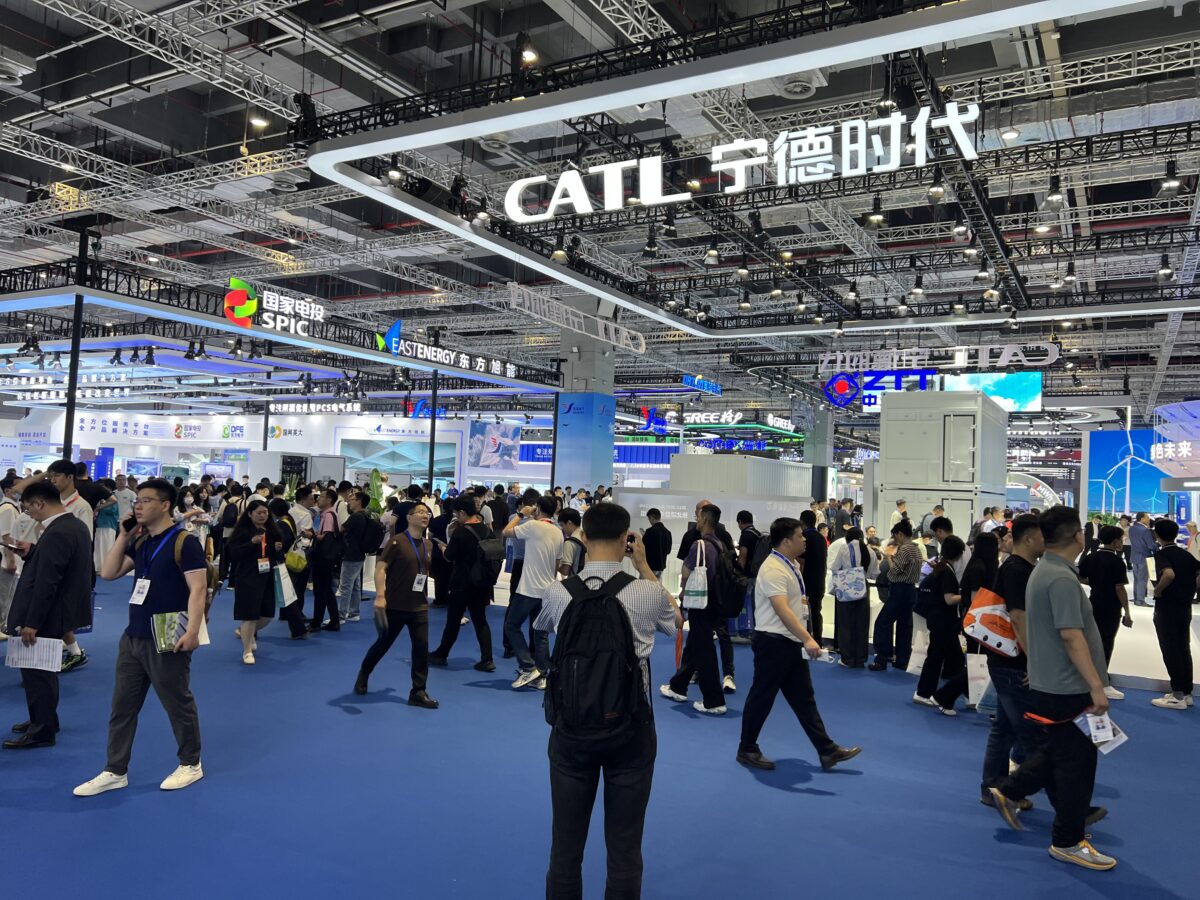
The 2025 edition of the SNEC PV Power Expo, which is currently taking place in Shanghai, China, demonstrates the resilience of the Chinese PV chain in the midst of serious overcapacity.
Despite the low prices and a low or zero margin environment, the largest solar fair in China remained well attended by both domestic and international visitors. This indicates continuing interest in new products and technologies, although the number of product announcements, in particular for PV modules, seems considerably lower than in previous editions.
While more manufacturers showed new prototypes with back-contact (BC) or perovskiet module, Topcon panels continued to dominate as the regular technology during this year’s show. Nevertheless, BC and Perovskite technologies attracted strong interest from potential buyers.
“My feeling is that the event is a little less present than last year,” said Dani Qian, global vice president at Jinkosolar, told PV -Magazine. “We can see that even manufacturers of top-class stands have less space. As an interesting trend we see an increasing interest in storage products. The entire storage activity is currently more exciting than the PV business thanks to a strong demand.”
Qian said that Jinkosolar will continue to concentrate on PureCon solutions, without hybridizing BC technologies.
“We are firmly convinced that Topcon will remain the dominant technology for many years, especially if we consider the benefits it offers in terms of price and bifaciality,” she said. “As a BC or Heterojunction, the Topcon technology continues to develop and improve, both in terms of costs and efficiency, which is the key to help us maintain a winning position.”
Yang Bao, Global Sales and Marketing President at Trinasolar, said that Snec will remain the best event for presenting new products and innovation.
“This year we have seen an increasing number of storage products being presented, which shows that the storage company has now taken a new dimension,” he said. “Snec offers this unique opportunity to see all storage and sun products in a single exhibition.”
Market uncertainty
Jessica Jin, solar analyst at S&P Global, said this year’s event is comparable to last year’s show, but with fewer Western people present.
“But in general I still see good meetings going on, although everyone asks what can happen on the Chinese market in the second half of this year,” she said. “There is still a lot of uncertainty and everyone is looking for new potential markets.”
She added that new PV module product launches have fallen considerably.
“There are few changes in traditional crystalline modules,” she said. “We see more companies that present Perovskite module prototypes here, although mass production is not yet there.”
S&P Global Head Analyst Edurne Zoco said that the reform of the Chinese energy sector has considerable effects on the PV market.
“China is transferring from feed-in rate to trader,” she said. “And the market needs some time to adjust. Manufacturers of batteries and modules are really worried about overcapacity and are looking for new markets, but we also see fewer foreign visitors on the show, with an important presence, but from India and Pakistan.”
According to Zoco, Price dominated earlier editions.
“The discussions are now usually about possible obstacles,” she said. “For example, we have heard a lot about inverters and grid -forming technology, which we expect to be one of the most important trends for 2026.”
Storage spotlight
Energy storage attracted more attention to the show floor.
Catl showed a new vertical concept of high capacity with two shipping containers stacked to deliver a 9 MWH solution. Sungrow showed his Powertitan 3.0, a battery energy storage system on batteries (BESS) with a utilities at 3.125 MW/12.5 MWh-a system of four hours.
The Powertitan 3.0 is equipped with state-of-load (SOC) balancing from cell to system level to improve availability. However, it is not packaged in a standard 20-foot container and weighs 96 tons heavily for overseas markets, according to a representative of Sungrow. A smaller version that is compatible with a 20-foot container, with 6.9 MWh, is now under development.
Gotion presented a 20 MWh system that also exceeds the container limits and must be assembled on the spot. This format could be used to retrieve existing PV plants afterwards who want to move the generation of the lunch peaks to prevent negative prices. In such cases, high volumetric energy density and spatial efficiency are crucial.
Safety also emerged as a central theme. Hithium showed fire images in which flames did not spread between containers. SVolt has viewed a new battery package with cells that are immersed in coolant for more even and effective thermal management.
Nevertheless, manufacturers refine LFP cells. Cornex uses, for example, additives such as active oxygen agents to improve performance. Customers can choose between cells optimized for stability at high temperature or reduced demolition, depending on the application.
Other innovations were a mobile electric vehicle (EV) charging robot by Cee Power. If chargers are not available at a highway station, the robot navigates autonomously to the car. “Every parking space becomes a loading place,” said a representative. The robot contains a battery of 60 kWh and delivers a load of 60 kW (DC).
This content is protected by copyright and may not be reused. If you want to work with us and reuse part of our content, please contact: editors@pv-magazine.com.
