

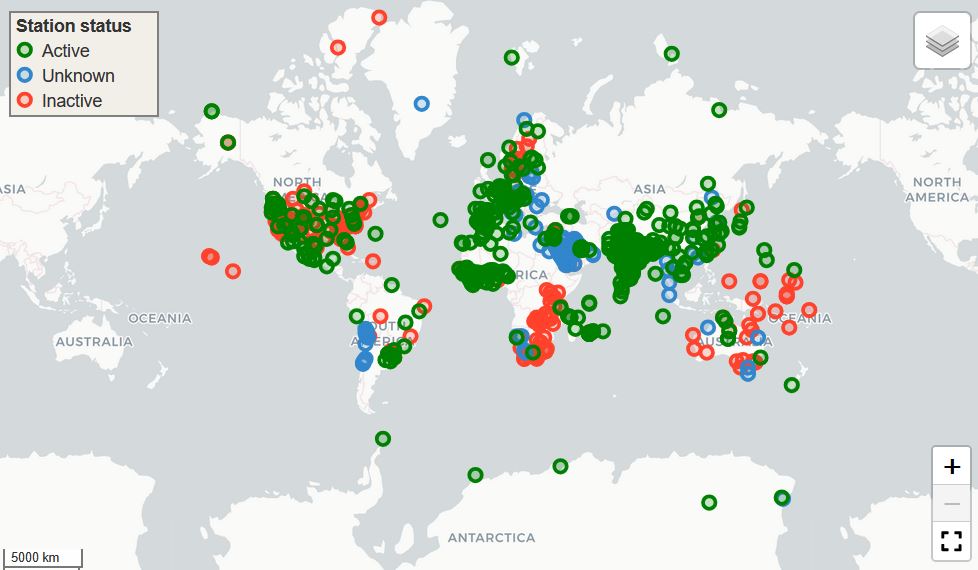
IEA PVPS task 16 recently introduced Solarstations.org, a global catalog of monitoring stations for solar radiation designed for researchers, developers and policy makers. These openly available Resource-Catalogi more than 800 multi-components Stationsts from which more than 400 are currently active an extensive image of high-quality land-based sun data.
The Golden Standard based on the ground-based measurements of solar radiation remain for evaluating solar potential, despite the progress in satellite-derived and modeled data. Nevertheless, researchers have always had difficulty finding reliable data sets because of spread, inconsistent or hidden station metadata.
Solarstations.org Directly focuses on this problem and offers an interactive catalog and a global map that describes locations, ownership, operation period, data availability and climate zone for each station.
Define quality of stations: the tier system
Not all solar stations have been drawn up. The catalog introduces a threefold classification based on instrument and data quality. Tier-1 stationsSuch as those in the BSRN network, meet the highest standards, using class-a thermopile pyranometers and pyrheliometers mounted on solar trackers to measure GHI, DNI and DHI. These stations are suitable for precise scientific and industrial applications.
Tier-2 Stations Use lower spec instruments or only measure two components. Although they offer reduced accuracy, they broaden the geographical representation, especially in the Global South. Tier-3 stationsThat do not meet baseline criteria for multi-components are excluded from the catalog to maintain the reliability of the data.
With this structured approach, users can match data sources with the uncertainty tolerance of their application and requirements for data quality, which are crucial in tasks ranging from PV prediction to atmospheric modeling.
Global coverage with local gaps
While the entries of the catalog include all continents, regional differences remain. Asia leads the number of stations, while Europe has the highest statio density at around six stations per million km². Regions such as Central Africa, West -Asia and Noord -Zuid -Amerika, however, remain under -represented.
These gaps can be a reflection of the incompleteness of the catalog or the actual scarcity of monitoring infrastructure. And many stations work isolated and miss visibility. Through crowdsourcing contributions and offering open-access metadata, Solarstations.org wants to bridge this gap and become a constantly evolving database for the Sun Community.
Use cases
Solarstations.org is already used in a wide range of contexts. Three illustrative use cases show its usefulness:
- Model benchmarking: Ongoing IEA PVPS -Taak 16 Benchmarking studies are now using the catalog to select stations with wider geographical and climatic diversity.
- Development of quality control: Researchers who develop new data quality algorithms use the catalog to identify stations in extreme environments such as large heights or moist tropics to test how algorithms strengthen it under various circumstances.
- Project -Planting and Validation: Developers can identify the nearest high-quality monitoring station with a proposed solar project and assess accessibility data, which helps to improve the site reviews and to lower the financial risk.
Every use case underlines how the catalog improves transparency and efficiency in the implementation of solar energy.
Remaining challenges
Despite its thoroughness, the catalog emphasizes persistent barriers for access to solar data. A significant part of the Stationsts in the name of Tier-1 area is not public data. And even when data is available, inconsistent formats, unclear documentation and maintenance problems can hinder usability. Moreover, 14% of the catalog stations have an unknown operational status, which limits their reliability for research or project planning.
The Solar energy Article requires standardized data formats, transparent documentation and institutional support to reduce these friction points. It also argues for a global network of open-access, high-quality stations to expand the reference base that go beyond legacy networks such as BSRN.
A community source
Solarstations.org is not only a database, it is a cooperation infrastructure. By cataloging and distributing critically standardized data on radiation monitoring stations, the platform offers users in the energy, climate and research sectors with tools to obtain more accurate assessments.
Because solar energy becomes a central pillar of global energy systems, these types of initiatives will be essential for accelerating the transition to clean energy.
About IA PVPS task 16
IEA PVPS task 16 focuses on the research and progress of data from solar resource and prediction for high penetration and large-scale sun applications. The work supports the use of solar energy by developing best practices, improving the accuracy of data from sun sources and improving methods for predicting the availability of solar energy. The task brings together experts from all over the world to improve the quality and bankability of solar projects by offering tools and insights that are essential for investors, developers and energy planners.
The views and opinions expressed in this article are the author, and do not necessarily reflect it by PV -Magazine.
This content is protected by copyright and may not be reused. If you want to work with us and reuse part of our content, please contact: editors@pv-magazine.com.
