

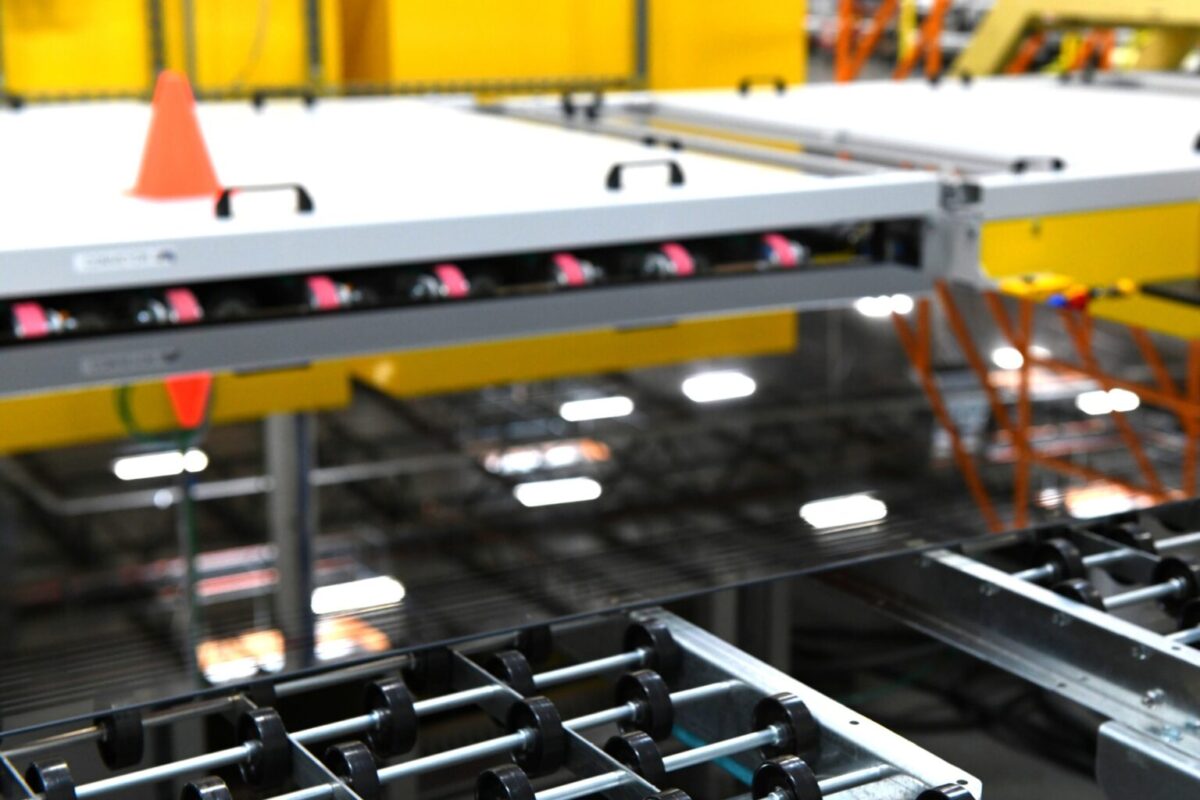
Solx’s Aurora hybrid module with Caelux’s perovskite glass aims to compete on performance beyond the federal tax burden.
The agreement between two American solar technology companies to production of new generation photovoltaic modules will expand production of products using domestic components, including cells, frames and glass. The principals said the partnership between solar manufacturer Solx and perovskite glass maker Caelux will meet U.S. demand for domestic content while producing more powerful modules that will compete internationally after the elimination of federal tax credits.
Caelux, based in Baldwin Park, California, completed the transition from research to commercial production of perovskite glass last year. The company’s Active Glass product replaces conventional solar glass as the top layer of a module, generating electricity from wavelengths that would otherwise go unused.
Solx will make the hybrid versions of its Aurora module in its new factory in Aguadilla, Puerto Rico. The cells for the new line will come from Georgia-based Suniva, the largest supplier of US-made silicon PV cells. Origami Solar supplies steel frames from the USA.
The Aurora hybrid modules are expected to operate at 28% efficiency, enabling up to 30% more power density than silicon-only modules. Solx’s new factory has an indicated production capacity of 1 GW of modules per year.
Early production of Solx Aurora modules incorporating Caelux’s Active Glass technology are expected to be deployed on a US project by an as-yet unnamed developer. Solx says commercial volumes are expected by 2027, with target production of more than one gigawatt per year. The Solx-Caelux deal specifies 3 GW of hybrid modules over a five-year period. The company says it plans to open new manufacturing facilities in the continental US
Delivering domestic content requirements is a factor in the partnership, John Holmes, co-founder and CEO of Solx, said pv magazine USA that short-term market signals are not the main driver.
“We’re really thinking beyond generating tax credits,” Holmes said. “We are built to win after the tax breaks disappear. Working with the technological edge is really a way we differentiate ourselves and support the long-term viability of both the Caelux and Solx businesses.”
According to Holmes, key factors in the future competitiveness of the partnership are the modern automation at the Aguadilla factory to produce modules cost-effectively, as well as the electricity production advantage enabled by Solx Aurora in combination with Caelux’s perovskite glass.
Scott Graybeal, CEO of Caelux, said pv magazine USA that producing perovskite glass on a large scale presents significant challenges, but the company has devoted significant research and development efforts to overcome these challenges.
“A lot of good work has been done in research and development, and a lot of great work has been done in product development,” Graybeal said. “Now we are building an organization that produces a product with an efficiency of 28%.”
As with any hybrid technology, whether tandem PV modules or printer-scanners, the integrated system is only as good as its key components. You don’t want a situation where the perovskite glass stops producing electricity before the silicon cells do.
“The biggest challenge in producing perovskite at scale is its sustainability,” says Graybeal. “We have had a number of breakthroughs in the last 18 months that have enabled us to solve the sustainability problem to the point where we can support a module manufacturer like Solx with technology that meets its requirements, especially its own module warranty.”
If pv magazine USA reported last yearCaelux has developed a four-terminal production process that sacrifices some conversion efficiency compared to other processes in exchange for improved sustainability. As a side note, Caelux was co-founded by Harry Atwater, a Caltech physics professor who later became a pioneer in the field of physics. space-based solar energy.
Holmes adds that Solx has a partner in Caelux, a manufacturing company with a strong R&D organization, and not a laboratory.
“We are working with a company that is already producing at meaningful scale,” he said. “Solx is truly a vector of giga production capabilities at our factory in Puerto Rico. What we are doing is integrating their mass production technology into our production process and optimizing it so that we can serve the market. We do not view this as experimental in nature, or that Caelux’s technology is moving from a laboratory to a line. Caelux is already operating a line at scale.”
The Solx-Caelux deal comes at a busy time for American solar technology companies. Suniva, supplier of Aurora’s silicon cells, recently announced it is investing $350 million to build a new factory in South Carolina is expected to have an annual capacity of 4.5 GW when it becomes operational in 2027. Perovskite-silicon solar panel manufacturer Tandem PV recently a demonstration plant opened with a capacity of 40 MW in Freemont, California, promises competition in the hybrid module market.
This content is copyrighted and may not be reused. If you would like to collaborate with us and reuse some of our content, please contact: editors@pv-magazine.com.
