

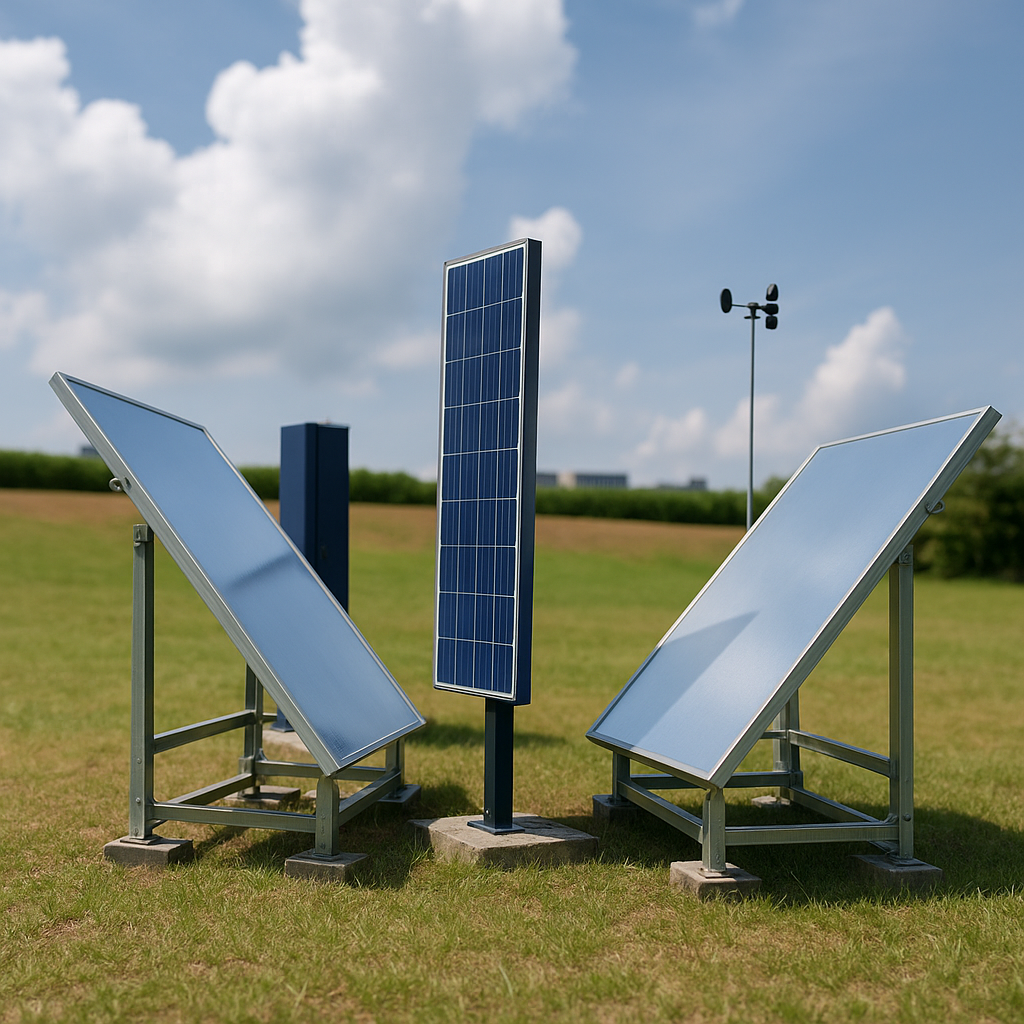
Researchers in Taiwan have developed an adjustable aluminum reflector system that increases the performance of vertically mounted bifacial solar modules. The prototype yielded a total power gain of 71.32% on a baseline system without reflectors.
Researchers from the National Taiwan University of Science and Technology have developed new adjustable reflection systems to increase the performance of vertical bifacial PV arrays.
“The system is able to automatically change both the tilt angle and the effective length on an hourly basis, based on real-time data from solar height and wind speed,” explained the scientists and noted that their attempt to use this technology in PV applications is not the first to be performed at research level. “This adaptive configuration improves the absorption of solar radiation and ensures structural safety during daily and seasonal variations.”
The research team used the so-called Taguchi method, which is intended to minimize the variation in a process through a robust design of experiments, even against uncontrollable environmental factors, to identify the most important parameter interactions and performance trends of the PV systems equipped by reflector.
The experimental institution included photovoltaic modules, adjustable reflectors, inverters, an anemometer to measure wind speed, a pyranometer for solar radiation, a power controller and a data lyger.
The bifacial modules were mounted vertically with an East -west orientation, while the reflectors at an angle were tilted equal to half of the solar height corner compared to the horizontal plane. With this configuration, the reflected sunlight becomes the solar panel surface perpendicular to the point, which, according to the scientists, maximizes the amount of reflected irradiation received by the panel.
“For example, when the angle of the solar height is 30 °, the optimum reflector corner is approximately 15 °; When the height angle is 45 °, the reflector must be set to approximately 22.5 °,” they also explained. “Taguchi optimization was further used to evaluate and determine the most effective combination of parameters, including reflector width, distance from the panel, material type and tracking mechanism.”
They also used the statistical tool (ANOVA) analysis (ANOVA) to determine whether the observed differences between factorn levels are significant and assess the influence of each factor on the response variable. They also used the TRNSYS model to perform a comparative analysis between the experimental results and the simulation output.
Testing showed that the best system configuration Can be reached with aluminum reflectors, both for and rear reflector corners set at half of the solar height, reflective areas larger than the module surface and an azimut corner of 110 °. This reportedly improves efficiency by approximately 11% compared to a standard bifacial system without reflectors, and by 3.19% compared to non-optimized reflector systems.
‘The optimized system achieved a total power gain of 71.32% compared to a baseline system without reflectors, and an improvement of 3.19% compared to non-optimized reflector configurations, which demonstrates significant performance benefits throughout the year“The researchers said.”The integrated use of TrnsyS simulation and the Taguchi method offers a robust framework for future design and optimization of reflector-improved PV systems. “
Looking ahead, the academics said they want to test the system in real PV systems and other regions.
Their findings can be found in the study “Performance improvement of vertically installed bifacial solar panels with adjustable reflectors optimized using the Taguchi method“Published in Energy Nexus.
Researchers from the University of Twente in the Netherlands have recently investigated how Luminescent solar concentrators with free space (FSLSCs) can be used to improve the performance of the Bifacial PV module in vertical PV installations and have discovered that electricity production could be increased by a maximum of 60% in the winter.
This content is protected by copyright and may not be reused. If you want to work with us and reuse part of our content, please contact: editors@pv-magazine.com.
