Tempestuous trade conditions and policy uncertainty have led to price price fragmentation in the United States. Prior to an expected reduction in the use of production capacity, the leading manufacturers in China produced a large volume of cells in the spring. OPIS editor Hanwei Wu explains the latest market developments.
From PV Magazine 6/25 – The hunt for high efficiency
Increasingly anticipated trade relationships have led to a variety of price spreads in important markets. Compared to free on board (FOB) China Tunnel Oxide Passivated Contact (Topcon) modules, according to the OPIS analysis, a premium of approximately $ 0.18/W were traded with a premium of approximately $ 0.18/W to the United States. This was the premium of $ 0.195/w registered at the start of the year. On the same comparison base, DDP Europe modules acted a premium of $ 0.03/W, compared to $ 0.016/W in January.
Uncertainty about the future of tax and investment incentives is the demand for demand and drain module of the module in the United States. Developers are against purchases because of nervousness among financiers who are concerned about the future availability of tax credits introduced by the previous US administration. In the meantime, Europe remains one of the most important markets where Chinese modules compete aggressively.
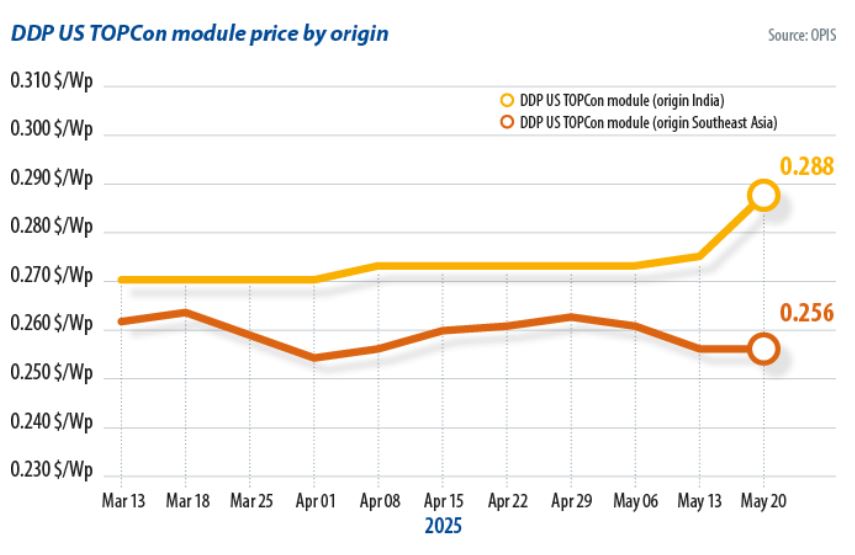
Even within the DDP US market there are signs of increasing price fragmentation. The price of Southeast -Asian import early March 2025, namely from Indonesia and Laos, traded on a discount of $ 0.007/W compared to Indian imports on a DDP US -based. But this later spread to $ 0.032/W on 20 May, with Indian loads rated at $ 0.288/W and Southeast -Asian loads at $ 0.256/W.
Tariff risks
Tarief risks, real or observed, remain the largest price mover on the DDP US market. Since the end of 2024, company-specific antidumping and counter vailing tasks (AD/CVD) have excluded most Southeast Asian modules from the American import market, except those from Indonesia and Laos, which have so far avoided the majority of American trade policy.
But the concern remains that AD/CVD would be applied to more Southeast Asian import. A general oversupply in the Zonnemarkt of Southeast Asia also continues, so that the offer prices are even distracted for modules from Indonesia and Laos. In the meantime, India is building its own Solar Supply Chain that could lead to much fewer trading units for its module export to the DDP US market, but the country has its own fast-growing domestic demand for locally made modules to fulfill. These contrasting dynamics seem to be set to stimulate the price fragmentation on the DDP US market in the short and medium term.
Furthermore, the scenery prices have been pushed back to levels that were seen at the end of 2024, after a light recovery. OPIS assessed the price of FOB China Topcon M10 cells at $ 0.035/W on 20 May, after a year to hit high high high of $ 0.039/W on 15 April. Chinese cell production was high from March to April, according to an Opis survey. Leading manufacturers used more than 70% of their production capacity, while producers of the second and third row maintain levels at around 50% use of capacity.
The prospects for May have deteriorated. Top manufacturers are expected to reduce the user percentages to less than 60%, while smaller players under 30%can fall. Sources report that the expected production has been revised from 64 GW in April to around 58 GW in May, with further cutbacks probably in the midst of further upstream weakness.
Future trends
Looking ahead, sources in the industry price trends can vary between different N-type cell specifications. Chinese cell producers are reportedly moving the focus to rectangular “210R” cells that measure 182 mm x 210 mm. This can increase the range and exert extra downward pressure on the prices for this specification.
The Global Polysilicon Marker (GPM), the OPIS benchmark for Polysilicon produced outside of China, continued to decrease in the midst of Marktpessimism, fell to $ 19,233/kg on 20 May, a low point of four years.
In contrast to expectations, the three-month suspension of new American rates could not significantly stimulate wafer production in Southeast Asia, causing the hope of a short-term boost in the non-Chinese Polysilicon question.
WAFER -Production levels in Southeast Asia are sufficient to support the limited solar exploit pit that are currently eligible for export to the United States, according to an important integrated manufacturer. That output is concentrated in a handful of countries.
Large manufacturers of polysilicon in China are reportedly planning to maintain low company rates, with the help of approximately 40% of production capacity. The upcoming rainy season will cause a decrease in electricity prices in hydrumbers, which should stimulate production in the Sichuan and Yunnan regions. Manufacturers are expected to perform factory maintenance to manage the total production levels.
About the author
Hanwei Wu, the editors of OPIS, leads the Asia-Pacific team in producing price assessments, own data and news analysis for solar, carbon, oil and petrochemical markets. In recent years he has launched data products for the market for oil and renewable energy sources, including solar energy.
The views and opinions expressed in this article are the author, and do not necessarily reflect it by PV -Magazine.
This content is protected by copyright and may not be reused. If you want to work with us and reuse part of our content, please contact: editors@pv-magazine.com.
Popular content