


Wood Mackenzie has released a new report that looks at the effects of the One Big Beautiful Bill Act (HR1) on the American residential solar market. The analysis group finds that the removal of the sec. 25D ITC will hinder the short -term growth, but the long term potentially remains strong. The growth is expected to return after 2028.

Credit: Dennis Schroeder/NREL
The latest insight from Wood Mackenzie, “Short-term challenges but in the long term potential: evaluation of the American residential solar addressable market“Notes that HR1 could downgrade the residential solar capacity by no less than 46% to 2030 compared to its businesslike and usual basicase from the second quarter.
“Many companies will not be able to do business,” says Zoe Gaston, director of Wood Mackenzie. “However, the market will eventually adjust, and the remaining players will diversify and find ways to save costs. Furthermore, rising retail rates will continue to make the solar value for solar sun.”
Despite these challenges in the short term, the report reveals considerable long -term opportunities. The Residential Solar Total addressable Market (TAM) is expected to reach nearly 1500 GW by 2050. Using US Census Bureau and Wood Mackenzie data, estimates the analysis, the analysis estimates around 92 million single-family homes that occupied houses will exist by 2050, with potential for more than 70 million houses.
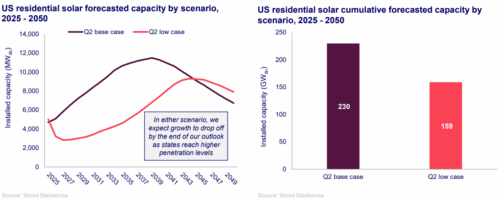
Even in the conservative 25-year-old scenario of Wood Mackenzie-that only 12% TAM penetration assumes the market still adds 150 GW residential solar capacity by 2050.
“However, a lot can change in 25 years, including technological and product developments, the evolution of the business model and the costs that the growth growth can accelerate,” Gaston added. “We expect a more positive result than our low case scenario.”
News item from Woodmac
