

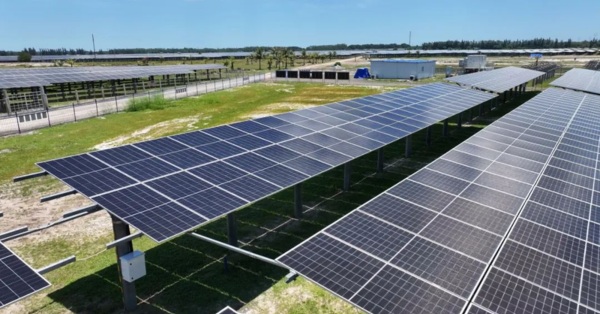
The PV sector of China has closed two technical breakthroughs for applications for extreme environment, with Trina Solar and Ja Solar field data and new products that underline the durability of Chinese modules in damp heating and Desert/Gobi Woestenij circumstances. The claims offer bankable options for various project environments worldwide.
Trina Solar reported throughout the year moist field results for its N-Type Topcon 700W+ Vertex module in Wenschang, Hainan-a tropical maritime site characterized by high temperature and humidity, 1,975 mm annual rainfall and approximately 86% relative humidity. After more than a year in real-world operation, the modules showed an intact mechanical structure without signs of corrosion and persistent high, stable performance.

The product was previously successful DH2000 (the double of the IEC-fiddling duration), with relegation far below the threshold of 5% industry, and top performance in seven improved reliability tests by Kiwa Pvel.
On the technological side, the module uses a upgraded I-Topcon cell design that optimizes the metallization in corrosion-sensitive electrodes areas and refines paste formulation to stimulate anti-corrosion performance. It also uses interconnection materials with low corrosiveness, a high encapsulating water barrier and a build with double glass to suppress the penetration of moisture.
These innovations make superior stability possible in extreme damp climates and are well received by end customers.
Meanwhile in Beijing, JA SOLAR Unveiled Molan (literally “desert blue”), invoiced as the world’s first module specially designed for deserts, Gobi and bare countries (Shage-Huang). Molan is designed to pack the resting of the dirt, abrasive sand and high wind, Molan introduces four targeted progress:
- Nano scale self-cleaning coating: Reduces the decline of transmission due to contamination by 32%, limiting a loss of performance and reduction frequency.
- Reliability increase: improves total reliability by 32%, which extends the expected lifespan by 3-5 years in hard desert conditions.
- Amplified mechanics: Front static mechanical tax classification of 6000 PA lake than 60% higher than conventional modules-to remove sandstorms and strong winds.
- Better performance at high temperature: Vermogenting temperature coefficient improved to -0.28%/° C, which delivers 0.5-0.6% higher energy yield at 50 ° C.
Field results of the Mengneng Ulan BUH project show an increase in the energy return of 4.49% after switching to Molan, while an installation of 100 MW can save about RMB 240,000 a year in manual cleaning.
The product has earned the world’s first certification “Desert Module” from TÜV Rheinland, which demonstrates strong performance under dust coverage and extreme temperature stress tests.
Industry experts note that these scenario-specific designs mark a shift in the Chinese PV technology, from products for general purposes to refined, application-driven solutions.
As the extreme climate of validation frames grow up, the Chinese modules are ready to strengthen their competitiveness in global use cases and to offer robust technical support for the energy transition.
