

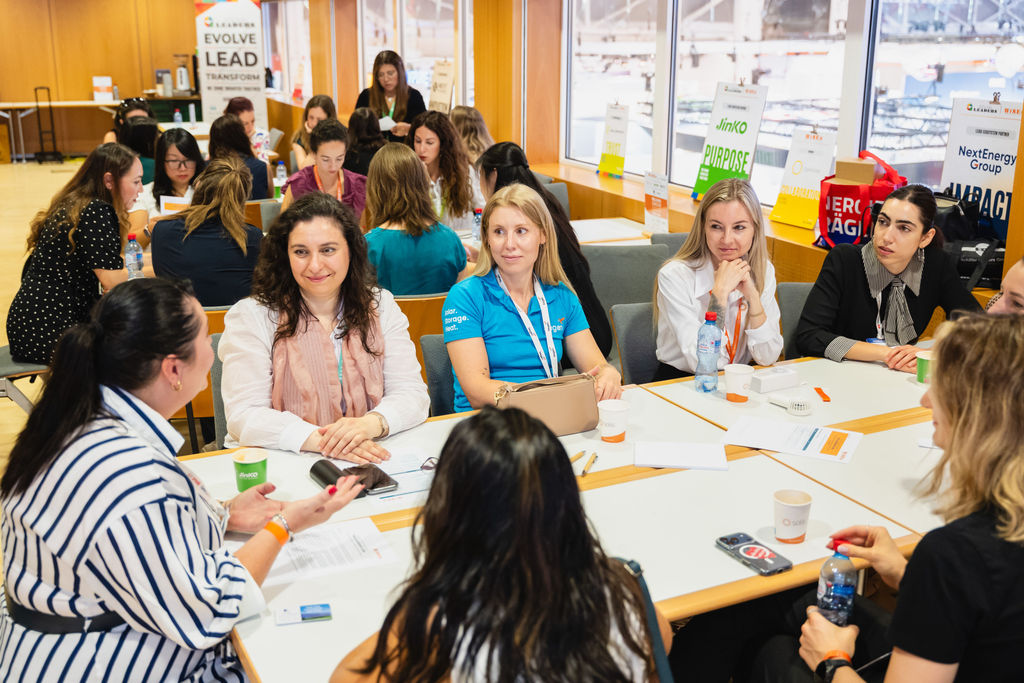
Under the theme The leadership lens: leading through double standards in the energy transitionWiSEu’s flagship breakfast workshop at Intersolar Europe created a space for honest conversations about the invisible rules that many women still navigate in their professional lives. What emerged was more than a reflection of personal experiences; it revealed a clear pattern of structural and cultural double standards that continue to impact visibility, progress, recognition and opportunity in the solar and storage sector.
Visibility without recognition
One of the strongest themes across all discussion groups was visibility, not just being seen, but being recognized. Janine Wirth, founder and CEO of Ilanco GmbH, captured a reality that many women in the room immediately recognized: “Too often, men still take credit for women’s work, and many women don’t feel comfortable challenging it because they fear being seen as emotional or creating unnecessary conflict.” Her point revealed more than a frustrating workplace habit. It exposed a leadership gap where contribution and recognition are not equally distributed.
This imbalance was echoed by Donaji Martínez, Lead Contract Manager Europe at Jinko ESS, whose group considered the invisible contributors behind every successful project. “There is always someone behind the machinery pushing things forward, but without visibility,” she said. “And yet those people are just as essential.”
It was a powerful reminder that not all leaders are on the frontlines. All too often, the people behind the scenes are the first to be overlooked.
The punishment for motherhood
The conversation quickly turned to one of the most persistent double standards in professional life: motherhood. Paola Berard, Sr Manager Strategic Logistics at Nextpower, described how her group explored the impact motherhood continues to have on women’s advancement, often in ways that feel deeply unfair.
“One of the examples we discussed was how a woman returns after six months to find that someone else has crossed her path and moved on,” she said. “That is a reality that many female professionals can identify with.”
What emerged from that discussion was not just frustration, but the emotional burden that women carry with them long before motherhood even begins. “As women we often have to think ahead; if I become a mother, how will this affect my career, my opportunities, my visibility?” Paola thought. “For men, becoming a father is rarely viewed through the same professional lens.”
That difference in expectations remains one of the clearest examples of how career paths are still unevenly shaped. But it also points to the crucial role that organizations play. Without clear reintegration mechanisms, transparent promotion pathways, and cultures that normalize parenthood as part of working life, women too often bear the costs of systems that were not designed with them in mind.
The discussion made one thing clear: motherhood itself is not the barrier. The barrier is the way leadership cultures and organizational structures respond.
Qualified, but still in doubt
Another recurring pattern was credibility, and how often women’s expertise is underestimated, even when their qualifications speak for themselves. Janine shared the story of an attorney from her group who explained that despite her title and credentials, she is regularly mistaken for administrative support rather than being recognized as a legal advisor.
“That came up repeatedly,” says Janine Wirth. “We also had an engineer in the group who spoke about the constant need to prove herself, despite having equal or stronger qualifications than the men around her.”
These stories pointed to a deeper problem: for many women, competence is not enough. Authority still has to be earned repeatedly, in ways that men are far less likely to be asked to justify.
The hidden risks of networking
The workshop also showed how informal networking spaces can pose very different risks for women. Janine described how many important customer relationships are still built in social settings, drinks, dinners, after-hours gatherings, spaces where women are often expected to participate in order to remain ‘part of the group’.
“But there is a double standard there too,” she explained. “If you don’t participate, you risk exclusion. But if you do, the boundary can quickly shift from professional to personal, and women can find themselves in uncomfortable or vulnerable situations.”
Her reflection highlighted a reality that often goes unspoken: networking is not always neutral territory. For many women, the same spaces that create opportunities can also create risks.
From awareness to action
Importantly, the workshop did not end with identifying the problem. It was about responsibility. Janine’s group has made a clear commitment: those in leadership positions must actively call out moments where credit is misplaced and advocate for those whose work might otherwise go unnoticed.
“We are committed to speaking out when we see someone else taking credit for someone else’s work,” she said. “Especially if it’s someone younger, quieter or less confident.” The group was also committed to mentoring and sponsorship, not only mentoring women but also actively helping to create opportunities for them. “As many of us have realized, that support can make a difference,” Janine said. “When a senior opens a door for you, everything changes.”
Her final reflection challenged another deeply held social expectation: humility. “From childhood, we are often taught not to brag, but to remain humble,” she says. “But there’s a difference between bragging and owning your achievements. We have to learn to stand up for our work.”
Women support women
For Donaji, the path forward was just as clear: inclusive leadership must create equal opportunities for diverse voices, perspectives and experiences to be heard. But she also emphasized another important truth: women in leadership must actively support each other.
“We need women in leadership, but we also need women supporting women,” she said. “Sometimes we challenge each other instead of lifting each other up. But there is room for all of us.” Her words spoke directly to the importance of breaking the scarcity mindset. Real progress requires collective power, not competition for limited seats at the table.
Allies within the system
Paola’s group brought another critical dimension to the discussion: allies. “There are people within organizations who can support us, give us strength and help create change,” she said. “We need to include them in these conversations.”
Her point was clear: if leadership culture is to evolve, women cannot be the ones doing the work alone. By helping allies understand the daily impact of these double standards, organizations can create stronger empathy and more powerful action. “If they have daughters,” Paola reflected, “they should ask themselves: Would I want her to experience this?”
Changing the rules
Closing the workshop, Carmen Madrid, founder of WiSEu-Women in Solar+ Europe, reminded the audience of a difficult but practical truth: “The game board is what it is. We did not invent the rules. But it is up to us to understand them, navigate them and change them for the women who come after us.”
Her message was clear: reach out, find mentors, ask seniors for support and use the power of networking. Every little change is important. “And while we work to change the rules, sometimes we have to learn how to bend them first,” she added.
That could be the real leadership lens that the energy transition needs.
